
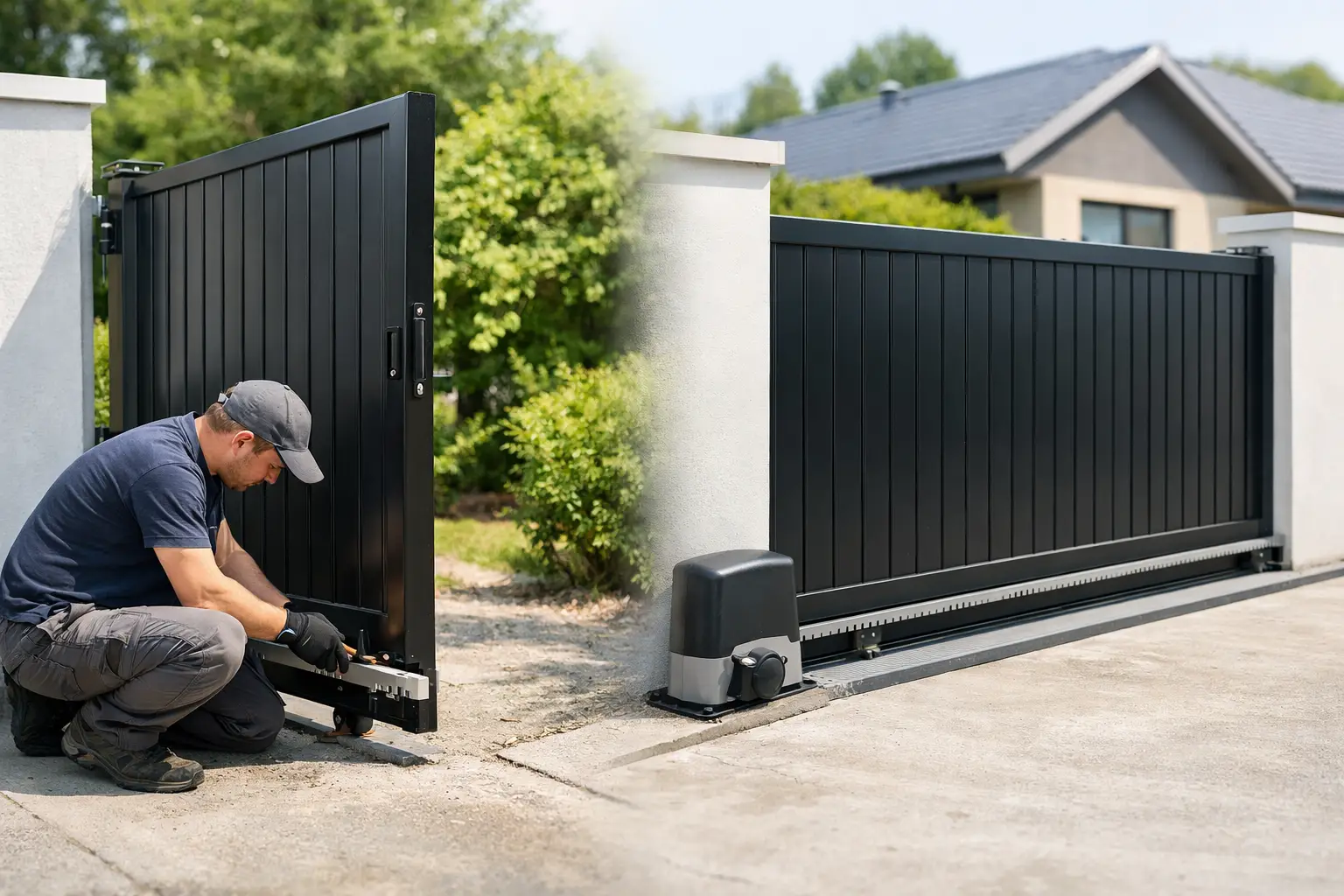
If your current gate swings out into a slope, catches the wind, or takes up too much driveway space, it is natural to ask how to turn a swing gate into a sliding gate. In practice, this is rarely a simple conversion. The gate leaf, posts, foundations, automation, safety equipment, and available run-back space all need careful assessment before any work begins.
For some properties, a sliding system is a better long-term solution. It can improve access on short driveways, work more reliably on uneven ground, and suit sites where parked vehicles or road position make swing gates awkward. That said, changing from swing to sliding is usually closer to a redesign than a straightforward alteration.
Can you turn a swing gate into a sliding gate?
The short answer is yes, but not always by reusing the existing gate in its current form. A swing gate is designed to pivot on hinges fixed to gate posts. A sliding gate needs either a track and wheels or a cantilever arrangement, plus a clear area for the gate to travel across when open. Those are very different mechanical demands.
In many cases, the existing gate can only be adapted if its weight, width, frame strength, and overall condition are suitable. Timber gates sometimes prove too heavy or too flexible for reliable sliding use, especially once automation is added. Wrought iron or aluminium gates may offer more scope, but even then the frame may need reinforcement and the support structure almost certainly needs changing.
That is why site survey matters. A proper assessment looks at the gate itself, the driveway surface, drainage, levels, motor position, power supply, and safety compliance. Without that, a conversion can become expensive for the wrong reasons.
What changes when converting from swing to sliding?
When clients ask how to turn a swing gate into a sliding gate, they often assume the main job is moving the gate from hinges to rollers. In reality, the supporting infrastructure is the bigger issue.
A sliding gate needs a stable path of travel. For a tracked gate, that means suitable foundations and a correctly installed track across the opening and along the run-back area. For a cantilever gate, it means more substantial support at one end because the gate carries its own overhang and balance section. Either option may require excavation, concrete work, and new steelwork.
The gate opening also needs enough side room. A sliding gate must move somewhere when open, so the available space beside the entrance is critical. If there is a wall, bank, fence line, planting, or change of level restricting that area, the design may need rethinking. This is one of the most common reasons a conversion is not practical.
Automation is another major change. Swing gate motors, whether underground or above ground, are not transferable to a sliding system. A sliding gate uses a different motor arrangement, gear rack, control setup, and safety devices. Photocells, safety edges, force settings, and obstacle detection all need to be specified for the new gate movement.
How to turn a swing gate into a sliding gate safely
The safest approach starts with deciding whether the existing gate should be reused at all. Sometimes a new sliding gate is the more sensible and more cost-effective answer, especially if the current gate is ageing, poorly aligned, or not built for the loads involved.
1. Assess the existing gate structure
The first question is whether the gate leaf is suitable for sliding operation. Weight matters, but so does rigidity. A gate that performs adequately on hinges may twist or deflect once mounted on rollers or cantilever gear. If the frame is weak, automation suffers and wear increases.
Material choice matters too. Heavy hardwood gates can be attractive, but if they are too substantial for the planned hardware and motor, conversion may create ongoing reliability issues. Metal gates can be easier to adapt, though corrosion, weld quality, and age still need inspection.
2. Check available run-back space
A sliding gate needs room to open fully. As a guide, the run-back area usually needs at least the width of the opening, and often more for hardware and support arrangements. Cantilever systems need additional length because of the counterbalance section.
This is where domestic and commercial sites differ. A wider entrance on a business premises may seem ideal for sliding automation, but the extra width increases gate size, support demands, and motor specification. On residential properties, landscaping or boundary layout often becomes the limiting factor.
3. Review the ground conditions
Tracked sliding gates need a stable, level track. If the driveway is prone to movement, flooding, or debris build-up, a standard tracked design may not be the best choice. Cantilever gates avoid a ground track across the entrance, which can help on gravel drives or sites where leaves, mud, or standing water are a problem.
However, cantilever systems are not automatically better. They are heavier, require stronger foundations, and need more side space. The right answer depends on the site, not just the gate type.
4. Replace the automation properly
A genuine conversion means fitting automation designed for sliding use. That includes the motor, control board, racks, limit setting, and safety devices. Electrical supply and cable routes may also need altering, particularly where an existing underground swing operator has been installed in a different position.
This is specialist work. Gate automation is not simply about making the gate move. It must be installed with the correct safety measures, tested properly, and configured for reliable daily use.
When conversion makes sense
There are cases where converting from swing to sliding is a practical option. If the entrance has good side room, the existing gate is structurally sound, and the property would benefit from better clearance or easier automation, then adaptation can be worthwhile.
It can also make sense where the posts are failing or the driveway geometry has changed. For example, if a resurfaced drive, new parking layout, or road access issue has made swing operation awkward, a sliding system can solve the problem more effectively than trying to correct the old arrangement.
Commercial premises often benefit from sliding gates where access control, frequent operation, and vehicle management are priorities. A properly specified sliding gate can integrate well with intercoms, keypads, ground loops, and other entry systems.
When a new sliding gate is the better option
Very often, the answer to how to turn a swing gate into a sliding gate is that you do not fully convert it – you replace key parts of the system. This is especially true if the existing gate is timber, oversized, worn, or simply not designed for the new loading.
A purpose-built sliding gate gives better control over balance, strength, automation compatibility, and long-term reliability. It also allows the whole installation to be designed as one system rather than adapting around old limitations. For many property owners, that is the better investment.
The same applies where safety compliance is a concern. Retrofitting older gates can introduce compromises. Starting again with the correct foundations, hardware, and controls often produces a neater, safer, and more dependable result.
Cost, disruption and practical expectations
A conversion is not always cheaper than replacement. If groundwork, fabrication changes, new automation, and safety upgrades are all needed, costs can rise quickly. That is why clear quotation and site-specific advice are important from the outset.
There is also some disruption to expect. Depending on the design, works may include digging out for foundations, installing posts or support structures, rerouting power, and setting up access control equipment. For domestic customers this usually means planning around driveway access for a short period. On commercial sites, traffic flow and site safety need managing carefully during installation.
What matters most is getting the design right before work starts. A sliding gate should feel smooth, secure, and properly integrated with the property. If it has been forced into an unsuitable space, problems tend to show up quickly.
Choosing the right installer for the job
This kind of project sits between metalwork, groundwork, and electrical automation. It needs more than a general gate fitter. You want an installer who understands structural loading, motor specification, safety requirements, and access control integration as one complete system.
For properties across Dorset and the South of England, that often means choosing a specialist company with experience in both residential and commercial electric gate installations. Crabtree Electrical Gates handles this type of work with a practical, survey-led approach, advising clearly on whether a conversion is viable or whether a new sliding gate would serve you better.
If you are weighing up a change from swing to sliding, the best next step is not to guess from photos or measurements alone. Have the entrance assessed properly, ask what can realistically be reused, and make the decision based on safety, reliability, and long-term value rather than short-term convenience.
0 Comments