
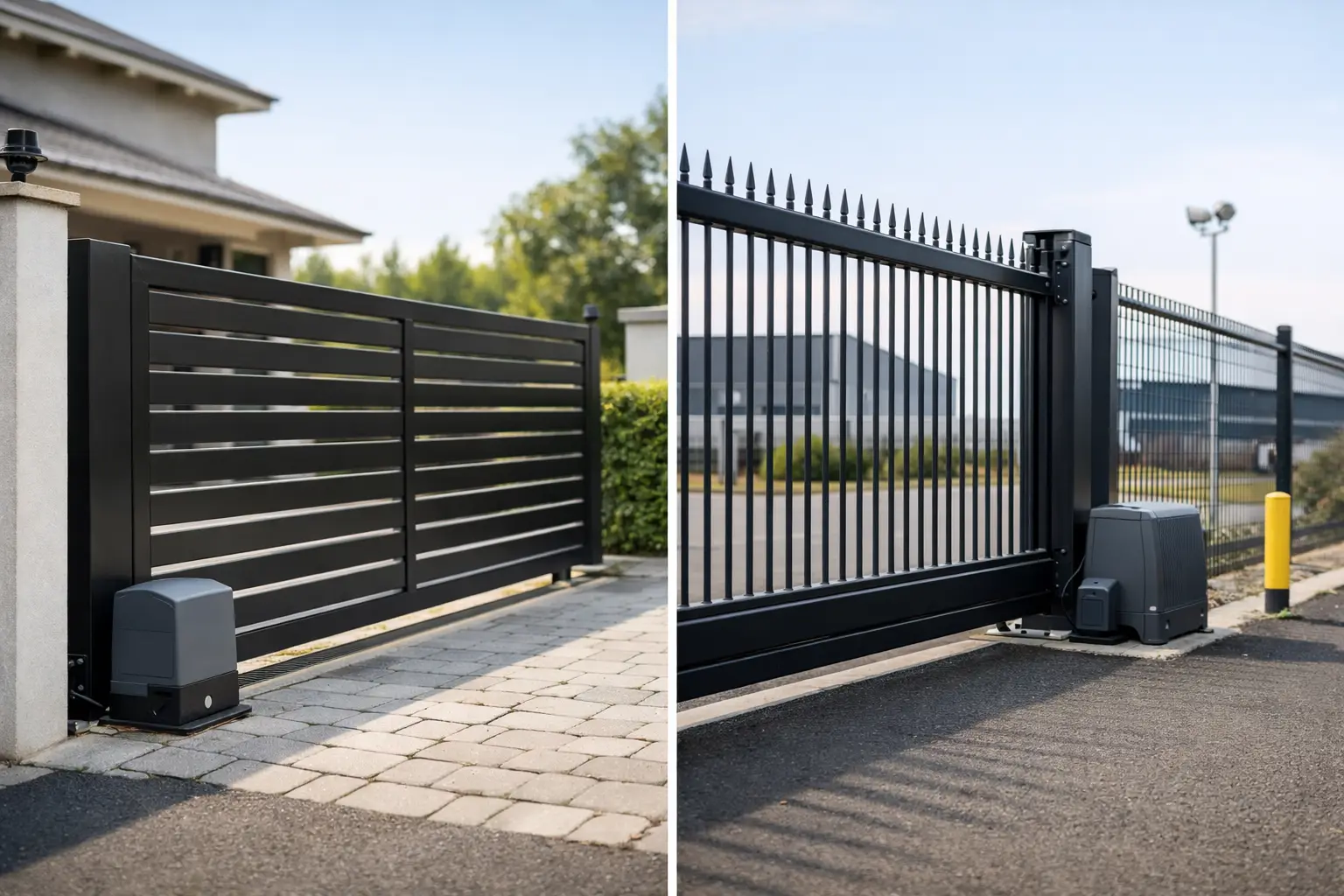
A gate that works well for a private driveway can be completely wrong for a busy business site. That is the real issue when comparing domestic vs commercial electric gates. Both provide controlled access, better security and day-to-day convenience, but they are built around very different patterns of use.
If you are planning a new installation, the right choice comes down to traffic levels, safety requirements, access control and how the gate will be used every day. For homeowners, appearance and ease of entry often matter just as much as security. For commercial sites, reliability under frequent use and clear control over vehicles and visitors usually come first.
Domestic vs commercial electric gates: what changes?
At a glance, domestic and commercial electric gates can look similar. You may still be choosing between swing gates and sliding gates, deciding where motors will sit, and considering extras such as intercoms or keypads. The difference is not just the gate itself. It is the whole system around it.
A domestic gate is normally designed for lower daily usage. It may open a handful of times in the morning and evening, with occasional visitor access during the day. In that setting, the priorities are often privacy, kerb appeal, secure entry and straightforward operation.
A commercial gate usually has a tougher job. It may need to handle regular staff vehicles, delivery vans, contractors and occasional out-of-hours access. That means heavier-duty automation, stronger access control, more rigorous safety planning and a layout that avoids delays at the entrance.
Usage levels shape the whole system
The biggest practical difference between domestic vs commercial electric gates is how often the system is expected to operate.
For a house, the automation may only need to cope with light to moderate use. That does not mean the equipment should be basic, but it does mean the system can often be specified around convenience and appearance without being engineered for constant cycles.
For a commercial premises, repeated daily opening and closing puts far more demand on motors, control boards, safety devices and the gate structure itself. A warehouse entrance, office development or managed site may see dozens or even hundreds of operations in a day. In those cases, using a lighter domestic-style setup often leads to avoidable faults, slower operation and more wear over time.
This is where proper specification matters. A gate should not just work on day one. It should continue to work reliably under the site’s actual operating conditions.
Security means different things in each setting
Security is one of the main reasons people invest in electric gates, but domestic and commercial sites usually define security differently.
On a residential property, security often means preventing casual unauthorised access, creating a clear boundary and allowing residents to screen visitors before opening. Privacy is often part of the same decision. Solid or semi-solid gates, discreet intercom systems and simple remote access are common choices because they suit family life and private driveways.
On a commercial site, security tends to be more procedural. The aim is not only to keep unwanted visitors out, but also to control who gets in, when they get in and how access is recorded. A business may need to separate staff entry from visitor entry, allow timed access for deliveries or link gate access with broader site management.
That is why commercial installations often include more advanced access control, such as keypads, intercoms, fobs, GSM entry or ground loops for vehicle detection. The gate becomes part of the site’s wider security arrangement rather than a stand-alone feature.
Access control is often the deciding factor
When customers are choosing between systems, access control is often what turns a simple gate into the right gate.
For many domestic properties, remote controls and an intercom are enough. Some households may want keypad access for family members or regular visitors, especially if several people need entry without relying on a single handset. The system needs to be easy to use and dependable, particularly in poor weather or during evening arrivals.
Commercial properties usually need more structure. Staff may require a consistent way to enter and exit, visitors may need to announce themselves, and some sites need the gate to respond automatically to vehicles leaving. Ground loops, audio or video entry, timed settings and multiple user permissions can all make a major difference to how smoothly the site runs.
The best setup depends on the site. A small business unit does not need the same control measures as a multi-tenant commercial premises or an industrial yard. That is why a proper site assessment is worth doing before equipment is chosen.
Safety requirements for domestic and commercial gates
Safety matters on every electric gate installation, but commercial systems often need more detailed planning because there are more users, more vehicles and more opportunities for misuse.
A residential gate may mainly be used by the same household every day. That gives a level of familiarity. Even so, safety features such as photocells, force limitation and correct spacing are still essential. A professional installation should never treat these as optional.
A commercial gate is usually less predictable. Drivers may be visiting for the first time, pedestrians may approach from different directions, and large vehicles may interact with the entrance differently from cars. That means safety measures need to account for a wider range of scenarios. The gate design, automation method and control devices all need to work together to reduce risk.
This is one of the strongest reasons to use a specialist installer with proper electrical knowledge and experience in gate automation, rather than treating the job as a general metalwork or access project.
Design and appearance still matter
It is easy to assume domestic gates are about looks and commercial gates are only about function. In practice, both matter.
For a home, the gate is part of the property’s frontage. It should suit the character of the house, sit properly within the entrance and feel proportionate. Timber, metal and mixed-finish designs can all work well depending on the setting. Underground automation is often popular where a cleaner appearance is preferred.
For commercial premises, the visual side is different but still important. A smart, well-fitted entrance gives a better impression to clients, residents, tenants or visitors. On some sites, the gate also needs to support branding, consistency or a more professional frontage. Function usually leads the specification, but appearance should not be ignored.
Which gate type suits each setting?
There is no single answer, because layout often decides the most practical option.
Swing gates are a common choice for domestic entrances where there is enough room for the leaves to open safely. They can suit traditional and modern properties alike, and they are often selected for their appearance.
Sliding gates are often a strong option where space is limited or where the entrance rises sharply behind the gate line. They are also commonly used on commercial sites because they can be better suited to wider openings, heavier gate construction and frequent operation. That said, some homes benefit from sliding gates and some businesses use swing gates. The right choice depends on space, levels, traffic flow and the gate’s intended use.
Cost is not just the gate price
Customers often ask whether domestic or commercial electric gates are more expensive. In most cases, commercial systems cost more, but the reason is not simply size.
The cost is usually driven by heavier-duty automation, more complex access control, increased safety requirements and the demands of higher usage. Installation conditions also affect price. Groundworks, cabling distances, power supply arrangements and the condition of existing posts or piers can all change the final figure.
For domestic customers, there is usually more flexibility to balance budget with appearance and features. For commercial clients, cutting specification too far can create false economy if the system is not built for the workload.
A good quote should reflect how the gate will actually be used, not just provide a basic price for automation.
Choosing the right installer matters as much as the gate
The difference between a reliable system and a troublesome one often comes down to design, wiring, safety setup and commissioning. That is particularly true when comparing domestic vs commercial electric gates, because both need the automation to be matched properly to the site.
An experienced specialist will look at traffic volume, entrance width, ground levels, power supply, user type and access control needs before recommending a system. They should also explain the trade-offs clearly. For example, a neat underground operator may suit the appearance of a private entrance, while a more visible setup may be the better long-term option on a demanding commercial site.
For customers across Dorset and the South of England, that practical approach is often what makes the process easier. Crabtree Electrical Gates focuses on the supply and installation of systems that are suited to the property, the traffic and the level of control required, rather than pushing a one-size-fits-all solution.
If you are deciding between a domestic or commercial electric gate, the best starting point is simple: think about how the entrance needs to perform on an ordinary day, not just how you want it to look on completion. The right system should feel straightforward to use, dependable in service and properly matched to the demands of your property.
0 Comments