
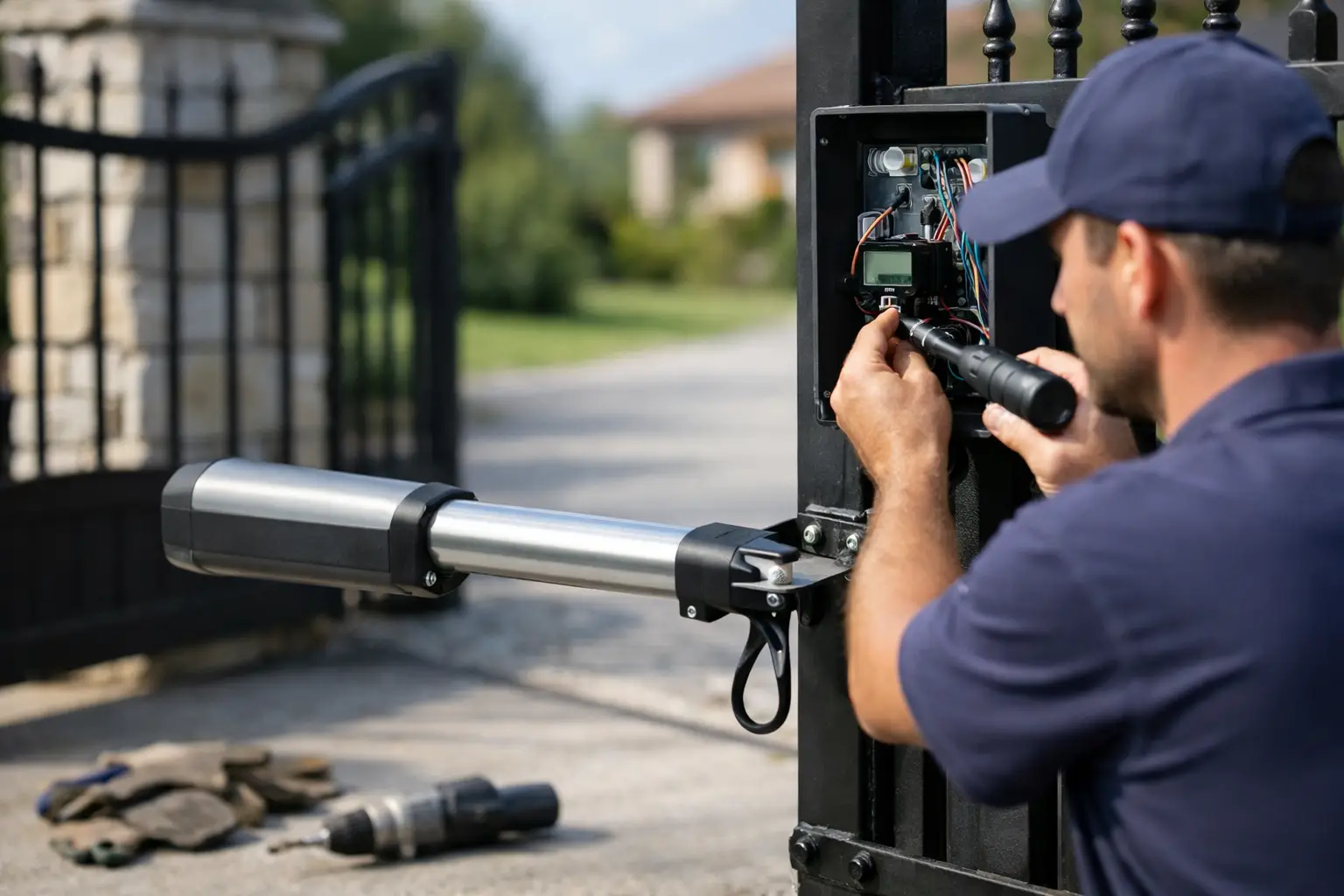
A swing gate opener rarely fails because of the motor alone. More often, the problem starts earlier – poor hinge alignment, the wrong mounting geometry, weak posts, or cables planned as an afterthought. If you are researching how to install swing gate opener systems, the real job is not just fixing a motor to a gate. It is making sure the whole entrance is suitable for safe, reliable automation.
For homeowners, estates and commercial sites alike, that matters. An automated gate has to open smoothly every day, stop safely when required, and cope with weather, regular use and site conditions. A neat-looking installation means very little if the gate twists, drags or loses limit positions after a few months.
Before you install a swing gate opener
The first question is whether the gate itself is ready for automation. A manual gate that sticks slightly or drops on one side may still be usable by hand, but automation places much greater strain on hinges, posts and fixings. Before any opener is fitted, the leaves should swing freely through their full travel, the posts should be sound, and the gate structure should be rigid enough to handle repeated powered movement.
This is also the stage to choose the right type of operator. Above-ground ram systems are common for domestic gates and are often the most practical option where access is straightforward. Articulated arm operators can suit wider posts or awkward hinge positions. Underground motors offer a cleaner appearance, but they involve more groundwork, drainage considerations and a higher level of installation complexity.
Power supply and access control need planning at the same time. If you intend to add intercoms, keypads, safety loops or photocells, the cabling routes should be set out before any brackets are fixed. Retrofitting these later is possible, but it is rarely the tidy or cost-effective route.
How to install swing gate opener systems step by step
Every manufacturer has its own measurements, bracket positions and control board setup, so the installation manual always takes priority. Even so, the sequence is broadly the same across most systems.
1. Confirm gate condition and opening geometry
Start by checking hinge points, post strength and leaf movement. Measure the gate width, weight and opening angle. These figures determine whether the chosen opener is suitable and where the brackets need to sit.
Geometry matters more than many people expect. The distance between the hinge centre, rear bracket and front fixing point controls how the gate starts, how much force it uses and whether it can reach the required opening angle. A few millimetres out can change the way the system behaves, particularly on heavy gates.
2. Set out cable routes and power supply
The electrical side should never be an afterthought. Mains power must be supplied correctly, with suitable protection, isolation and cable sizing for the equipment installed. Low-voltage accessories also need dedicated routes to avoid messy surface runs and future faults.
If the entrance is some distance from the property, voltage drop and cable specification become important. Commercial sites may also require integration with traffic control, access systems or timed opening routines. This is one of the main reasons specialist installation makes a difference.
3. Fix the mounting brackets accurately
Once the set-out dimensions are confirmed, fit the post bracket and gate bracket in line with the manufacturer’s chart. They must be square, secure and suitable for the gate material and support structure. On steel gates, this often means welded brackets. On masonry or brick piers, fixing quality is critical, especially with heavier leaves.
This stage needs patience. If bracket placement is rushed, the operator can bind, overwork or fail to open fully. Good installation is often about precision rather than speed.
4. Install the motors and manual release
With the brackets in place, mount the motors and check that each unit moves cleanly through the required travel. Manual release access should remain practical in the event of a power cut or maintenance visit. There is little value in a release mechanism if it cannot be reached easily when the gate is closed.
At this point, the gate should still be checked manually. Automation should not be used to force a poor-fitting gate into working order.
5. Fit the control panel and safety devices
The control panel should be mounted in a protected, accessible location and wired exactly to the manufacturer’s instructions. Safety devices such as photocells are not optional extras on a proper installation. They are central to safe operation and should be positioned to protect the movement area effectively.
Depending on the site, you may also need flashing beacons, safety edges, loop detectors or monitored safety inputs. Domestic driveways and commercial entrances have different risk profiles, so the setup should match the environment rather than follow a one-size-fits-all approach.
6. Programme travel, force and operating logic
Once wired, the system can be programmed. This includes opening and closing limits, leaf delay, automatic closing times and force settings. Some modern systems self-learn parts of this process, but they still need checking and refining.
This is where technical judgment comes in. A gate should use enough force to operate reliably, but not so much that it creates unnecessary risk or mechanical stress. Faster is not always better, especially on heavier or exposed gates.
7. Test thoroughly and complete handover
Final testing should cover full travel in both directions, obstacle response, safety device function, manual release, remote controls and any access control equipment. The gate should be observed through repeated cycles, not just opened and closed once.
A proper handover also matters. The owner or site manager should understand how the system operates, what to do in the event of a fault or power failure, and when servicing is due.
Common mistakes when installing a swing gate opener
The biggest mistake is trying to automate a gate that is not mechanically sound. Motors are not a cure for dropped hinges, warped leaves or weak posts. They simply expose those problems faster.
Another common issue is poor bracket geometry. The operator may technically move the gate, but it does so under strain, with reduced opening angles or inconsistent stopping positions. Over time, that shortens component life.
Electrical errors are also common. Undersized cable, poor joints, inadequate protection or badly planned ducting can lead to intermittent faults that are frustrating to trace later. Outdoor automation needs clean, dependable electrical work from the start.
Then there is safety compliance. Gates are moving machines, not just convenience products. Incomplete safety provision or poor force setup can create serious risk. That is why professional installation is often the sensible route, particularly for shared entrances, commercial premises or any site with regular pedestrian use.
DIY or specialist installation?
Some competent property owners with strong mechanical and electrical knowledge may be able to fit a basic kit on a straightforward domestic gate. That tends to be the exception rather than the rule. Once you are dealing with heavy leaves, brick piers, underground motors, intercoms, access control or uncertain gate alignment, the margin for error narrows quickly.
A specialist installer does more than connect equipment. They assess gate suitability, set up safe operating forces, plan cable routes properly and make sure the system works as a complete entrance solution. That becomes even more valuable where appearance, reliability and aftercare matter.
For customers across Dorset and the South of England, this is often the deciding point. If the gate is part of your property security, daily access and kerb appeal, it makes sense to have it installed by a company that works with electric gate systems routinely rather than as a sideline.
When installation conditions change the approach
Not every swing gate opener installation follows the same pattern. A timber driveway gate on existing posts presents different challenges from a steel estate entrance or a commercial access point with frequent use. Underground services, sloping drives, wide piers and exposed coastal locations all affect product choice and installation method.
That is why site surveys matter. The right opener on paper can still be the wrong solution if the hinge position is awkward or drainage is poor. In practice, the best installation is the one matched to the gate, the site and the way the entrance is used.
If you are weighing up how to install swing gate opener systems on your property, the safest approach is to start with the gate itself and work outward from there. A well-planned installation will always outperform a rushed one, and when the system is fitted properly, you notice it in the quiet, reliable way it works every day.
0 Comments