
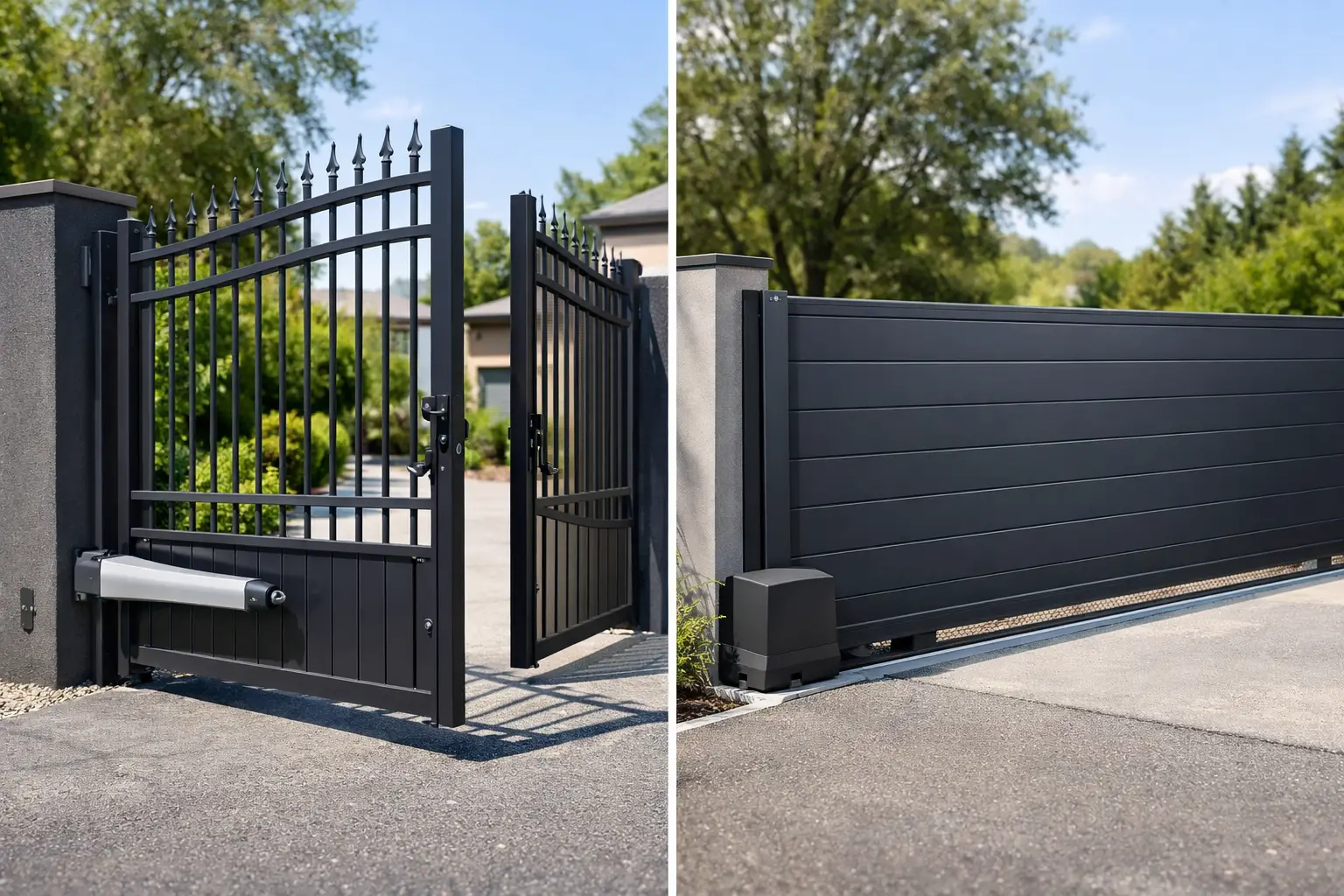
If you are weighing up an automatic swing gate vs sliding gate, the right answer usually comes down to one thing – how your entrance works in real life. A gate might look ideal on paper, but if the driveway rises sharply, the opening is tight, or the ground is uneven, that choice can quickly become expensive. For most property owners, the best system is the one that suits the site, operates reliably, and gives you straightforward control day after day.
At Crabtree Electrical Gates, this is often the first conversation we have with homeowners, estates and commercial sites across the South of England. Both gate types can be automated to a high standard and integrated with intercoms, keypads and other access control. The difference is in how they behave on site, what they need structurally, and how much room they require.
Automatic swing gate vs sliding gate: what changes the decision?
A swing gate opens in an arc, much like a door. It can be a single leaf or a pair of leaves meeting in the middle. A sliding gate moves sideways across the entrance, usually along a track or as a cantilever design where the gate is supported without a full ground track across the opening.
That sounds simple enough, but the site conditions matter far more than the basic movement. A wide, level entrance with good clearance can suit swing gates very well. A sloping driveway, restricted forecourt or commercial opening with frequent vehicle use may lean more naturally towards a sliding system. Choosing properly at the start saves compromise later.
When swing gates are the better fit
Swing gates remain a popular choice for domestic properties because they suit many traditional driveways and can be very attractive from the front of the property. They work especially well where there is enough room for the leaves to open fully and where the ground levels allow for clean movement without fouling the surface.
For many homes, swing gates also offer a familiar appearance. Timber, aluminium and metal gates can all be automated, and underground motors can keep the mechanism discreet if appearance is a priority. If kerb appeal matters just as much as access control, swing gates are often the preferred option.
They can also be a practical choice where the entrance is not especially wide and there is no side run available for a sliding gate. A sliding gate needs space to travel beyond the clear opening. If that space does not exist because of walls, landscaping or nearby structures, swing gates may be the more realistic solution.
That said, swing gates do ask more of the area in front of and behind the gate. If cars regularly stop close to the entrance, if there is limited stacking space, or if the driveway rises immediately behind the gates, the opening arc can become a problem.
Key considerations for swing gate automation
The posts and hinges must be properly suited to the gate weight and size. Automation places force through the gate structure, so strength and alignment are not optional extras. Ground levels also need careful attention. Even small changes in level can affect the clearance needed for smooth opening.
Wind loading is another factor people often overlook. A solid gate in an exposed location can place significant strain on the automation system. That does not mean swing gates are unsuitable, but it does mean the motor choice, gate build and safety setup need to be specified properly.
When a sliding gate makes more sense
Sliding gates are often the more practical answer where space is tight or the driveway layout is awkward. Because the gate moves sideways rather than swinging in or out, it does not need a clear arc. This can be extremely useful for shorter driveways, busier entrances and sites where vehicles cannot wait well back from the gate line.
They are also well suited to entrances on a gradient. If a swing gate would clash with rising ground, a sliding gate can avoid that issue altogether. On commercial sites, this is one reason sliding systems are frequently chosen. They can handle wider openings, repeated use and stricter access control arrangements without taking up valuable manoeuvring space.
From a security point of view, sliding gates can also feel more resistant because they move within a fixed path and can be harder to force than a pair of swinging leaves. That depends on the gate design and installation quality, but it is a genuine advantage in some settings.
The trade-off is that sliding gates need room to one side of the opening for the gate to travel. If the clear opening is four metres, the run-back area will usually need to be at least that and often more depending on the gate design. The foundation work is also critical. Tracks, supports, drainage and motor positions all need to be right for dependable operation.
Track sliding or cantilever?
A tracked sliding gate runs on wheels along a ground track. It can be a very effective system, but the track area needs to stay reasonably clear. Leaves, gravel and debris can affect performance if maintenance is neglected.
A cantilever gate avoids a full track across the entrance because the gate is supported from one side. This can be an excellent option where ground conditions are less forgiving or where you want to avoid a track across the roadway. However, cantilever systems usually require more side space and a well-engineered support structure.
Automatic swing gate vs sliding gate for homes
For domestic properties, appearance and ease of use are usually high on the list. A swing gate often suits a private driveway where there is enough opening space and the entrance is relatively level. It can complement the style of the house and create a more traditional finish.
A sliding gate is often the better fit where the driveway is shorter, the entrance is wider, or the property sits close to the road. If there is little room for vehicles to wait while the gate opens, or if the drive rises sharply, sliding systems tend to offer fewer compromises.
Noise can matter too. A well-installed system of either type should operate smoothly, but poor alignment, weak foundations or inappropriate hardware can make any gate troublesome. That is why site survey and specification matter more than catalogue appearance.
Automatic swing gate vs sliding gate for commercial premises
Commercial sites usually place greater emphasis on control, frequency of use and durability. A sliding gate is often preferred because it handles frequent operation well and keeps the opening area clear for vehicles. For yards, compounds, offices and managed sites, that practical advantage can outweigh the visual appeal of swing gates.
That does not mean swing gates are never used commercially. They can still work very well at lower-use entrances, residential developments and sites with suitable layout. But if heavy use, wider openings or difficult levels are involved, sliding gates are often easier to justify.
Integrated access control is another part of the decision. Intercoms, keypads, fobs, ANPR, safety edges and ground loops can be built into either style, but the way vehicles approach and queue at the entrance affects how well the whole system works.
Installation quality matters more than gate type
The question is not just swing or sliding. It is whether the gate has been designed around the entrance, the usage and the automation. A good installer will look at levels, clearances, hinge points, foundations, power supply, safety compliance and access control from the start.
This is where technical electrical knowledge makes a real difference. Automation is not simply bolting a motor onto a gate. Reliable operation depends on how the electrical system, safety devices and gate mechanics all work together. If one element is poorly planned, the whole installation suffers.
There is also the issue of aftercare. Gates are moving systems exposed to weather and regular use. Choosing an installer who offers guaranteed workmanship, proper setup and ongoing support is just as important as choosing the gate style itself.
So which gate should you choose?
If your entrance is level, has room for the leaves to open, and you want a more classic look, swing gates are often an excellent option. If space is restricted, the drive is on a slope, or the site needs a practical, high-use solution, a sliding gate may be the better investment.
There is no sensible one-size-fits-all answer here. The right choice depends on the width of the opening, the available space, the ground conditions, the amount of daily traffic and how you want the entrance to function. A proper site assessment will usually make the best option clear quite quickly.
If you are deciding between the two, it helps to think less about which gate looks best in isolation and more about which one will still feel right after years of daily use. That is usually the choice you will be happiest with.
0 Comments