
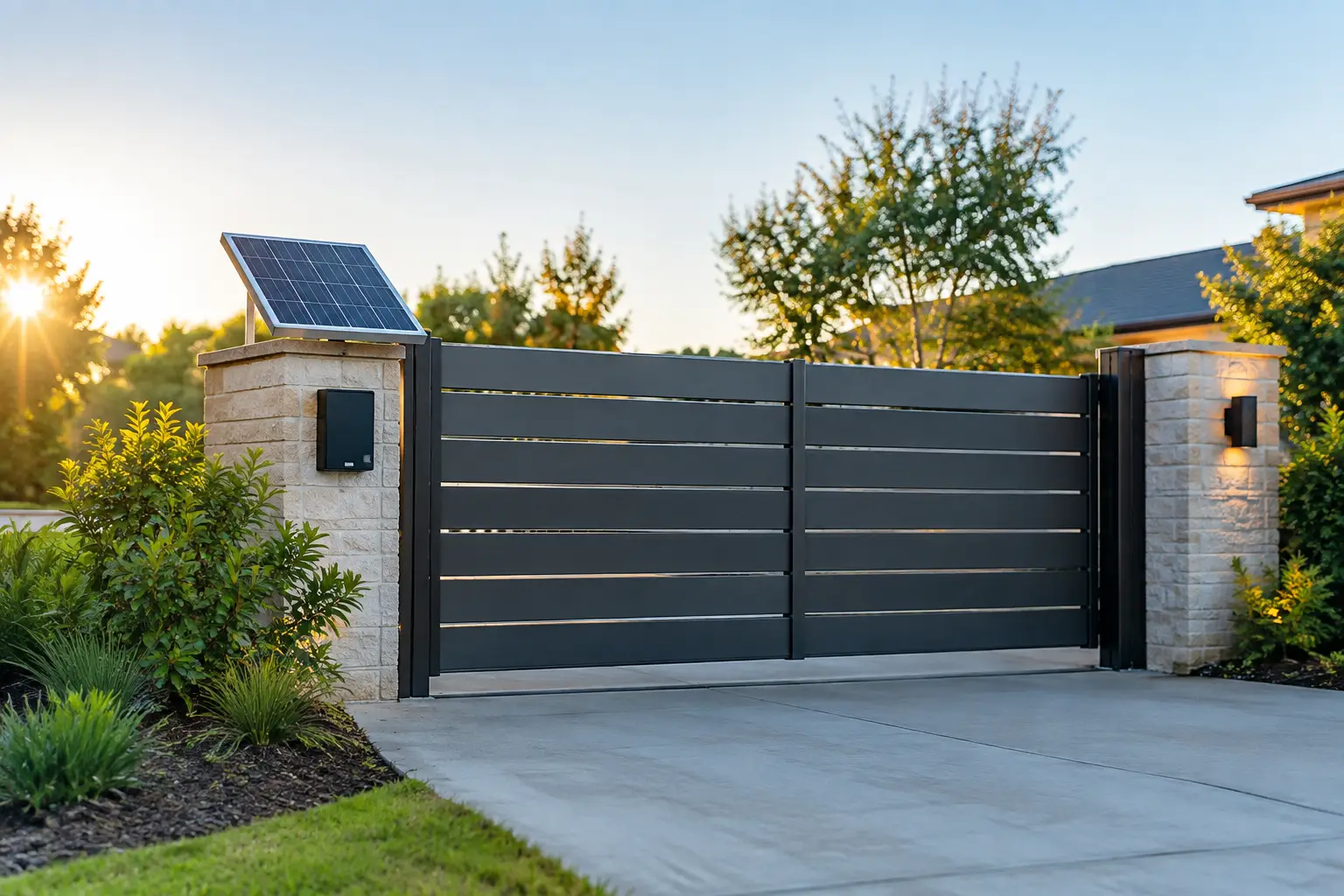
A gate at the end of a long drive can be difficult to automate when there is no practical mains supply nearby. Solar gate power offers a sensible alternative in the right setting, allowing an automated gate to operate from energy collected by photovoltaic panels and stored in batteries. It can reduce the need for disruptive trenching, but it is not a one-size-fits-all answer.
For a reliable result, the system must be designed around the gate, its daily use, the local site conditions and the amount of available sunlight. A professionally specified solar-powered system can provide convenient, controlled access to a rural home, private estate or commercial entrance. An undersized system can leave a gate struggling during the darker months, when reliability matters most.
How solar gate power works
A solar gate system uses panels to charge a battery bank. That stored power runs the gate motors, control board and selected access equipment, such as remote controls, keypads, intercoms or safety devices. The panels collect energy during daylight hours, while the batteries provide the power needed when the gate opens and closes.
This arrangement is particularly useful where running an armoured cable from a property or distribution board would involve a long excavation, crossing a driveway, disturbing landscaped ground or working around established services. It can also be a practical choice for entrances on farms, country estates and remote commercial sites.
The panel is only one part of the installation. Battery capacity, charge control, motor efficiency, wiring quality and the gate’s mechanical condition all affect whether the system performs consistently. The objective is not simply to make the gate move on a bright day. It is to provide dependable operation through periods of lower light, colder weather and normal day-to-day use.
When a solar-powered gate makes sense
Solar power is often best suited to gates with moderate use and a clear, suitably positioned location for the panels. A private driveway that opens a few times each day may be a good candidate, particularly when the entrance is some distance from the house.
It can also work well for a commercial or managed entrance with predictable traffic levels. However, commercial use needs closer assessment. A site with frequent vehicle movements, multiple staff arrivals, delivery traffic and an intensive access-control setup may demand more power than a solar-only arrangement can reliably provide. In these cases, a mains supply, or a carefully planned hybrid solution, may be the better long-term option.
The direction and shading of the proposed panel position matter. Trees, nearby buildings, high hedges and seasonal changes in foliage can significantly reduce charging. A panel that receives good summer sunlight may not receive enough useful light in December and January. This is why a site survey is more valuable than choosing a panel by size alone.
The questions that determine system size
A proper solar gate design starts with the expected load. This includes more than the weight of the gate. Swing gates and sliding gates use power differently, while a gate that is stiff, poorly aligned or exposed to strong winds will place greater demand on the motors.
An installer will normally consider how many opening cycles are needed each day, the size and construction of the gate, and whether it is swinging or sliding. They will also assess the length of travel, gradient, ground conditions and the likely effect of wind. A solid pair of tall timber gates may need a very different arrangement from a lightweight aluminium sliding gate.
Access equipment should be included in the calculation from the outset. A simple remote-control system has a lower energy demand than a setup with a video intercom, GSM calling, keypad, lighting, maglock or induction ground loop. These additions can be worthwhile for security and convenience, but they must be supported by sufficient generation and battery storage.
Battery reserve is especially important. Solar production naturally varies from day to day, so the system needs enough stored capacity to continue operating during dull weather. The right balance depends on the site and expected use. Fitting too little battery capacity may lower the initial cost, but it creates a system that is more likely to disappoint in winter.
Safety and reliable gate operation
An automated gate is a moving piece of machinery, not simply a gate with a motor attached. Solar power does not reduce the need for correct safety measures. The installation must be designed to limit the risk of trapping, crushing and impact, with the appropriate controls and safety devices for the gate type and layout.
Photocells, safety edges and correctly set force limits may all form part of the solution. The exact requirements depend on the gate design, the position of hinges or rollers, pedestrian access, pinch points and how the entrance is used. A gate used by family members, visitors and delivery drivers presents different considerations from a controlled staff-only entrance.
Mechanical preparation matters just as much as the electrical system. Gates should move freely and be properly supported before automation is fitted. No solar package can compensate for dragging hinges, damaged rollers, a twisted frame or poor foundations. Addressing these issues first protects the automation equipment and helps reduce power consumption.
A manual release is also essential. In the event of a fault or depleted battery, the gate must be capable of being released safely so access can still be gained. Property owners should be shown how this works and should keep the release key available rather than locked inside the property.
Solar gate power for homes and commercial sites
For homeowners, the main appeal is often convenience without the cost and disruption of bringing mains electricity down a long driveway. A solar system can operate swing or sliding gates while supporting practical controls such as fobs, keypads and intercoms. The best arrangement is one that suits how the household actually arrives, leaves and receives visitors.
For estate managers and commercial operators, access control may be the priority. The gate can help manage vehicle entry, protect a yard or restrict access outside working hours. Yet higher use usually means a more detailed energy assessment. It may be sensible to separate high-demand equipment from the solar gate supply, simplify the access arrangement or provide mains power where the site requires continuous heavy-duty operation.
There is also a planning consideration. Solar panels need a secure location that is unlikely to be damaged, stolen or shaded in future. A panel mounted close to the entrance may be convenient for cabling, but it must not obstruct sightlines for vehicles or pedestrians. On some properties, locating panels away from the gate can provide better exposure, provided the cable route is designed and protected correctly.
Maintenance and seasonal checks
Solar-powered automation is generally low maintenance, but it is not maintenance-free. Panels should be kept reasonably clear of dirt, leaves and bird droppings, particularly where trees or agricultural activity create more debris. A dirty panel produces less charge at precisely the time its output may already be limited.
The gate itself should be inspected regularly. Check that it moves smoothly, safety devices are unobstructed and the area around the travel path is clear. Hedges and shrubs should not be allowed to interfere with the gate, photocells or panel exposure.
Batteries have a service life and will eventually need replacement. Their condition can affect performance before they fail completely, so a gate that begins to operate slowly or inconsistently should be assessed rather than ignored. Early attention can prevent an avoidable loss of access.
It is also sensible to review how the entrance is being used after installation. A system originally intended for a family home may need upgrading if the property becomes a holiday let, business premises or shared development with substantially more daily traffic.
Choosing the right installation approach
The most cost-effective solar installation is not always the smallest package. It is the system matched to the real conditions of the entrance, with suitable safety provision and enough capacity for winter operation. In some cases, solar power will be the clear choice. In others, installing a mains supply from the start will offer better value and fewer limitations.
Crabtree Electrical Gates assesses gate automation as a complete installation, considering the gate structure, electrical requirements, access controls and intended use before recommending an approach. This avoids treating the power supply as an afterthought.
If your entrance is remote from the property, start by considering how often the gate will operate, what equipment it needs to power and whether the panel location will receive useful daylight all year. A site assessment can turn those questions into a system that remains dependable when the weather is at its least forgiving.
0 Comments