
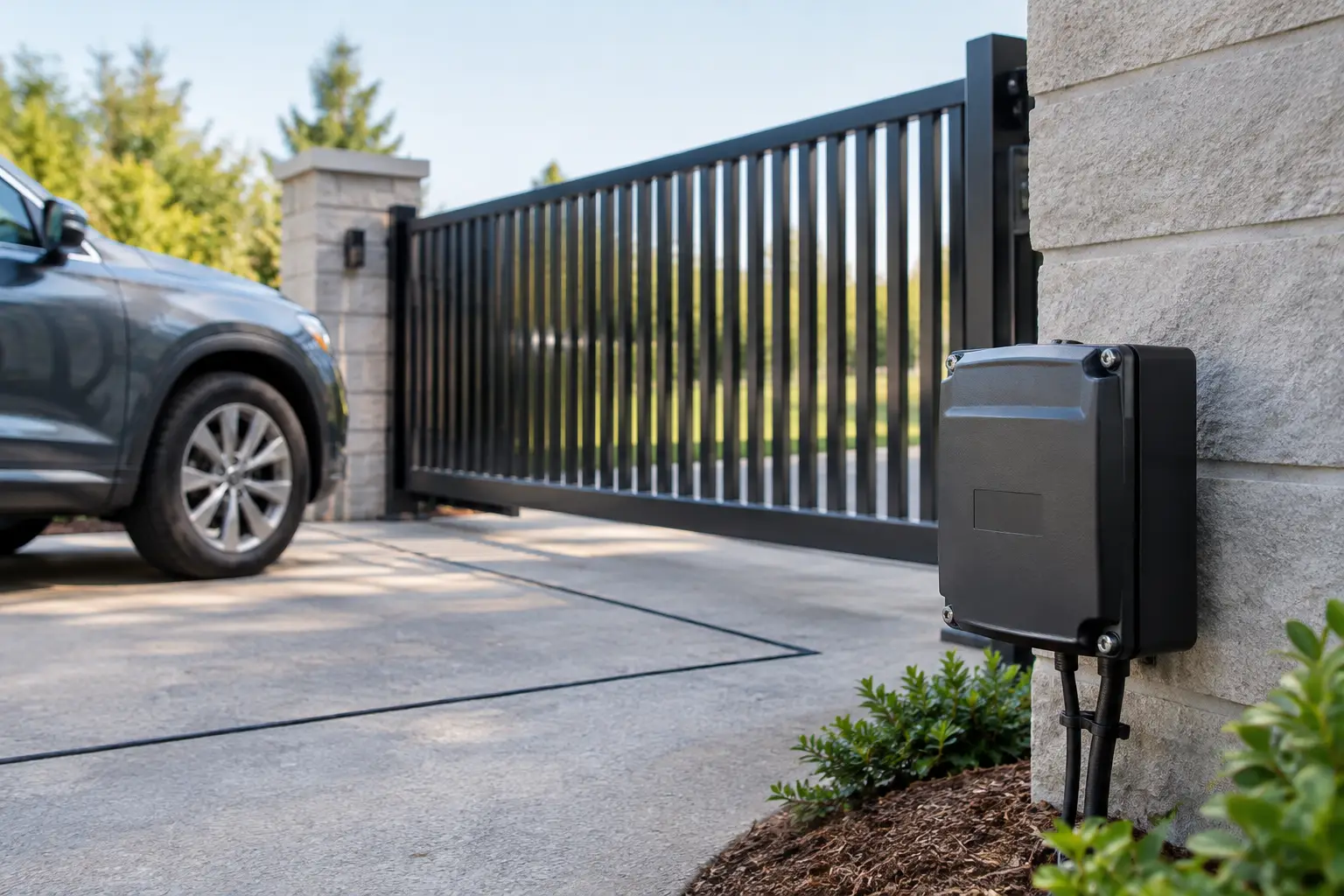
A gate that opens late, fails to hold for an exiting car, or closes onto a vehicle quickly becomes more than an inconvenience. The best vehicle loop detectors give an automated gate a dependable way to recognise a vehicle, control access and protect the route through. For private driveways, shared developments and busy commercial entrances, the right detector must suit the gate system, traffic pattern and ground conditions – not simply be the lowest-cost option.
A vehicle loop detector is usually part of a wider gate automation design. A cable loop is installed in a channel cut into the driveway surface, then connected to a detector module in the control enclosure. When a vehicle passes over or waits above the loop, its metal mass changes the loop’s inductance. The detector recognises that change and sends a signal to the gate controller.
What makes the best vehicle loop detectors?
The best vehicle loop detectors are dependable in difficult conditions, straightforward to set correctly and compatible with the gate controls they serve. They should reliably distinguish a car, van or lorry from normal environmental changes, while providing the right output for the intended function.
That function matters. A loop near the entrance may trigger opening for authorised traffic when paired with an access-control system. A loop on the exit side can provide free exit. A safety loop, sometimes called a presence loop, tells the gate to remain open while a vehicle is in the path of travel. These jobs may require different settings and positions, even where the same detector model is used.
A quality detector should offer adjustable sensitivity, automatic or manual sensitivity settings, clear status indicators and a stable response after a power interruption. In commercial settings, a fault output can also be valuable, as it alerts the control system or maintenance team when a loop has developed a wiring fault.
It is tempting to choose a detector on the basis of the headline sensitivity figure. In practice, consistent performance is more useful than extreme sensitivity. A detector set too high can respond unpredictably to nearby metalwork, moving gate leaves or environmental interference. Set too low, it may miss smaller vehicles or fail to maintain presence when a vehicle stops over the loop.
The main types of loop detector
Single-channel detectors
A single-channel loop detector monitors one loop. It is often suitable for a simple exit loop at a domestic property, or for one dedicated safety function. It is a sensible choice where the gate layout is uncomplicated and only one detection area is needed.
The limitation is clear: separate opening and safety loops require separate modules, more enclosure space and additional wiring. This is not necessarily a problem, but it should be allowed for at the design stage.
Dual-channel detectors
Dual-channel units monitor two independent loops from one module. They are useful where a gate needs an exit loop and a safety loop, or where entry and exit routes are closely managed. For commercial sites, dual-channel detection can reduce cabinet clutter and make testing more organised.
The two channels need to be independently configurable. One loop may need a short pulse to command an opening cycle, while another must maintain a continuous presence signal to stop the gate closing. Do not assume both channels will be configured the same way.
Plug-in and surface-mount modules
Loop detectors are commonly supplied as plug-in modules for compatible control panels or as DIN-rail and surface-mount units for installation inside a separate enclosure. Plug-in options can keep a neat installation where the gate controller supports them. Standalone modules offer greater flexibility when integrating with different control equipment, barriers, traffic lights or access control.
The best choice depends on the controller and available space. A professionally planned enclosure should leave room for safe cable routing, labelling and future servicing rather than packing every component tightly together.
Wired loops and wireless vehicle detection
A wired inductive loop remains the established choice for fixed gate installations. It is difficult to bypass accidentally, does not require a vehicle-mounted transmitter and can provide dependable presence detection when installed correctly.
Wireless detection can be useful where cutting a finished surface is impractical, where temporary access control is required or where a specific gate system has an approved wireless solution. However, wireless devices rely on batteries, radio range and correct positioning. They should not automatically replace a wired safety loop on a site where reliable vehicle presence detection is essential.
Choosing a detector for your gate layout
Start by deciding what each loop needs to do. A loop used for free exit should be far enough inside the property that a vehicle has fully cleared the gate before it triggers. This reduces the chance of the gate opening simply because a vehicle is passing on the public road or waiting near the entrance.
A safety or presence loop needs more careful planning. It must cover the area where a vehicle could be struck or trapped by the moving gate, while avoiding positions where the gate leaf, underground steelwork or adjacent metal objects cause unreliable detection. Sliding gates and swing gates have different risk areas, so the loop arrangement should be designed around the actual gate movement.
For a long private driveway, consider how a visitor approaches and where they will stop to use an intercom or keypad. The loop should support the access process rather than create an awkward sequence where the driver must reverse or move forward repeatedly. On commercial premises, consider delivery vehicles, turning circles, multiple lanes and whether the detector must recognise higher-clearance vehicles as reliably as cars.
The driveway finish also affects the work. Loops can be installed in tarmac, concrete or block paving, but the method needs to protect the cable and maintain the surface. Saw cuts in tarmac or concrete are normally sealed with a suitable compound after the loop cable is laid. With block paving, the cable route may be installed beneath or between blocks where appropriate. Poor sealing and badly protected cable are common causes of future faults.
Installation details that affect reliability
The detector module gets much of the attention, but the loop itself is equally important. The cable should be suitable for underground use and installed as a continuous loop with twisted feeder tails back to the enclosure. Twisting the feeder reduces the chance of electrical interference affecting the signal.
Loop size, number of turns and cable routing must follow the detector manufacturer’s requirements. A loop that is too large, too small or incorrectly wound may fall outside the detector’s permitted inductance range. It may work at first, then become unstable as conditions change.
Keep loop feeders separate from mains power cables wherever possible. Gate motors, lighting circuits and other electrical equipment can introduce interference, particularly if cables share an unsuitable route for a long distance. Good electrical installation practice is central to reliable automation, not an optional extra.
The loop should also be tested before the channel is permanently sealed and again after commissioning. This includes confirming that the detector sees the smallest expected vehicle, holds its output while the vehicle remains present and releases correctly once it has passed. The gate must then be tested through complete opening and closing cycles, including its safety responses.
Sensitivity, presence and timing settings
Most problems with vehicle loops are commissioning issues rather than defective equipment. Sensitivity should be set for the vehicles that will genuinely use the entrance. A domestic gate may need to recognise a small hatchback as well as a larger family vehicle. A commercial entrance may need dependable operation for a forklift, a van or a fully laden lorry.
Presence settings determine how long the detector remains active after it detects a vehicle. For a safety loop, continuous presence is generally required while the vehicle is above the loop. For an exit trigger, a pulse output may be enough. If the output timing is wrong, a gate could start to close before the vehicle has moved through the opening, or remain open longer than intended.
Some detectors automatically retune to compensate for slow environmental changes. This is useful, but it must be selected carefully. A detector used as a safety device should not tune out a stationary vehicle over time. The settings should be chosen around the safety role, the controller logic and the manufacturer’s instructions.
When a loop detector is the right answer
Vehicle loops are particularly effective where hands-free exit is needed, where radio fobs would be inconvenient, or where gate operation needs to respond consistently to traffic. They are widely used on residential driveways, flat and estate entrances, farms, depots, business parks and service yards.
They are not the only access-control option. A keypad, video intercom, proximity reader or remote control may be better for authorising entry. A loop normally complements these systems by managing vehicle movement and maintaining a safe route through the gate.
For a lightly used private entrance, a single exit loop combined with photocells and a properly configured gate controller may be all that is required. For a commercial site with regular deliveries, multiple lanes or separate entry and exit flows, a planned combination of dual-channel detection, safety devices, traffic control and access control is often more appropriate.
Ask for a site-specific recommendation
There is no single detector that is best for every gate. The right unit is the one matched to the control panel, loop design, vehicle types and safety requirements of the entrance. Selecting it without considering the gate layout can lead to nuisance opening, missed detections and avoidable call-outs.
Crabtree Electrical Gates can assess the full installation, from ground-loop position and electrical connections to the gate automation and access-control equipment around it. A proper site survey gives you a system that works naturally for the people and vehicles using it, with the reassurance of professional installation and commissioning.
0 Comments