
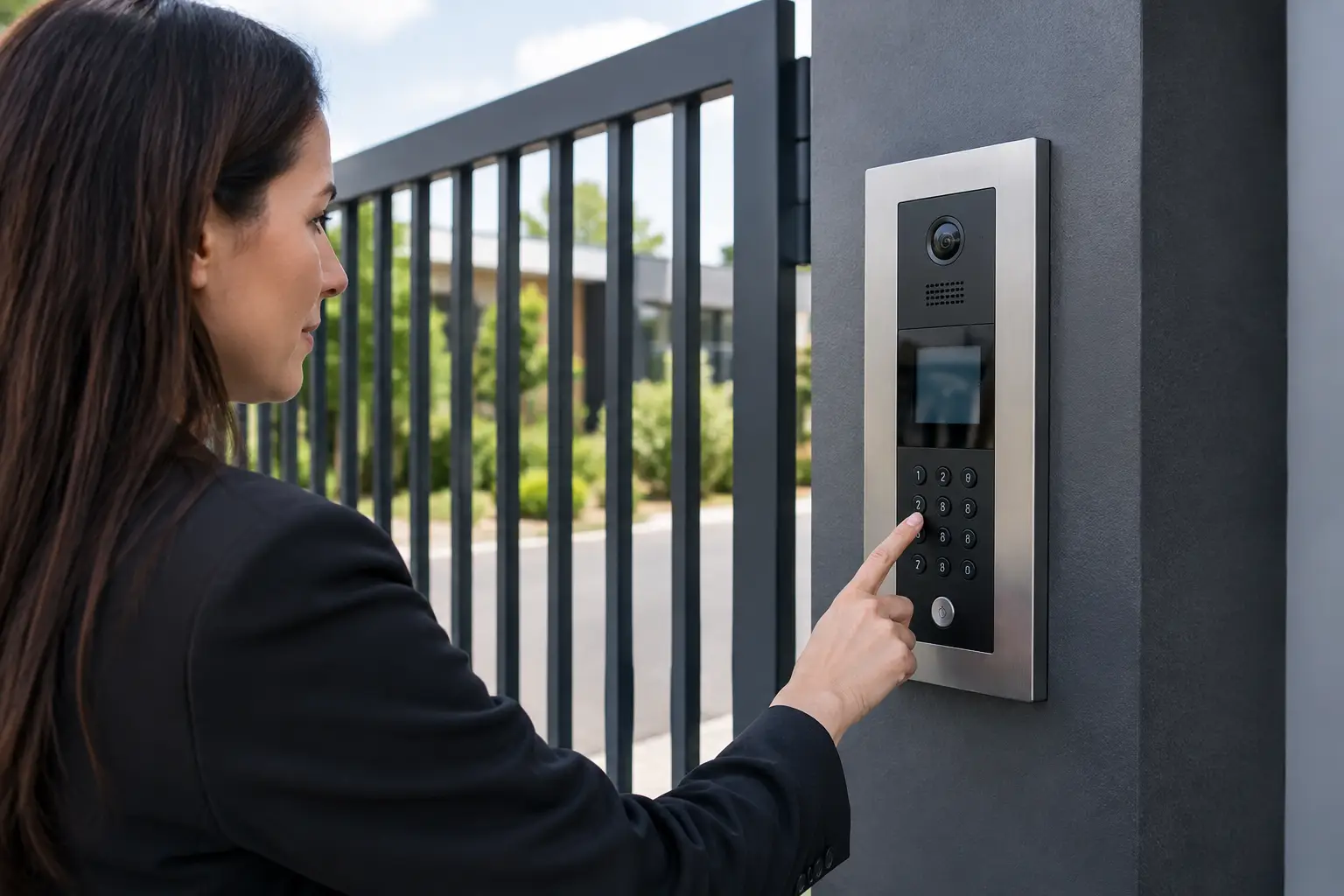
A delivery driver arrives at a busy yard, a visitor calls at an office entrance, or a contractor needs access outside normal hours. In each case, the best commercial gate intercoms give the person responsible for the site a clear way to identify callers and control entry without leaving the building.
For commercial premises, an intercom is more than a convenience. It is part of the wider access-control system, working alongside automated gates, pedestrian entrances, keypads, fobs and safety equipment. The right choice depends on how the site operates, who needs access and whether there is a reliable power and communications route to the gate.
What Makes the Best Commercial Gate Intercoms?
The best system is not automatically the one with the most features. It needs to be dependable in daily use, clear enough for staff to communicate with visitors, and suitable for the number of users and access points on site.
A small office with a single sliding gate may only need a quality video intercom connected to one or two internal handsets. A warehouse, school, industrial estate or managed commercial site may need several call points, multiple reception locations, mobile-phone calling and controlled access for regular users.
The key is to design the system around the site rather than fitting a standard package. Cable routes, gate position, distance to the building, lighting, vehicle movements and available internet or mobile coverage all affect what will work reliably.
Audio Intercoms for Straightforward Site Entry
Audio intercoms remain a practical choice for commercial gates where visual identification is not essential. The visitor presses a call button, speaks to reception or an authorised member of staff, and the gate can be released remotely if required.
They suit lower-risk entrances, staff car parks and sites with good visibility from the office. They can also be a sensible option where the budget is focused on a strong automated gate system and simple visitor control.
The limitation is obvious: staff cannot see who is calling. At a site with frequent deliveries, public visitors or security concerns, relying on voice alone can make it harder to confirm identity. Background noise from traffic, machinery or poor weather can also affect communication, so the equipment must be chosen and positioned carefully.
Video Gate Intercoms for Better Verification
For many businesses, video entry is the preferred option. A camera at the gate allows staff to see visitors before granting access, helping them deal with deliveries, contractors and unknown callers with greater confidence.
A properly specified video intercom should provide a clear image in both daylight and low light. Camera angle matters just as much as picture quality. It needs to capture the driver or pedestrian at the call point, not simply the bonnet of a vehicle or the road beyond the entrance.
Video intercoms are particularly useful for offices, care settings, schools, storage facilities and managed premises where staff need to make informed decisions about access. They can connect to dedicated internal monitors, a reception desk or, where appropriate, authorised mobile devices.
There is a trade-off. Video systems involve more equipment and may require more careful planning for cabling, network connection and screen locations. However, for sites that regularly receive visitors, the extra visibility is often worthwhile.
GSM Intercoms for Calls to Mobile Phones
GSM intercoms use a mobile network to call a nominated telephone number when a visitor presses the call button. The person receiving the call can speak to the visitor and, on many systems, open the gate from their phone.
This can be a useful solution for unmanned entrances, farms, compounds, private commercial yards and small businesses without a fixed reception point. It also allows managers or duty holders to deal with visitors when they are away from the desk.
Before choosing GSM, mobile signal at the gate must be checked. A system is only as reliable as the network coverage available at that precise location. It is also worth considering how access permissions will be managed when staff change, especially if several people need to receive calls or use dial-to-open functions.
GSM systems can be highly effective, but they are not always the best answer for a large, busy site. If calls need to reach several departments, if detailed audit information is required, or if a gate must operate regardless of mobile network issues, a hard-wired or networked solution may be more appropriate.
Networked and IP Intercom Systems
Networked intercoms connect through the site’s data network and can offer a high level of flexibility. Depending on the system, calls can be directed to multiple indoor stations, reception software, security desks or approved mobile devices. Some installations can support several entrances across one site.
These systems suit larger offices, business parks, flat developments with commercial access areas, schools and multi-tenant sites. They can be a good long-term choice where access requirements may grow or change.
The main consideration is infrastructure. The network connection needs to be stable, secure and available at the gate location. Outdoor equipment and connection points must also be installed properly to cope with the British weather. A wireless connection may work in some circumstances, but it should not be assumed to be the most dependable route for a critical entrance.
Choosing Access Methods for Regular Users
An intercom manages visitors, but most commercial premises also need a quick way for staff, tenants and approved contractors to enter. The most effective gate systems combine the intercom with suitable access methods.
Keypads can work well for smaller teams, though codes should be changed when staff leave or access needs to be restricted. Proximity fobs and cards give more controlled access because individual credentials can be removed without changing a code for everyone. Vehicle tags, long-range readers and ground loops can be useful where regular vehicles need automatic or hands-free entry.
For a commercial site, it is worth deciding who needs access at different times of day. The answer may be different for office staff, delivery drivers, maintenance contractors and emergency services. A well-planned system makes normal access simple while avoiding the habit of leaving gates open for convenience.
Installation Details That Affect Reliability
The intercom unit is only one part of the installation. Commercial gate intercom reliability depends heavily on the electrical work, cable protection, mounting position and integration with the gate controls.
Call points should be accessible from a vehicle without forcing drivers to get out in a live entrance area. They need to be at a sensible height, visible after dark and protected from accidental impact. Where HGVs and cars use the same entrance, the layout may need separate provisions or a carefully selected position that works for both.
Cables should be installed with the right protection for underground routes and moving gate areas. Power supplies, control panels and network equipment need suitable housing, and the gate safety system must not be compromised by the access-control setup. Intercom release functions should work correctly with the automation controls and site safety devices.
A professional survey identifies these practical issues before installation begins. It also helps avoid the false economy of fitting a good intercom in a location where staff cannot hear it, the camera cannot see callers, or the mobile signal is too weak to support it.
Questions to Ask Before Selecting a System
Before comparing makes and features, establish the operational requirements. Consider these points:
- How many gates, pedestrian doors and call points need to be controlled?
- Who will answer calls during working hours and when the site is unattended?
- Do staff need audio only, video verification or calls to mobile phones?
- How will employees, tenants and regular contractors gain entry?
- Is there dependable mains power, cable access, internet connection or mobile signal at the gate?
- Does the entrance handle cars, vans, lorries or a mixture of vehicles?
Clear answers make the specification far more accurate. They also allow the installer to recommend equipment that fits the site rather than adding features that will not be used.
A Commercial Intercom Should Be Built Around the Gate
Commercial access control works best when the intercom, gate automation and safety measures are planned as one installation. A high-quality call panel cannot compensate for an unsuitable gate layout, poor visibility or unreliable electrical infrastructure.
Crabtree Electrical Gates supplies and installs commercial gate automation and access-control solutions across Dorset and the South of England, with systems tailored to the practical needs of each site. The most useful next step is a site assessment that looks at how people, vehicles and deliveries move through the entrance each day. That approach leads to an intercom system staff can rely on, rather than one that creates another daily problem.
0 Comments