
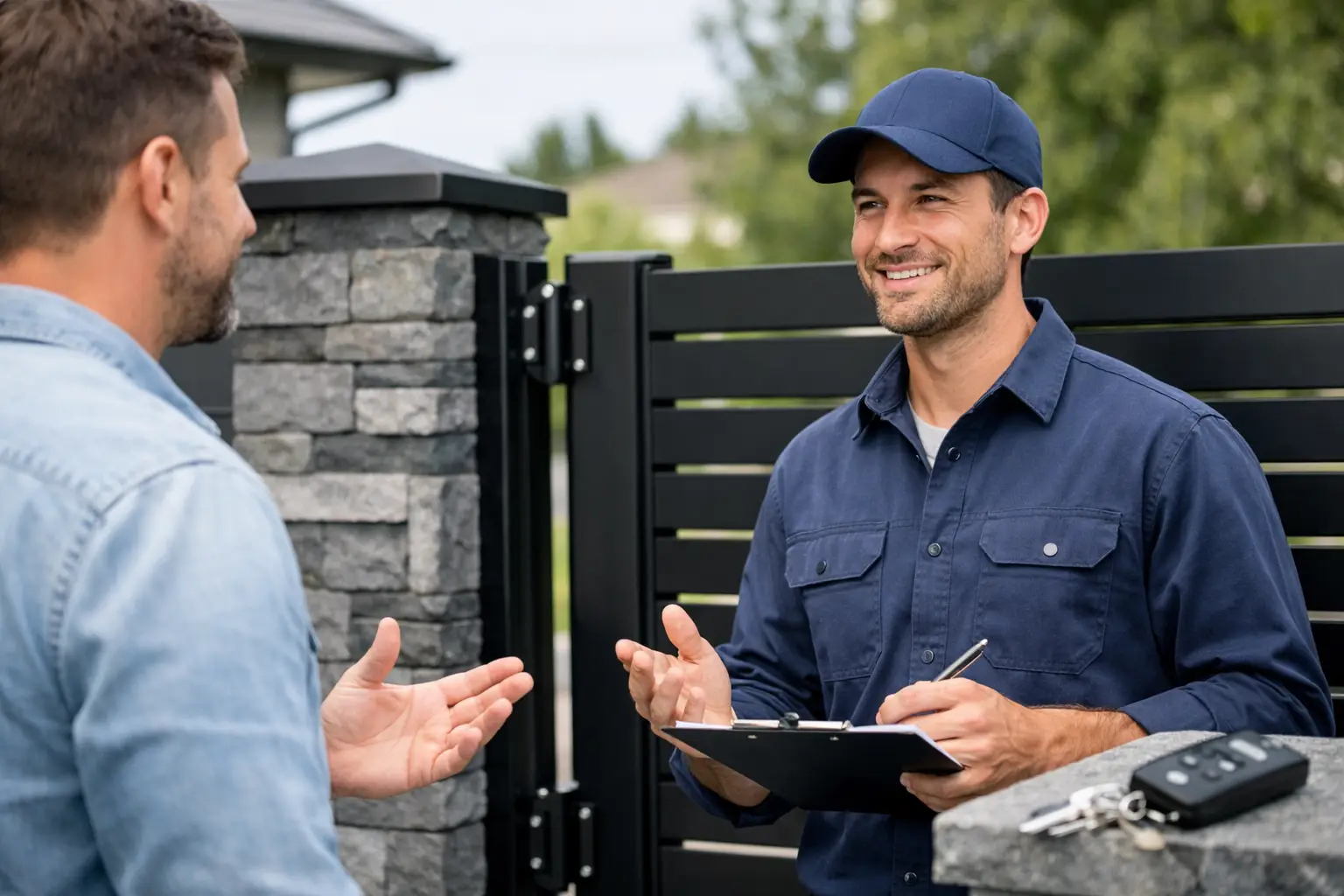
A new electric gate should make arriving home or managing a site easier from day one. The right questions for gate installers will tell you far more than a headline price ever can: whether the system is safe, suitable for the entrance, properly powered and supported once it is in use.
For a private driveway, a gate is often a long-term investment in security, convenience and appearance. For a commercial entrance, it may also control deliveries, staff access and visitor movement. In both cases, the installation needs careful planning by a specialist with sound electrical knowledge, not a one-size-fits-all approach.
Questions for gate installers about your site
1. Which gate type suits my entrance?
Swing gates and sliding gates solve different problems. A swing gate can be an excellent choice where there is clear space inside the property for the leaves to open. A sliding gate is often better for sloping driveways, limited opening space or wider commercial entrances.
Ask the installer to explain why their recommendation fits your ground levels, available space, existing gate posts and daily use. It is worth discussing whether the gate needs to open inwards, how far it must travel and where vehicles will wait while it operates. A good survey should consider these practical details before equipment is specified.
2. Can my existing gates be automated?
Sometimes they can, but not every manual gate is suitable. The gate structure must be strong enough, correctly hung and in good condition. Automation will not resolve rotten timber, weak hinges, damaged posts or an uneven track.
An installer should assess the gate weight, dimensions, movement and condition before confirming that automation is appropriate. In some cases, repairing or replacing the gates first is the sensible option. This may add to the initial budget, but it helps avoid unreliable operation and premature wear on the motors.
3. What groundwork and electrical work are required?
This is one of the most useful questions to ask early. Underground cable routes, power supply, drainage, foundations and safety devices all need consideration. Underground swing-gate motors, for example, require proper drainage to prevent water from sitting around the equipment.
Find out who is responsible for trenching, ducting, concrete bases and reinstatement. Ask where the control cabinet will be located and whether a suitable electrical supply already exists. A clear written scope prevents unexpected work appearing later in the project.
Questions about safety and reliability
4. How will the system be made safe?
An automatic gate is a moving machine, so safety must be built into the design rather than treated as an optional extra. Depending on the installation, this may include photocells, safety edges, force limitation, warning devices and carefully positioned controls.
Ask how the installer will identify trapping, crushing and impact risks around the gate, posts, walls and adjacent fencing. The answer should relate to your actual entrance, particularly if children, pedestrians, animals or visitors may be near the gate. A system that opens and closes reliably is not necessarily a safe one unless the appropriate protective measures are in place.
5. What happens in a power cut or fault?
Every automated gate should have a practical manual release method so authorised users can operate it if mains power is unavailable. Ask where this release is located, how it works and who will be shown how to use it.
For some homes and sites, battery backup is worth considering. It can keep the gate working for a limited period during a power interruption, although its suitability depends on gate size, usage and the equipment selected. Commercial customers may also need a clear procedure for maintaining access if the system is temporarily out of service.
6. Is the equipment suited to how often the gate will be used?
A gate serving a quiet home has very different demands from one used by staff, visitors, contractors and deliveries throughout the day. Motors have duty-cycle limits, and choosing equipment that is under-specified can lead to avoidable faults and reduced service life.
Be clear about peak traffic, the number of users and whether larger vehicles need access. A residential driveway may need simple, dependable operation a few times a day. A business park or yard may require heavier-duty automation, wider opening capacity and access controls that can cope with frequent use.
Questions about entry control
7. Which access control option is right for me?
Remote controls are straightforward for regular users, but they may not provide enough control for a shared driveway or commercial site. Keypads, intercoms, GSM systems, proximity fobs and vehicle detection loops each have different benefits.
An intercom lets residents or staff speak to visitors before granting access. A keypad can work well for trusted contractors, although codes should be changed when they are no longer needed. Ground loops are useful where vehicles need automatic exit without relying on a handheld remote. Ask how each option will work in everyday use, not just how it looks on a quotation.
8. Can the gate work with other security systems?
It may be possible to integrate gate automation with lighting, cameras, pedestrian access, timed operation or existing access-control arrangements. The best approach depends on the equipment already installed and what level of control is genuinely needed.
Ask whether the installer will check compatibility before work begins. For commercial sites, it is particularly useful to establish who can add or remove users, how lost fobs are managed and whether entry records are required. Keeping control arrangements simple usually makes them more reliable for everyone using the site.
Questions about price, programme and workmanship
9. What is included in the quotation?
A detailed quotation is easier to compare than a single total. It should make clear whether it covers gates, motors, safety equipment, access control, electrical supply work, groundwork, commissioning and VAT where applicable.
Ask about items that may be excluded or subject to site conditions. For example, a concealed cable route can be more involved than expected once excavation starts, and old brickwork or unstable posts may need attention. Honest installers will explain likely variables rather than promising a fixed outcome without a proper survey.
10. How long will installation take?
The answer depends on the gate type, fabrication lead times, weather, groundwork and the complexity of the access controls. A straightforward automation upgrade may be completed more quickly than a full installation involving new gates, posts, underground motors and a long cable run.
Ask what happens at each stage: survey, quotation, ordering, groundwork, installation, testing and handover. If the entrance is your only access point, discuss how vehicles and pedestrians will enter the property while work is underway. Commercial customers should also consider deliveries and site traffic during the programme.
11. What guarantee and insurance do you provide?
Workmanship and product guarantees should be explained clearly, including what is covered and for how long. It is equally reasonable to ask whether the installer is insured for the work they undertake.
These details matter if an adjustment, repair or return visit is needed after installation. They are also a useful indication of how a company approaches accountability. A specialist installer should be comfortable discussing the equipment, their workmanship and the process for dealing with any issue.
12. What aftercare and maintenance will the gate need?
Electric gates need occasional attention to remain safe and dependable. Hinges, tracks, rollers, photocells, drainage areas and safety devices can all be affected by dirt, weather, movement or everyday wear. High-use commercial gates may need planned maintenance more frequently than a domestic system.
Ask what checks you can carry out, what should only be handled by a qualified engineer and how quickly help is available if the gate stops operating. At handover, you should receive a clear explanation of normal operation, manual release, remotes or codes, safety features and basic care.
Choosing an installer with confidence
The cheapest quote is not always the lowest-cost choice over the life of the system. A poorly matched motor, inadequate safety provision or unclear electrical work can create disruption that outweighs an initial saving. Equally, expensive equipment is not automatically the right answer if it does not match the site and how the entrance is used.
Choose an installer who carries out a proper survey, answers technical questions in plain language and provides a defined scope of work. Crabtree Electrical Gates installs automated gate and access-control systems across Dorset and the South of England, with advice based on the property, access requirements and practical conditions on site.
Before accepting a quote, take a final walk to the entrance at the busiest time of day. Think about visitors, deliveries, pedestrians, reversing vehicles and what happens when the power is off. Those real-world details will help you ask better questions and choose a gate system that remains convenient, safe and dependable for years to come.
0 Comments