
A gate should not become an obstacle when you arrive home in the rain, receive a delivery or need to manage visitors to a busy site. Understanding how electric gates work makes it easier to choose an automation system that is secure, safe and suited to the way your property is used.
An electric gate is not simply a gate with a motor attached. It is a connected system of gate leaves or a sliding panel, an operator, a control board, safety equipment and an access method. Each part must be correctly selected and installed for the gate to open reliably and, just as importantly, stop safely when it needs to.
How electric gates work from signal to movement
The process usually begins when somebody sends an authorised signal. This could come from a remote fob, keypad, intercom, phone-based access system, key switch or vehicle detection loop. The signal reaches the control panel, which checks that the gate can move safely before instructing the motor to operate.
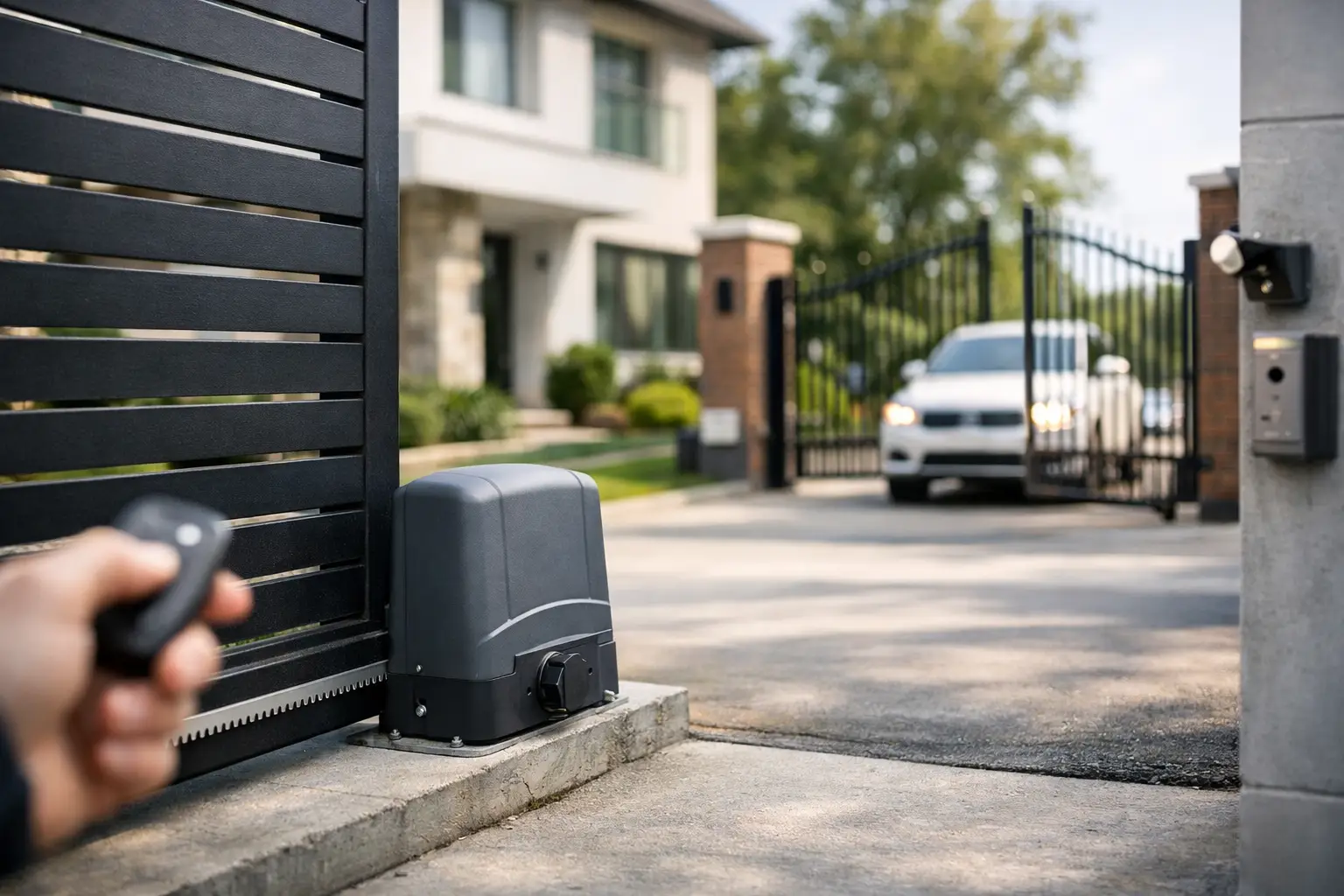
The motor then moves the gate through its programmed opening cycle. With a swing gate, this means moving one or two leaves around their hinge points. With a sliding gate, the motor drives a toothed rack fixed along the gate, moving it horizontally along its track or cantilever system.
As the gate moves, safety devices monitor the entrance. If a photocell beam is interrupted by a person, vehicle or object, the system should stop and, depending on its programming and the type of system, reverse or remain stationary. Once the gate reaches its open or closed position, limit settings tell the motor to stop.
The same sequence happens in reverse when the gate closes. A well-designed installation makes this feel straightforward to the user, but the reliability of that operation depends on proper groundwork, sound gate construction, suitable electrical supplies and correctly configured safety equipment.
The main parts of an automated gate system
The gate and supporting structure
Automation can only perform as well as the gate it is moving. A gate that is too heavy, poorly balanced, sagging on its hinges or running unevenly will place unnecessary strain on the operator. Posts, hinges, tracks, rollers and foundations all need to be assessed before automation is installed.
For swing gates, the weight, width and wind loading of each leaf matter. A solid timber or metal gate may be within the operator’s weight limit but still need a more powerful system because it catches the wind. Long gate leaves also create greater leverage at the hinges.
For sliding gates, the route must remain level and clear. A tracked sliding gate needs a stable track and rollers, while a cantilever gate needs more space beside the entrance and substantial foundations. Sliding systems are often a practical choice where a driveway rises behind the gates or where wider openings need to be controlled.
The motor or operator
The operator provides the movement. There are several common options, and the right one depends on the gate design, available space and expected use.
Above-ground linear rams are often used on swing gates. They are visible on the rear of the gate and push or pull the leaf open. Articulated arm operators use a jointed arm and can suit wider posts or layouts where the gate geometry does not suit a linear ram.
Underground operators are fitted in foundation boxes beneath the hinge area. They provide a discreet finish because the mechanism is largely out of sight, making them popular for higher-end residential gates and properties where appearance is a priority. They do, however, require careful drainage and access for future servicing.
A sliding gate normally uses a ground-mounted motor with a drive gear that engages with the rack on the gate. The motor must be matched to the gate’s weight, length and duty cycle. A lightly used domestic gate and a commercial entrance with frequent vehicle movements have very different demands.
The control panel and electrical supply
The control panel is the system’s decision-making point. It receives commands from remotes and access controls, powers the operator and safety devices, manages the opening and closing sequence, and responds if a fault is detected.
Most electric gate systems are supplied from a mains electrical connection, installed with suitable protection and cabling. In some locations, a solar-powered solution may be possible, particularly where running a mains supply would be difficult. Solar systems depend on site conditions, battery capacity and expected usage, so they are not automatically the best option for shaded entrances or high-traffic commercial sites.
Correct electrical installation is a key part of dependable gate automation. Cables need appropriate protection, connections must be made safely, and equipment should be positioned where it can be maintained without compromising security or appearance.
Access control decides who can enter
Automation makes the gate move; access control determines who can request that movement. The simplest option is a remote fob carried in a vehicle. This is convenient for householders and regular users, although lost remotes need to be removed from the system and replacements programmed.
A keypad can provide access using a code, which is useful for contractors, staff or guests. Codes should be changed when personnel change, especially at commercial premises. Intercom systems add another level of control by allowing the person inside to speak to, and often see, the visitor before releasing the gate.
For larger sites, vehicle ground loops can be installed beneath the driveway surface. A loop can detect a vehicle approaching from inside the property and open the gate for safe exit, without requiring the driver to use a remote or keypad. It can also help prevent a gate from closing onto a vehicle waiting in the entrance area.
The best arrangement depends on who uses the site and how often. A private home may only need remotes and a video intercom. A business, estate or shared access road may need keypads, timed controls, multiple user permissions and vehicle detection to keep traffic moving without giving up control.
Safety systems are not optional extras
Electric gates are heavy moving structures. They must be designed to reduce the risk of trapping, crushing, impact and shearing. Safety needs to be considered at the survey stage, not added as an afterthought.
Photocells are among the most familiar safety devices. They create an invisible beam across the entrance, and the gate will respond if that beam is broken during a closing cycle. A single set of photocells may not protect every risk area, particularly around a swing gate’s hinge side or the closing edge of a sliding gate.
Safety edges are pressure-sensitive strips fitted to gate edges or other risk points. If they contact an obstruction, they signal the control panel to stop the gate. Motor force detection can also identify unusual resistance, but it should not be treated as a substitute for correctly positioned safety devices.
Other important measures can include warning lights, audible warnings, guards around moving parts and carefully planned gate positions. An experienced installer will assess the entrance, the gate design, likely users and foreseeable hazards before specifying the necessary protection.
A manual release is also essential. In the event of a power cut or system fault, the operator can be disengaged with the appropriate key so the gate can be moved by hand. Property owners should know where this release is and how to use it safely.
Why gate type, usage and site conditions matter
There is no single motor or access-control package that suits every entrance. A pair of ornate driveway gates used a few times a day needs a different approach from a sliding gate at a commercial yard that opens repeatedly throughout the working day.
Domestic installations often prioritise appearance, quiet operation and simple visitor access. Underground motors and integrated video intercoms can provide a clean finish, but they require proper installation below ground and a plan for drainage and servicing.
Commercial systems tend to place greater emphasis on duty rating, user management and traffic flow. Equipment may need to withstand frequent cycles, larger gates and more demanding weather exposure. Access control may also need to work alongside staff procedures, delivery schedules and out-of-hours security.
The entrance itself can affect the design. A sloping driveway may rule out a conventional swing gate opening inwards. Limited space behind the gate may favour a sliding system. Poor drainage, uneven ground and exposed coastal conditions all need to be addressed before the automation is selected.
Keeping an electric gate reliable
Electric gates need periodic servicing, particularly where they are used frequently or exposed to dirt, leaves, salt air and standing water. Maintenance checks should cover the gate’s physical movement as well as the automation equipment. Hinges, rollers, tracks, fixings, safety devices and manual releases all need attention.
Owners can help by keeping the entrance clear and checking that photocells are clean and unobstructed. A gate that begins moving slowly, makes unusual noises, stops unpredictably or fails to close fully should be inspected rather than repeatedly forced to operate. Small mechanical issues can quickly become motor or control-board problems if left unresolved.
For new installations across Dorset and the South of England, Crabtree Electrical Gates can assess the gate, power supply, access requirements and safety needs as one complete system. This avoids the common problem of fitting automation to a gate that is not ready to carry it.
The most useful starting point is a site survey. It provides a clear view of how the entrance is used, what risks need managing and which system will give you dependable access without compromising safety.
0 Comments