
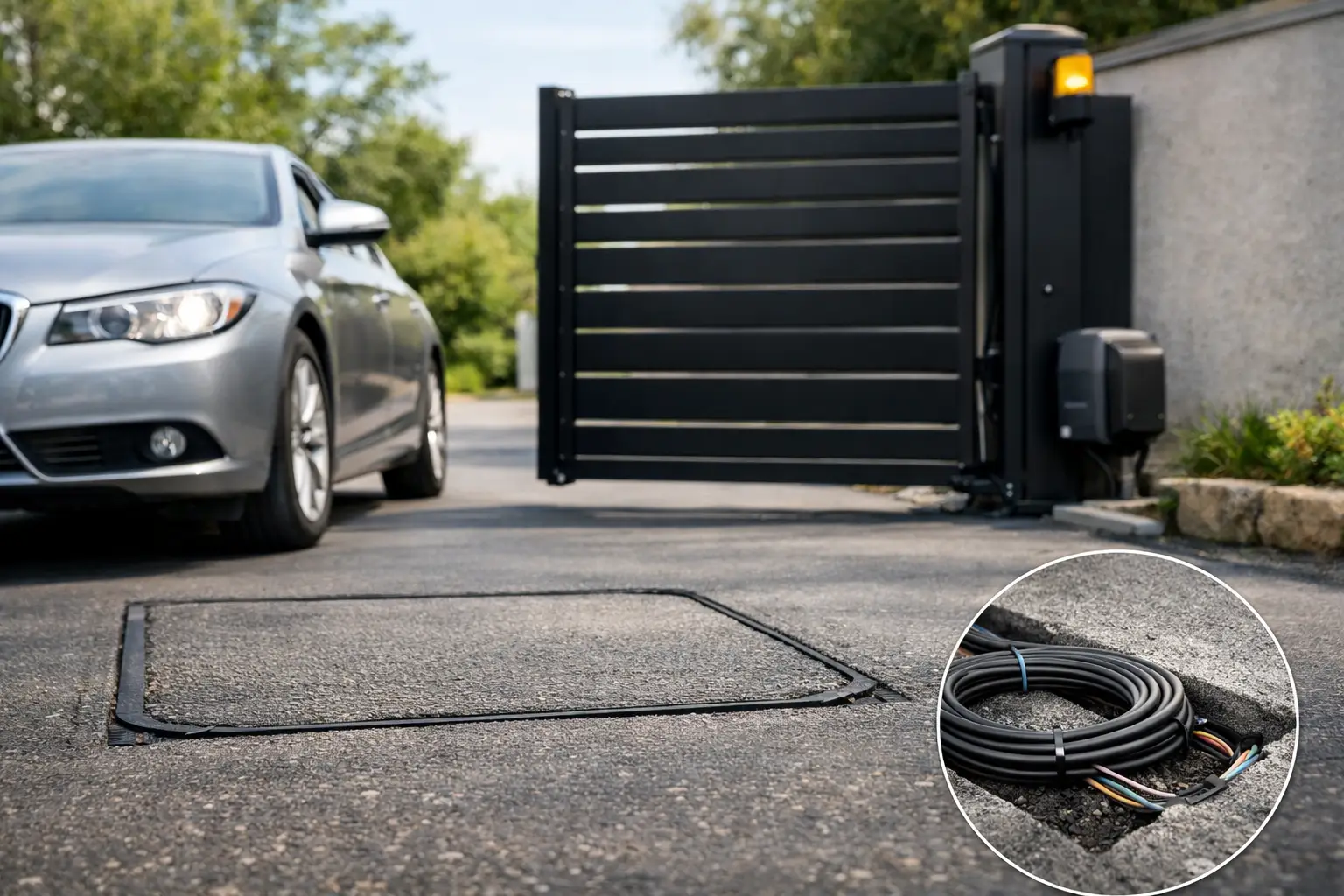
A vehicle waiting at an automated gate should not need a handset, keypad code or passenger to get out and press a button. Ground loop vehicle detection provides a practical way to open a gate automatically when a car, van or lorry reaches the exit point. When it is correctly designed and installed, it makes day-to-day access quicker while helping property owners maintain control over entry.
For private driveways, estate entrances and commercial sites, an induction loop can be integrated into a wider gate automation and access control system. The right arrangement depends on how the entrance is used, the gate type, the road surface and, above all, the safety requirements of the installation.
How ground loop vehicle detection works
A ground loop is a length of insulated cable installed in a carefully cut channel in the driveway surface. The cable is laid in a loop pattern, sealed into place and connected to an induction loop detector within the gate control equipment.
The loop creates a magnetic field. When a vehicle containing sufficient metal enters that field, the detector recognises a change and sends a signal to the gate controls. That signal can be set to open the gates, hold them open, or prevent them from closing while a vehicle remains in the detection area.
For most gate installations, the loop is used on the inside of the property as an automatic exit trigger. A driver approaches, the loop detects the vehicle and the gates open without any additional action. Entry is usually controlled separately through an intercom, keypad, remote control, GSM system, number plate recognition or another authorised access method.
This distinction matters. Automatic exit is convenient, but unrestricted automatic entry may not provide the level of security a home, business or managed site requires.
Where induction loops are most useful
Ground loops are particularly well suited to properties where drivers leave frequently and need a reliable hands-free exit. They are common on longer driveways, busy commercial entrances, flat developments, farms, private estates and premises where staff or delivery vehicles regularly move in and out.
At a domestic property, a loop can remove the frustration of stopping close to the gate, finding a remote and waiting for the gate to respond. It is also useful where several household members use different vehicles, as there is no need to issue and manage remotes solely for leaving the property.
On commercial sites, the benefits are often operational as well as convenient. Staff vehicles can exit efficiently, while visitor and contractor entry remains controlled at the gate. For sites with a sliding gate, the loop position and gate opening time need particular consideration so vehicles do not queue too close to a public highway.
Ground loops can also support a better closing sequence. A separate presence loop can tell the control panel that a vehicle is still within a designated area, helping to avoid a gate beginning its closing cycle too soon. However, a loop must never be treated as the only safety measure around an automated gate.
Vehicle detection is not a substitute for gate safety
An automated gate is a moving machine, and its safety system must be assessed as a complete installation. Ground loops detect metal vehicles. They are not designed to reliably identify pedestrians, children, cyclists, animals or every potential obstruction.
For that reason, a properly specified gate system may also require safety photocells, safety edges, force limitation, warning devices and appropriate control settings. The exact measures depend on the gate design, its weight and travel, the layout of the entrance, and who can access the area.
A loop can be useful as part of the safety strategy, especially for vehicles in a known detection zone, but it cannot protect every route into the path of a moving gate. A professional survey identifies pinch points, trapping risks and the most suitable safeguards before installation begins.
This is particularly relevant with swing gates. The direction of travel creates a large moving area, and the loop must be positioned so a vehicle can trigger the gate without sitting in a hazardous location. With sliding gates, attention is needed around the closing line, run-back area and pedestrian access.
Planning the loop position
The location of the loop is one of the most important decisions in the project. It needs to detect the vehicle early enough for the gate to open safely, but not so early that vehicles passing nearby trigger it unnecessarily.
A simple internal exit loop is often installed a suitable distance back from the gates. This gives a vehicle room to stop while the gate opens and reduces the risk of detection occurring where the vehicle could obstruct the gate leaf. The required distance varies with gate speed, gate type, approach angle and available driveway space.
Some sites need more than one loop. An exit loop may command an opening cycle, while a second loop closer to the gate confirms that a vehicle is present and prevents closing until the vehicle has cleared the entrance. A larger commercial entrance may need tailored detection zones for cars, vans and lorries.
The surface construction also affects the approach. Loops are commonly installed into tarmac or concrete by saw-cutting channels, but block paving, gravel driveways and newly planned surfaces require a different method. Where a driveway is being built or resurfaced, installing the loop at the right stage can give a neater, more durable result.
What affects reliability
A correctly installed induction loop is highly dependable, but reliability is not simply a matter of putting cable into the ground. The loop size, number of cable turns, detector settings, lead cable arrangement and sealing method all influence its performance.
The system must be set up for the vehicles expected to use it. Most cars and vans are detected without difficulty, but very small motorcycles, bicycles and some specialist vehicles may not provide enough metal for consistent operation. If motorcycles are common at the property, this should be discussed during the survey so another access method can be provided where necessary.
Nearby metalwork and electrical equipment can affect detection if the design is poor. Reinforcement steel in concrete, underground services, large metal gate components and adjacent loops all need to be considered. A suitable detector and careful commissioning reduce the chance of false triggers or missed vehicles.
Water ingress is another avoidable cause of faults. The saw cuts must be cleaned, the cable protected and the channels properly sealed with a material suited to the driveway surface. Poor sealing can allow movement, moisture and damage over time, particularly on driveways exposed to regular traffic and winter weather.
Integrating a loop with access control
Ground loop vehicle detection works best when it is planned alongside the rest of the gate system rather than added as an afterthought. The detector can be connected to the automation controls so it follows the required opening, hold-open and closing logic.
For example, a home may use an intercom or keypad for visitors entering, remote controls for regular users and an induction loop for vehicles exiting. A business may combine a loop with timed access permissions, staff credentials and an intercom connected to reception.
The settings should reflect how the site actually operates. A gate that closes immediately after the loop clears may be appropriate in some locations, but other entrances need a longer delay for trailers, slower vehicles or two vehicles travelling out together. Longer hold-open times improve convenience but may reduce security, so there is a balance to be agreed.
Where emergency access, deliveries or out-of-hours operation are concerns, these should be considered at the design stage. A reliable system is one that accounts for normal use as well as the exceptions that happen every week.
Installation and aftercare
A professional installation starts with a site survey. This establishes the gate layout, power supply, driveway construction, drainage, vehicle types and intended access arrangements. It is also the point at which the installer can identify whether a ground loop is the best solution or whether a keypad, remote control, GSM call system or other method would better suit the property.
The cable route is then planned before the driveway is cut. Once installed, the loop is connected, tested with representative vehicles and integrated with the gate safety equipment. The gates should open and close correctly under real operating conditions, not just respond to a basic detector test.
Like any part of an automated entrance, loops and controls benefit from routine inspection. If a gate stops reacting to vehicles, opens unexpectedly or behaves differently after resurfacing work, the system should be checked rather than bypassed. Damage to the loop cable, changes to the driveway or an issue with the detector can usually be diagnosed by a qualified gate automation engineer.
Crabtree Electrical Gates designs and installs electric gate systems across Dorset and the South of England, with ground loops specified around the needs of the property rather than treated as a standard add-on. A clear survey is the best starting point for a system that is convenient for drivers, secure at the boundary and safe in everyday use.
If automatic exit would make your entrance easier to use, discuss the driveway layout and traffic pattern before choosing equipment. A well-positioned loop is a small part of the installation, but it can make a noticeable difference every time a vehicle leaves the property.
0 Comments