
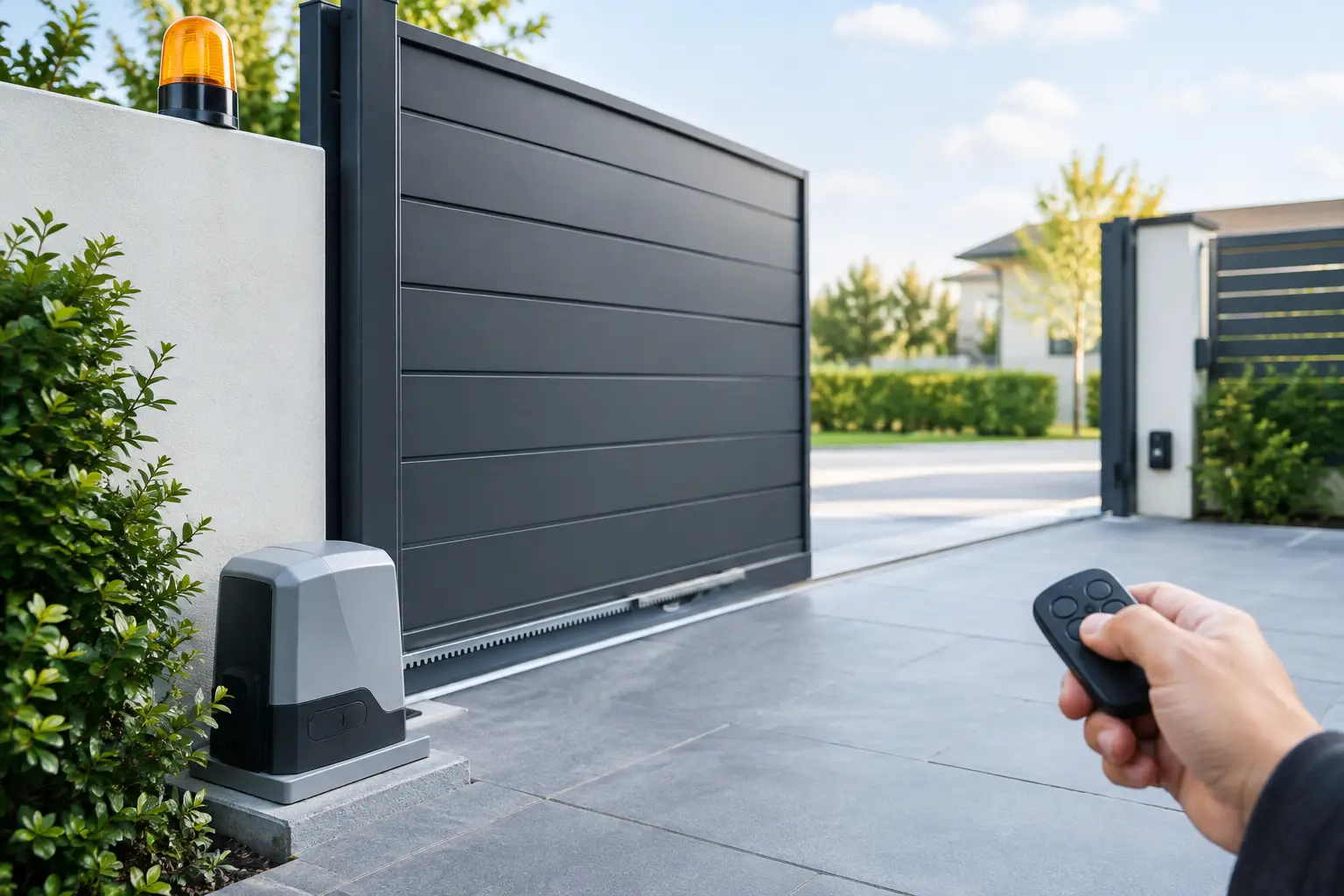
An electric gate should make arriving home or managing a site easier, not introduce a hidden risk at the entrance. This gate automation safety guide sets out what safe operation looks like, why professional design matters and what property owners should check once a system is in use.
Automated gates are heavy moving structures. A gate that looks well made can still be unsafe if its motor, control equipment or safety devices are poorly specified, incorrectly fitted or left unmaintained. The risks are greatest where a moving leaf can trap someone against a post, wall, fence, vehicle or fixed obstacle.
For homeowners, this may mean protecting children, visitors, delivery drivers and pets. For commercial premises, it also means managing the movement of staff, customers, contractors, cars and larger vehicles through a controlled access point. Each setting needs an installation planned around the actual site, rather than a standard kit fitted to every driveway.
Gate automation safety guide: start with the site
Safe gate automation begins before equipment is selected. The installer should assess how the gate will travel, where people can stand, what lies beside and behind the opening, and how vehicles approach the entrance. A sliding gate needs a different safety approach from a pair of swing gates, while a busy commercial entrance presents different demands from a private driveway.
The weight, size and construction of the existing gate are equally important. Automation cannot compensate for a gate that is badly hung, damaged, excessively heavy for its structure or difficult to move by hand. Hinges, rollers, tracks, posts and foundations must be in suitable condition before an operator is installed.
It also matters how the entrance is used. If pedestrians regularly walk through the vehicle gateway, a separate pedestrian route may be the safest answer. If vans, trailers or lorries use the site, the gate position, opening speed and stopping areas need to account for their turning space. A system designed solely around a family car can be unsuitable for a shared estate or working yard.
Identify every trapping and crushing point
The key safety question is simple: where could a person become trapped as the gate moves? These hazard zones are not always obvious. With swing gates, they can occur between the moving gate and a closing post, wall, pillar or adjacent fencing. There can also be pinch points at hinges and between two leaves as they meet.
On sliding gates, hazards may exist at the leading edge, between the gate and the support post, around rollers and in the run-back area where the gate parks when open. An underground operator can create different risks around the pivot and opening geometry. Gates installed on a slope, or those with decorative openings that could catch hands or clothing, need particularly careful consideration.
Appropriate protective measures depend on the hazard. Safety edges can detect contact and command the gate to stop or reverse. Photocells create an invisible beam across an opening, preventing movement or stopping the gate when a person or vehicle breaks that beam. Fixed guards, covers and safe clearances can prevent access to moving mechanisms in the first place.
One device is rarely enough for every entrance. Photocells are useful, but they do not protect every possible crushing area. Safety edges are valuable at contact points, but they are not a substitute for sound layout and guarding. A competent installation uses a combination of measures based on the risks found on site.
Controls must be placed and configured carefully
A remote control, keypad, intercom or key switch should allow users to operate the gate without entering a danger zone. Controls that require someone to stand close to a moving gate need particular thought. The user must have a clear view of the gate, and the control should not be accessible to children or unauthorised people.
Access control is part of safety as well as security. An intercom can help occupants confirm who is at the entrance before opening the gate. Keypads and fobs can limit use to authorised people. On commercial sites, ground loops and vehicle detection can help manage traffic flow, but they must be positioned and set up so the gate does not close onto a vehicle that has not fully cleared the opening.
Automatic closing is convenient, but it is not right for every situation. The delay must give vehicles enough time to pass through, including less confident drivers and larger vehicles. Where there is frequent pedestrian activity, a hold-open option or a separate controlled pedestrian entrance may be a better solution.
Emergency release and power failure planning
Every automated gate should have a suitable means of manual release so it can be opened during a power cut or equipment fault. Those responsible for the property need to know where the release is, how to use it and how to secure the gate afterwards. There is little value in an emergency release that only the original installer understands.
Manual operation has its own risks. A large gate may be difficult to control once released, particularly in high winds or on a gradient. The release procedure should therefore be explained at handover, and users should avoid forcing or attempting repairs to a gate that is jammed or visibly damaged.
For sites where access must be maintained at all times, such as managed estates, businesses or agricultural premises, discuss contingency arrangements during the design stage. This might include backup power, an alternative access route or a clear process for opening the gate safely if the system is unavailable.
Safe installation is electrical work as well as mechanical work
Gate automation brings together moving machinery, electrical supply, controls and often external cabling. This is why specialist electrical knowledge is valuable. Cabling needs suitable protection, equipment must be correctly rated for its environment, and electrical connections need to be installed and tested properly.
Outdoor equipment is exposed to rain, dirt, insects, temperature changes and accidental damage from vehicles or gardening work. Poorly protected cables and enclosures can lead to unreliable operation as well as safety concerns. A professional installation considers drainage, cable routes, isolation, earthing arrangements where required and the long-term condition of the equipment.
The completed system should be commissioned, not simply switched on. This includes checking the gate’s movement, force settings, stopping behaviour, safety devices, manual release and control methods. The person taking responsibility for the gate should receive clear guidance on normal use and what to do if something does not work as expected.
Maintenance is not optional
Safety devices can only protect people when they are working. Dirt on photocells, leaves in a sliding gate track, worn hinges, loose fixings and vehicle damage can all affect how an automated gate performs. Regular visual checks by the owner or site manager can catch obvious problems early, but they do not replace planned professional servicing.
At least once a month, observe the gate through a full opening and closing cycle. Keep well clear while doing so. Look for unusual noises, scraping, jerking, slow movement, a gate that no longer stops where it should, damaged safety edges or photocells that are dirty or misaligned. Check that warning signs remain visible where they are needed.
Do not bypass a photocell, disconnect a safety edge or increase force settings to overcome a problem. These actions can turn a minor fault into a serious hazard. Stop using the automated function and arrange an inspection if the gate behaves unexpectedly, has been struck by a vehicle, or does not reverse or stop as intended.
A professional service should examine both the mechanical gate and its automation. That means checking the structure, hinges or track, fixings, motor, limits, safety devices, electrical components and control equipment. The right servicing interval depends on use, weather exposure, gate type and the operating environment. A lightly used domestic gate may have different needs from an entrance that opens hundreds of times each week.
Choosing the right installer
Price matters, but a gate automation quote should also show that the installer has considered safety and the realities of the site. Ask how trapping points will be addressed, which protective devices are proposed, how the gate will operate during a power failure and what commissioning and aftercare are included.
You should also expect clear information about workmanship, insurance and who will support the system after installation. An automated gate is a long-term piece of equipment at the boundary of your property. It deserves more than a quick motor fitting.
Crabtree Electrical Gates designs and installs electric gate automation for domestic and commercial customers across Dorset and the South of England. A site visit allows the gate type, access controls, safety measures and practical use of the entrance to be considered together.
If you are planning a new automated gate, or have concerns about an existing one, arrange a professional assessment before a small issue becomes a risk. A well-designed system should give you controlled access and everyday convenience, with safety built into every movement.
0 Comments