
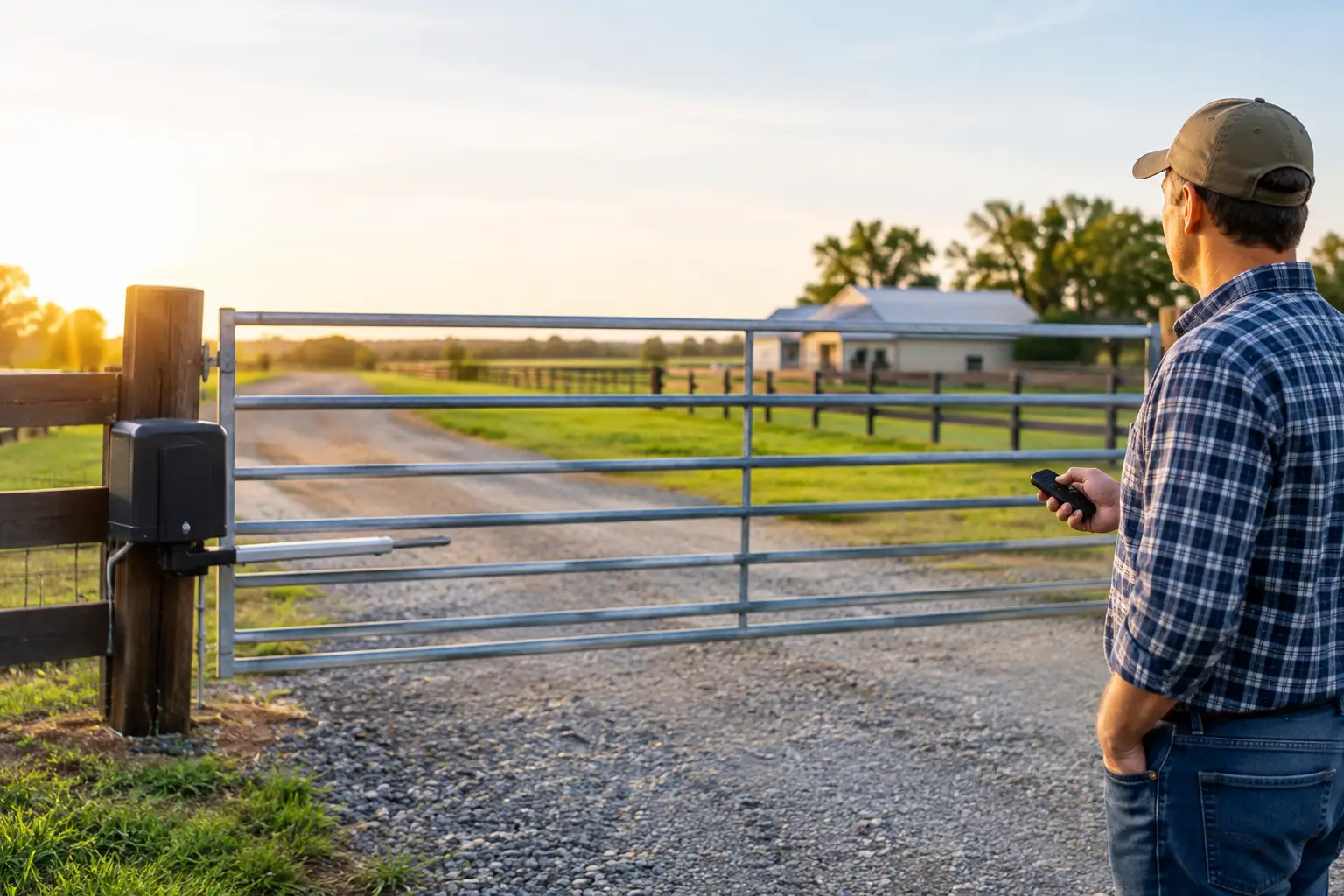
A farm gate that is opened and closed several times a day soon becomes more than an inconvenience. In wet weather, during early starts, or when moving livestock, machinery and deliveries, gate automation for farms can make access safer, quicker and easier to manage. The right system also gives the farm owner proper control over who can enter the property.
Automated gates are not a one-size-fits-all installation. A rural entrance may need to accommodate tractors, trailers, horseboxes, feed lorries and visitors, while also coping with uneven ground, limited mains power and exposed weather conditions. Choosing the right gate type, operator and access controls from the outset avoids costly alterations later.
Why farms benefit from automated gates
Farm entrances are often busy, but they are not always supervised. An automated gate allows authorised people to enter without leaving a vehicle, while helping to deter unauthorised access, fly-tipping and opportunist theft.
For a working farm, convenience matters as much as security. A driver arriving with a trailer does not need to stop on a narrow lane, open the gate manually and then repeat the process once through. Remote controls, keypads, intercoms and mobile-controlled access can all be selected to suit how the entrance is used.
Automation can also support better management of larger sites. Separate access arrangements may be needed for the farmhouse, yard, holiday accommodation, storage areas or commercial units. Instead of relying on a single key shared between numerous people, access can be controlled and changed when required.
Choosing the right gate automation for farms
The best system depends first on the gate itself and the space around it. Existing gates can sometimes be automated, provided they are in good structural condition, correctly hung and suitable for the forces placed on them by an operator. In other cases, replacing an old field or entrance gate is the more dependable long-term option.
Swing gates for traditional entrances
Swing gates are a popular choice for farmhouses, private estates and yard entrances where there is clear space behind the gates. They can suit timber, steel and aluminium gates, and can provide an attractive, traditional appearance without sacrificing practical access control.
Above-ground operators are often suitable where access for future servicing is straightforward. Underground operators offer a more discreet finish, as the mechanism is largely hidden beneath the gate. However, underground systems need careful drainage and preparation, particularly on rural sites where standing water and muddy conditions can be an issue.
A key consideration is the gate’s opening arc. Swing gates need enough clear space to open safely and must not swing out onto a public road, track or pavement.
Sliding gates where space is limited
A sliding gate moves sideways rather than into the entrance, making it useful where the driveway rises behind the gate, space is restricted, or a larger opening is needed for agricultural vehicles. For sites with wide entrances, sliding gates can also be more practical than very large swing gates.
They do require sufficient run-back room at one side of the opening. The track or cantilever arrangement must be planned with the ground conditions in mind. Loose stone, mud, leaves and regular vehicle movements can affect a poorly designed system, so the supporting groundwork is as important as the motor itself.
Access controls should reflect daily use
The most suitable access control is usually determined by who needs to enter and how often. A simple remote-control system may suit a private farm entrance used by family and staff. A keypad can be useful for contractors, tenants or regular delivery drivers, as codes can be changed without collecting keys.
An intercom with audio or video gives the owner the opportunity to speak to visitors before allowing entry. This is particularly useful where the gate is some distance from the house or office. Ground loops can detect a vehicle at the exit, allowing the gate to open automatically as it approaches from inside the property.
For a busy commercial farm or estate, a combination of controls often works best. For example, staff may use remotes, visitors can call through an intercom, and exiting vehicles can trigger a ground loop. The system should be straightforward for regular users, not complicated for the sake of extra features.
Rural power and ground conditions need proper planning
Many farm gate projects are shaped by the available power supply. If there is a reliable mains electrical supply near the entrance, this generally provides the most consistent solution. The electrical installation should be designed and completed correctly for outdoor use, with appropriate protection and cable routing.
Where mains power is impractical or expensive to bring to the gate, solar-powered automation may be considered. Solar can work well for lower-use entrances in open locations, but it is dependent on suitable panel positioning, battery capacity and expected usage. A shaded gateway, frequent operation or winter demand may make mains power the more reliable choice.
Groundworks should never be treated as an afterthought. Gate posts, foundations, cable trenches and drainage all affect the reliability of the finished installation. A gate that is perfectly aligned on day one can become difficult to automate if posts move, ground settles or water is allowed to collect around below-ground equipment.
Before specifying a system, an experienced installer should assess the entrance width, gradient, gate weight, vehicle types, power source and the condition of the existing structure. This site-specific approach is particularly valuable on older farms where entrances have been altered over many years.
Safety is part of the installation, not an optional extra
An automated gate has moving parts and must be installed with safety at the centre of the design. Farm sites can be unpredictable environments, with children, visitors, dogs, pedestrians, animals and large vehicles all using or passing through the entrance.
Safety measures may include photocells, safety edges, correctly adjusted force settings and emergency manual release. These components help the gate detect an obstruction or stop before it creates a hazard. The exact arrangement will depend on the gate design, site layout and how people and vehicles use the entrance.
It is also worth considering what happens during a power cut. A properly installed system should provide a safe manual release method, allowing the gate to be operated when necessary. Farm owners and regular users should know where this release is located and how to use it.
Do not assume that a heavy gate is inherently more secure. An oversized gate with unsuitable automation can create unnecessary strain on the equipment and increase safety risks. The aim is a correctly specified system that operates consistently, closes securely and is easy to maintain.
Planning for agricultural vehicles and deliveries
An entrance that works well for a car may be unsuitable for a tractor and trailer. Before selecting a gate, consider the widest and longest vehicles likely to use the site, including feed deliveries, fuel suppliers, waste collection and emergency services.
The opening width is only one part of the calculation. Turning space, sightlines from the road, gradients and the position of gate posts all affect whether a vehicle can enter without difficulty. Where a lorry has to pause on a road while waiting for a gate to open, operating speed and visibility become especially important.
A useful specification conversation should cover:
- the largest vehicles expected through the entrance
- how often the gate will operate each day
- whether visitors need to call from the gate
- who requires regular access and how this will be managed
- whether mains electricity is available at the entrance
These practical details help avoid a system that looks suitable on paper but causes delays during a busy working day.
Maintenance protects reliability
Automated gates are exposed to daily use and changing weather. On farms, dust, mud, vegetation and debris can build up more quickly than at a typical domestic driveway. Sliding gate tracks should be kept clear, while hinges, moving components and safety devices should be inspected regularly.
Routine servicing helps identify wear before it develops into a fault. It is also sensible to test photocells, safety edges and manual release arrangements periodically. If the gate begins moving unusually slowly, makes unfamiliar noises, stops inconsistently or no longer closes correctly, it should be checked rather than forced to continue operating.
A professionally installed system with quality equipment, suitable groundwork and planned aftercare will generally provide better value than a low-cost installation that has not accounted for the demands of a rural site.
For farm owners across Dorset and the South of England, Crabtree Electrical Gates can assess the entrance, explain the suitable options and provide a clear quotation for a system built around the way the property operates. A conversation at the planning stage can turn a difficult daily gateway into an entrance that works reliably through every season.
0 Comments