
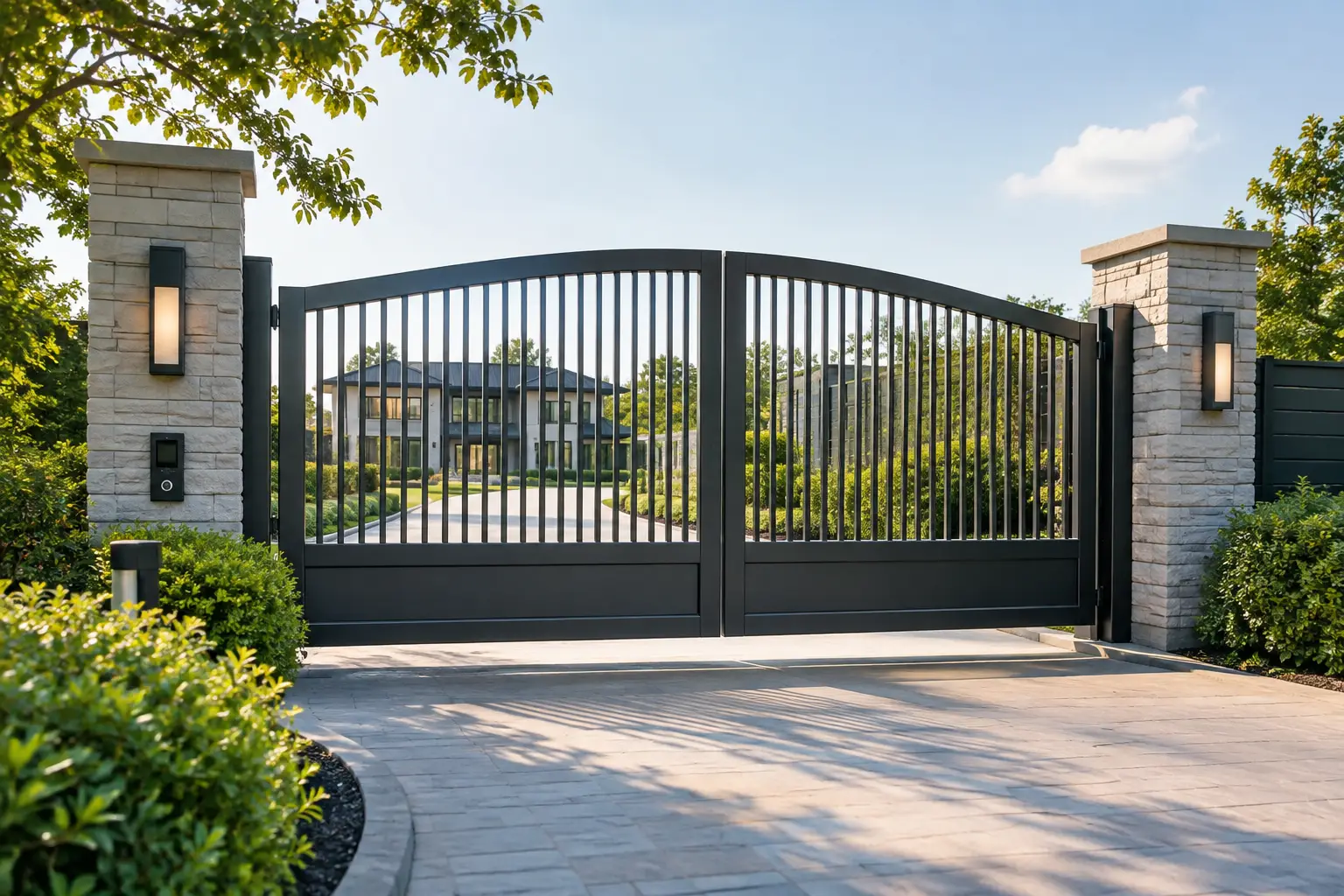
A successful estate entrance gate design does more than make a strong first impression. It has to manage the everyday reality of vehicles arriving and leaving, visitors requiring access, deliveries, changing weather and the safety of everyone using the entrance. For private estates, country homes and commercial sites, the best result begins with the site itself, not a catalogue image.
The right gate should suit the scale and character of the property while providing dependable, controlled entry. That means considering the driveway gradient, available opening space, power supply, vehicle movements and the level of access control required before deciding on a gate style or automation system.
Start with how the entrance will be used
The question is not simply whether a gate should swing or slide. It is how people and vehicles will approach, use and leave the entrance on a typical day.
A private estate may need easy access for residents, regular tradespeople and occasional larger vehicles. A commercial site may need a more structured solution, with authorised staff access, visitor communication and the ability to keep the entrance secure outside working hours. If delivery lorries, refuse vehicles or emergency services need access, the clear opening width and turning space become particularly important.
It is also worth thinking about the location of the gate in relation to the public highway. A vehicle should be able to pull safely clear of the road before stopping at an intercom or keypad. Where this is not possible, access control needs careful planning so that the entrance does not create congestion or an unsafe waiting point.
Choosing the right gate arrangement
Most estate entrances use either swing gates or sliding gates. Both can provide an attractive, secure finish, but the site will normally determine which is the better fit.
Swing gates
Swing gates are a popular choice for driveways with sufficient level space inside the property boundary. They can be designed as a traditional pair of leaves opening from the centre, or as a single leaf where the layout allows. Timber, steel, aluminium and wrought-style designs can all work well, depending on the property.
Their main consideration is the arc of travel. The gate leaves need room to open without meeting rising ground, parked vehicles, walls or landscaping. A steep driveway can make a standard swing gate unsuitable unless the gate design and automation are adapted accordingly. Wind loading also matters, particularly for solid or close-boarded gates in exposed locations.
Sliding gates
Sliding gates are often the practical answer where a driveway slopes upwards behind the entrance, where there is limited depth for opening leaves, or where a wide opening is required. A sliding gate moves parallel with the boundary rather than into the driveway, making it particularly useful for busy entrances and sites with restricted space.
There must, however, be enough clear run-back room along the fence line or wall for the gate to travel. A tracked sliding gate relies on a properly prepared track and surface, while a cantilever gate runs above ground and can be preferable where leaves, gravel, snow or uneven ground could affect a track. Cantilever systems need more space to one side because of their counterbalance section.
The choice should be made after measuring the full approach, opening and run-back area. A gate that looks right in plan can be inconvenient or impractical once the movement of the gate is considered on site.
Materials should match the property and maintenance expectations
Material affects appearance, security, weight, long-term maintenance and the size of automation system needed. There is no single best option for every estate entrance.
Steel gates offer strength and a wide choice of traditional or contemporary detailing. They can be made with open railings, decorative infill or more solid panels for greater privacy. A properly finished steel gate can provide years of service, but its protective coating should be maintained to prevent corrosion, especially near the coast.
Timber gates bring warmth and can suit rural or period properties particularly well. They need suitable treatment and periodic care, as timber naturally responds to moisture and temperature changes. The gate frame, hinges and automation must be specified to accommodate the gate’s weight and potential movement over time.
Aluminium is often chosen for its low maintenance and clean appearance. It is lighter than steel, which can reduce mechanical strain, and it is available in a broad range of finishes. It may be ideal for a modern home, although the final design should still provide the strength, privacy and visual presence the entrance requires.
Masonry piers, brickwork and boundary walls also deserve attention. Heavy gates place significant forces on hinges, posts and supporting structures. Existing piers may look substantial but still require assessment before an automated gate is fitted. New foundations, reinforced posts or purpose-built piers can prevent problems later.
Estate entrance gate design needs proper automation planning
Automation should be selected to suit the gate, not added as an afterthought. The weight, length, frequency of use, exposure to wind and required speed all influence the type and capacity of the motors.
Above-ground ram or articulated arm systems can be a practical option for many swing gates. Underground operators are often selected where a cleaner appearance is wanted, as the motors are concealed below ground. They require careful drainage and installation work, particularly in areas with wet ground or poor natural drainage.
For sliding gates, the motor and rack system must be matched to the gate’s size and duty cycle. A gate used a few times each day has different requirements from one serving a managed estate, business premises or shared development with frequent traffic.
Reliable electrical work is central to the installation. Power supplies, cable routes, isolation and protection should be planned as part of the project. A professional installer will also consider how the system can be released manually during a power cut, ensuring authorised users are not left without access.
Access control makes the gate useful every day
A gate is only as convenient as the method used to open it. The simplest arrangement may be remote controls for a private driveway, but many estate entrances benefit from more flexible access control.
An audio or video intercom allows visitors to call from the entrance before being admitted. Keypads provide a practical option for regular visitors, contractors or staff, while proximity tags and fobs offer quick access without sharing a fixed code. Telephone-based entry systems can allow residents or managers to answer a call from their mobile, which is useful for properties where the entrance is some distance from the house.
For commercial and managed sites, vehicle detection loops can prevent a gate from closing on a departing vehicle and can automate exit where appropriate. Timed access permissions, separate pedestrian gates and integration with existing security arrangements may also be worth considering.
Convenience should not undermine security. Shared keypad codes are easy to pass on, so they may not be the best choice where access needs close control. A combination of intercom access, individual credentials and properly configured safety systems is often more suitable.
Safety and compliance are part of the design
Automated gates are powerful moving machines. A well-designed system must identify and manage risks such as crushing, shearing, drawing-in and impact points around the gate, hinges, posts and adjacent fencing.
Safety measures can include photocells, safety edges, force limitation, guards and carefully designed clearances. The correct measures depend on the gate type and site layout. For example, a sliding gate needs protection around its leading edge and areas where a person could be drawn between the moving gate and a fixed structure.
The entrance should be assessed for pedestrians as well as vehicles. Children, visitors and delivery drivers may not understand how the system works or where it is safe to stand. A separate pedestrian route can be a sensible part of the overall plan, particularly on commercial premises and shared estates.
Professional installation, commissioning and ongoing maintenance are essential. Gates should be checked periodically for wear, damage, alignment and correct safety operation. A gate that becomes stiff, noisy or unreliable should be inspected promptly rather than left until it fails.
Make the entrance feel considered, not overworked
The visual design should complement the building, boundary treatment and surrounding landscape. On a rural estate, simple timber gates between stone or brick piers may feel appropriate. A contemporary property may suit aluminium panels, clean lines and discreet underground automation. For commercial entrances, visibility, controlled access and clear sightlines may take priority over elaborate detailing.
Privacy is another decision that benefits from balance. Solid gates can screen a property effectively, but they are more affected by wind and can create a heavier appearance. Open or partially open designs offer better visibility and may feel more welcoming, although they reveal more of the property beyond.
Lighting can improve the approach and help visitors use access controls safely after dark. It should illuminate the gate, intercom and driveway without creating glare for road users or neighbouring properties. Consider the cabling and controls early, as retrofitting them after the gate has been installed can be more disruptive.
A site survey is the sensible first step for any significant entrance project. Crabtree Electrical Gates can assess the driveway, gate structure, electrical requirements and access controls before recommending a system suited to the property.
A well-planned estate entrance should feel straightforward to use from the first day. When the gate, automation and access controls are chosen around the site rather than forced into it, the result is secure access that continues to work reliably for the people who depend on it.
0 Comments