
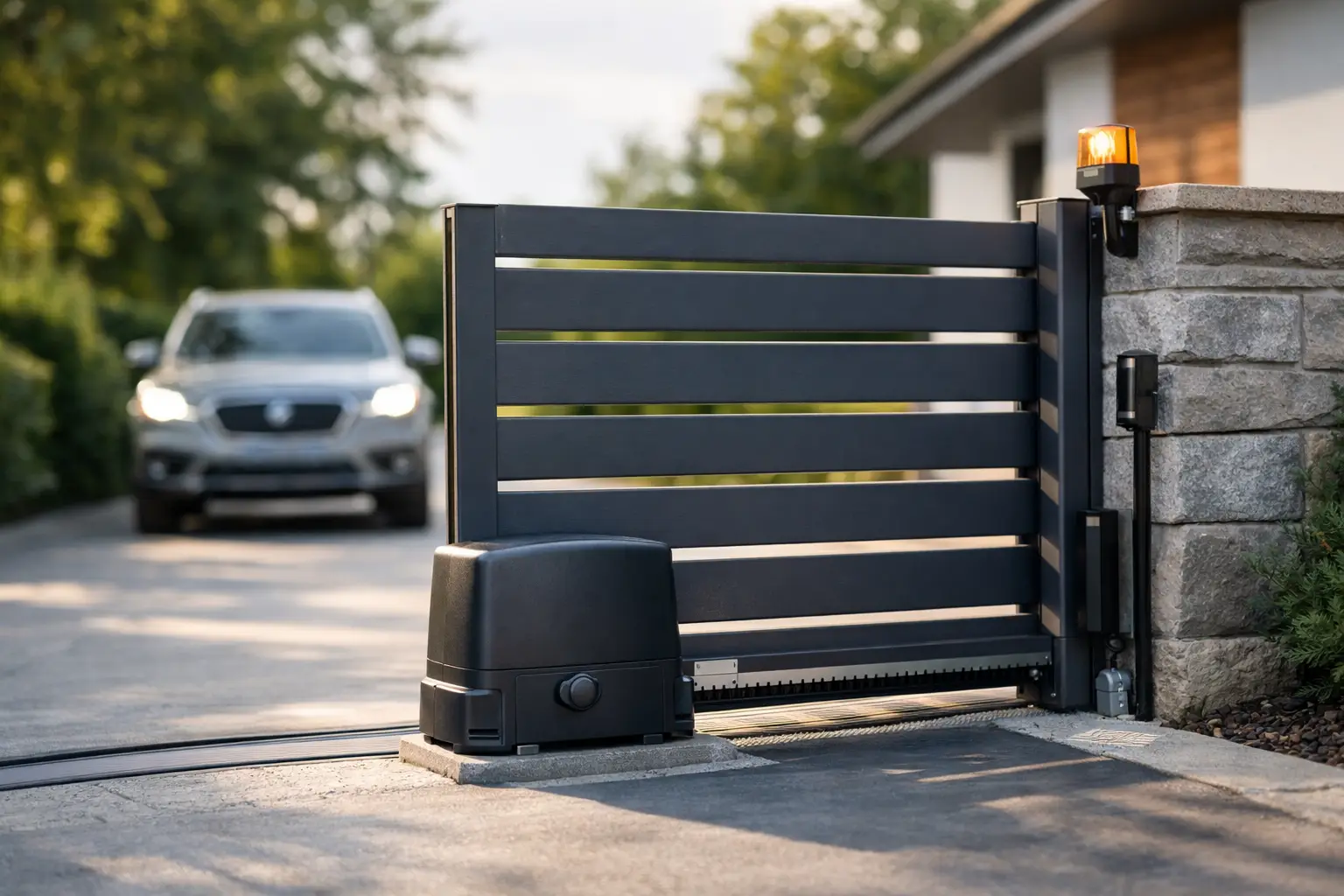
A gate that looks right but stops short of closing in wet weather, catches on a sloping drive or leaves no safe route for a pedestrian soon becomes a daily frustration. Electric gates for driveways need to be selected around the site, the way people use it and the condition of the existing entrance – not simply chosen from a catalogue.
For homes, estates and commercial premises across Dorset and the South of England, a well-planned automated gate gives better control over access without making arrivals complicated. The difference lies in the survey, the electrical work, the safety measures and the quality of the installation.
Start with the driveway, not the gate style
The available space is usually the first deciding factor. A swing gate opens into the property and needs clear room behind it throughout its travel. This can be an excellent choice for a level driveway with adequate depth, particularly where traditional timber or metal gates suit the property.
A sliding gate moves sideways along the boundary instead. It is often more practical where the driveway rises immediately after the entrance, where there is limited space behind the gate, or where a wide opening needs to be secured. It does, however, require sufficient run-back space at the side and a suitable foundation or track arrangement.
Ground conditions also matter. Gate posts, hinges, tracks and motors must be fitted to structures capable of carrying the load. Heavy gates, loose masonry, poor drainage and an uneven surface can all affect performance. Addressing these points before automation is installed is more cost-effective than trying to compensate for them afterwards.
It is equally worth considering how vehicles approach the entrance. A gate positioned too close to the road can leave visitors waiting in traffic while it opens. On a commercial site, lorries, delivery vans and staff vehicles may need different clearance and opening times from a private car. The gate should suit real traffic movements, not an idealised version of them.
Choosing electric gates for driveways
There is no single best arrangement for every property. The right system depends on the gate weight and dimensions, the available opening area, the desired appearance and how frequently it will operate.
Swing gate automation
Above-ground swing gate motors are visible and accessible, making future servicing straightforward. Depending on the gates and posts, articulated arms, linear rams or other suitable operators may be used. These systems can work well on many domestic entrances, provided that the gate geometry and opening space are correct.
Underground motors are a discreet alternative. The drive unit is installed below ground near the hinge point, leaving the gate face clear of visible arms. This is often requested for period homes and higher-end entrances where appearance is a priority. Underground installation requires careful preparation, drainage and access for maintenance, so it should be planned properly rather than treated as a cosmetic add-on.
Sliding gate automation
Sliding gates are suited to sites where a swing gate would conflict with a slope, parked vehicles or limited internal space. A tracked sliding gate runs along a ground track, while a cantilever gate is supported above the driveway and does not need a track across the entrance. Cantilever systems can be useful where debris, gravel or regular water run-off would make a ground track less practical.
Sliding systems need correctly specified motors, foundations and safety devices. A large timber or steel gate has different demands from a lighter domestic gate, and busy commercial entrances may need equipment designed for more frequent cycles. Specifying the motor by price alone is a false economy.
Access control should suit everyday use
Automation is only convenient if the controls make sense for the people using the entrance. A simple handset may be enough for a private driveway, but many properties benefit from an intercom or keypad at the gate. An audio or video intercom lets occupants check who has arrived before releasing the gate, while a keypad can provide controlled access for family members, staff, contractors or regular visitors.
For commercial and shared sites, access may be managed through keypads, proximity fobs, timed settings or telephone-based systems. Ground loops can detect vehicles and trigger opening or exit functions where appropriate. The best approach depends on who needs access, when they need it and whether entry should be recorded or restricted.
Consider the awkward moments as well as normal use. Can a delivery driver contact someone easily? Is there a safe pedestrian route? What happens when a cleaner, gardener or emergency tradesperson arrives? A good installation gives the owner control without creating avoidable delays for legitimate visitors.
Safety is part of the installation, not an extra
Automated gates are moving machinery. They must be designed and installed with suitable safety measures to reduce the risk of trapping, crushing, shearing or impact. This is particularly important at homes with children, properties used by the public and workplaces with regular vehicle movements.
Safety may include photocells, safety edges, force limitation, warning devices and carefully positioned controls. The precise arrangement depends on the gate design and the hazards around it. For example, a wide sliding gate has different risk areas from a pair of inward-opening swing gates, and a pedestrian access point needs its own consideration.
Professional electrical installation is central to safe, reliable operation. Power supplies, cable routing, isolation, earthing and external equipment all need to be assessed for the environment. Outdoor systems face rain, frost, heat, mud and repeated use, so workmanship beneath the surface matters as much as what is visible at the entrance.
A gate should also be capable of manual release if there is a power cut or equipment fault. Property owners need to know how this works, and the release mechanism should remain accessible without compromising security.
Plan for the conditions that cause problems
The South of England has a mix of exposed coastal sites, rural lanes, shaded drives and urban properties. Water management is often underestimated, especially with underground operators and sliding gate tracks. Standing water, leaves, grit and poor drainage can interfere with moving parts and shorten the working life of the system.
Trees and hedges can also affect photocells and gate travel. A gate that works perfectly in winter may meet new growth in spring. If an entrance is exposed to strong wind, the gate structure and automation should be selected with that load in mind. In rural locations, reliable control equipment and sensible cable protection are particularly worthwhile.
Existing gates can sometimes be automated, but suitability must be checked first. They need to be structurally sound, correctly hung and appropriate in weight and movement. Adding motors to a worn gate with loose hinges does not solve the underlying problem. In some cases, repairing or replacing the gate before automation is the more dependable option.
Think beyond installation day
Like any mechanical and electrical system, an automated gate benefits from routine checks and servicing. Hinges, tracks, rollers, safety devices, batteries and control equipment need attention at appropriate intervals. The frequency will depend on use, weather exposure and the type of system.
A domestic gate used a few times a day has different maintenance needs from a commercial entrance operating throughout the working day. Keeping tracks clear, reporting unusual noises promptly and checking that safety devices respond correctly can prevent a small issue from becoming a call-out.
When choosing an installer, ask who will carry out the work, what is included in the quotation and what support is available after handover. It is sensible to look for clear advice, insured work, guaranteed workmanship and an installer with specific electrical and gate automation experience. Crabtree Electrical Gates provides bespoke automation installations for residential and commercial entrances, with systems selected around the property rather than forced into a standard package.
Get a proper site survey before deciding
Photographs and approximate measurements are useful, but they do not replace a visit to the property. A survey allows the installer to assess levels, gate condition, access routes, power requirements, drainage, safety risks and the position of control equipment. It also gives you the chance to discuss how you actually use the entrance each day.
A clear quotation should explain the proposed gate automation, access controls, electrical work and any preparation required. If there are choices between visible and underground motors, swing and sliding operation, or different intercom options, the practical implications should be explained plainly.
The right electric gate is one you barely have to think about: it opens when it should, closes safely, suits the property and gives you confidence over who comes through the entrance. Speak to a specialist before committing to a design, and the finished system is far more likely to serve the property well for years to come.
0 Comments