
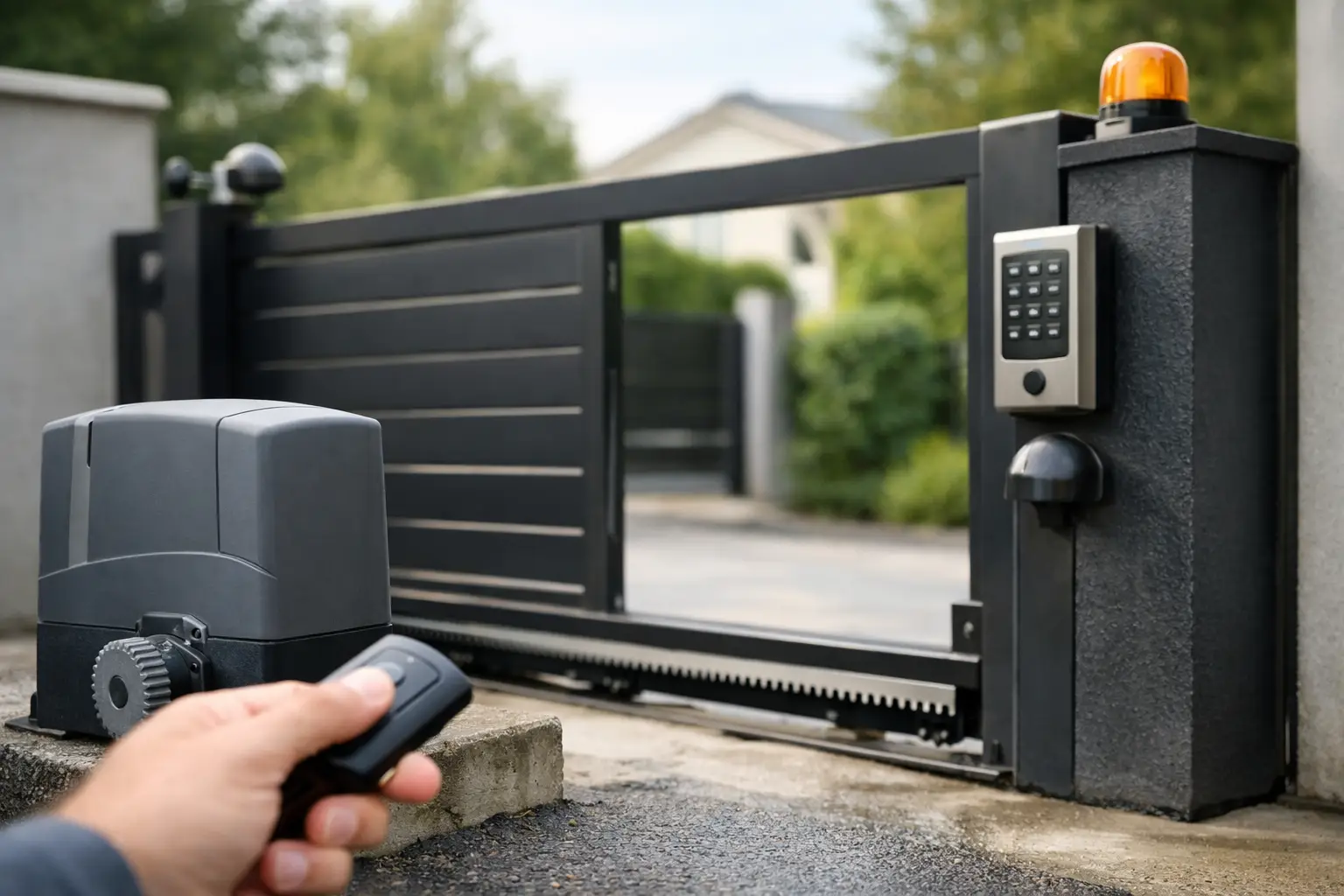
A gate that looks right on a driveway can still be the wrong gate for the site. The available opening width, slope, traffic pattern, power supply and level of security all affect whether an automated system will work reliably. This electric gate planning guide sets out the decisions worth making before installation, helping homeowners, estate managers and commercial operators plan with confidence.
Start with how the entrance will be used
The first question is not whether you prefer swing or sliding gates. It is who needs to enter, how often they enter, and what they are driving. A private home may only need controlled access for family, visitors and deliveries. A business premises may need to manage staff vehicles, customers, contractors, HGVs or emergency access throughout the day.
Consider the approach to the gate as well as the gate itself. Is there enough space for a vehicle to pull safely off the road while waiting? Will a car need to stop on a slope? Is the entrance used by pedestrians, cyclists or children? These details influence the most suitable gate design, safety equipment and access controls.
For commercial sites, it is useful to decide early who should be able to gain entry and at what times. A keypad may suit a small yard with regular staff, while an intercom, proximity fob system or number plate recognition may be more appropriate where visitor access needs managing. Ground loops can also be used to detect vehicles and prevent a gate closing onto a car.
Choosing the right gate layout
Swing gates
Swing gates remain a popular choice for domestic driveways because they provide a traditional appearance and can work well with timber, metal or composite gate leaves. They can be automated with above-ground rams, articulated arms or discreet underground motors.
They do, however, need clear space to open. Inward-opening gates are often preferred where they sit close to a public highway, but the driveway must have sufficient room for the leaves to travel. A steeply rising driveway can make a standard swing arrangement impractical unless the gates and hinges are designed specifically for the gradient.
Underground automation is an excellent option where appearance matters and the customer wants the motors hidden from view. It requires careful groundwork, drainage and servicing access. This added civil work can make it more expensive than surface-mounted operators, but it can be the right long-term choice for high-quality entrance gates.
Sliding gates
A sliding gate moves sideways rather than into the driveway, making it well suited to sites with limited depth behind the entrance or a sloping approach. It is commonly chosen for commercial premises, wider openings and properties where a single gate leaf would be too heavy or cumbersome.
A tracked sliding gate needs a sound, level foundation and a clear run-back area alongside the opening. Cantilever sliding gates avoid a ground track across the entrance, which can be beneficial where leaves, gravel, mud or regular vehicle traffic would otherwise create maintenance issues. The trade-off is that a cantilever gate needs more side space to accommodate its counterbalance section.
The gate itself must be properly specified for automation. Weight, wind loading, frame strength, hinges or rollers, and the condition of existing posts all matter. Adding a motor to an unsuitable manual gate often creates poor operation and unnecessary call-outs later.
Electric gate planning guide: power and groundwork
Reliable automation starts below ground level. Before choosing a motor, a site survey should establish how power will reach the entrance, where control equipment can be housed and what excavation work is needed. Cable routes, ducting, drainage and foundations should be planned together, rather than treated as separate jobs.
Mains-powered systems are normally the most dependable option for frequent use, particularly at commercial sites. The electrical installation must be designed and completed correctly, with suitable protection and isolation. A qualified electrical specialist can assess the route from the property or distribution board and identify whether additional works are required.
Solar-powered gate automation can be useful where bringing a supply to the gate would involve extensive digging or crossing difficult ground. It is not a universal answer. Panel position, seasonal daylight, gate weight, daily cycles and the chosen access controls all affect performance. For a lightly used rural entrance, solar may be practical. For a busy business entrance with intercoms, lighting and frequent opening cycles, mains power is usually the more dependable choice.
Drainage also deserves attention. Underground motors, tracks, control cabinets and cable joints must not be left vulnerable to standing water. Proper drainage and well-finished groundworks protect the system and make future maintenance far simpler.
Plan safety into the system from the outset
Automated gates can cause serious injury if they are poorly designed, incorrectly fitted or fitted without the right safeguards. Safety is not an optional extra to add at the end of the project. It should shape the gate layout, operating method and access arrangements from the beginning.
A professional installation will assess possible trapping, crushing, shearing and impact points. Depending on the gate type and site, protective measures may include photocells, safety edges, force limitation, warning devices, guards and carefully positioned controls. Pedestrian routes should be considered separately, particularly at shared entrances and business premises.
A gate should not be treated like a simple powered driveway feature. It is a moving machine. The correct safety devices depend on the gate, its surroundings and how people use the entrance. This is one reason an on-site survey is more valuable than selecting a package based on gate width alone.
Existing automated gates should also be checked before being reused or altered. Older systems may lack modern safety measures, have worn hinges or tracks, or use controls that no longer suit the property. Upgrading the operator without addressing the gate structure and safety arrangement can leave the underlying problem unresolved.
Select access control that suits daily life
The right access control should make entry easier without weakening site security. For a family home, a video intercom allows occupants to see and speak to visitors before opening the gate. Keypads provide convenient access for trusted visitors, gardeners or tradespeople, although codes should be changed when circumstances change.
Remote controls are simple and familiar, but they need sensible management. Lost or unreturned fobs should be removed from the system where possible, especially after a tenancy change or staff departure. Smartphone-controlled access can be useful for some properties, but it depends on reliable connectivity and the preferences of the people using it.
Commercial sites often benefit from combining methods. Staff may use fobs or keypads, visitors can call through an intercom, and delivery vehicles can be admitted under supervision. A separate pedestrian gate is often worth considering too. It reduces the need to operate the main vehicle gate unnecessarily and provides a clearer, safer route for people on foot.
Allow for maintenance and manual operation
Every electric gate needs periodic servicing. Gates move in all weather, and the parts that carry the greatest load, such as hinges, rollers, tracks, motors and safety devices, need inspecting and maintaining. A planned service can identify worn components or misalignment before they develop into a failure at the entrance.
Ask where the control panel will be located, how the gate can be released manually during a power cut, and who will hold the release key. If the gate is the only vehicle access to a property or site, this is essential practical planning. Battery backup may also be worth discussing where uninterrupted access is particularly important.
For properties across Dorset and the South of England, Crabtree Electrical Gates can assess the entrance, electrical requirements and preferred access controls as part of a tailored quotation. A clear specification at the start helps avoid unexpected changes once groundwork has begun.
Get the right information before committing
A useful quotation should reflect the actual site, not just a broad estimate based on a photograph. Share the opening width, driveway surface, slope, existing gate details, nearby power supply and the type of vehicles that use the entrance. For commercial projects, include expected daily traffic, access hours and any requirement for separate pedestrian entry.
It is sensible to compare more than the headline price. Check what is included for foundations, cabling, safety devices, access control, commissioning and aftercare. A cheaper proposal may omit work that is necessary for a safe, reliable installation. Equally, not every entrance needs the most complex system. The right solution is one that suits the site, the gate and the people who use it every day.
A short site consultation before ordering gates or automation can prevent costly compromises. It gives you the opportunity to plan an entrance that is secure, practical and built to keep working when it matters.
0 Comments