
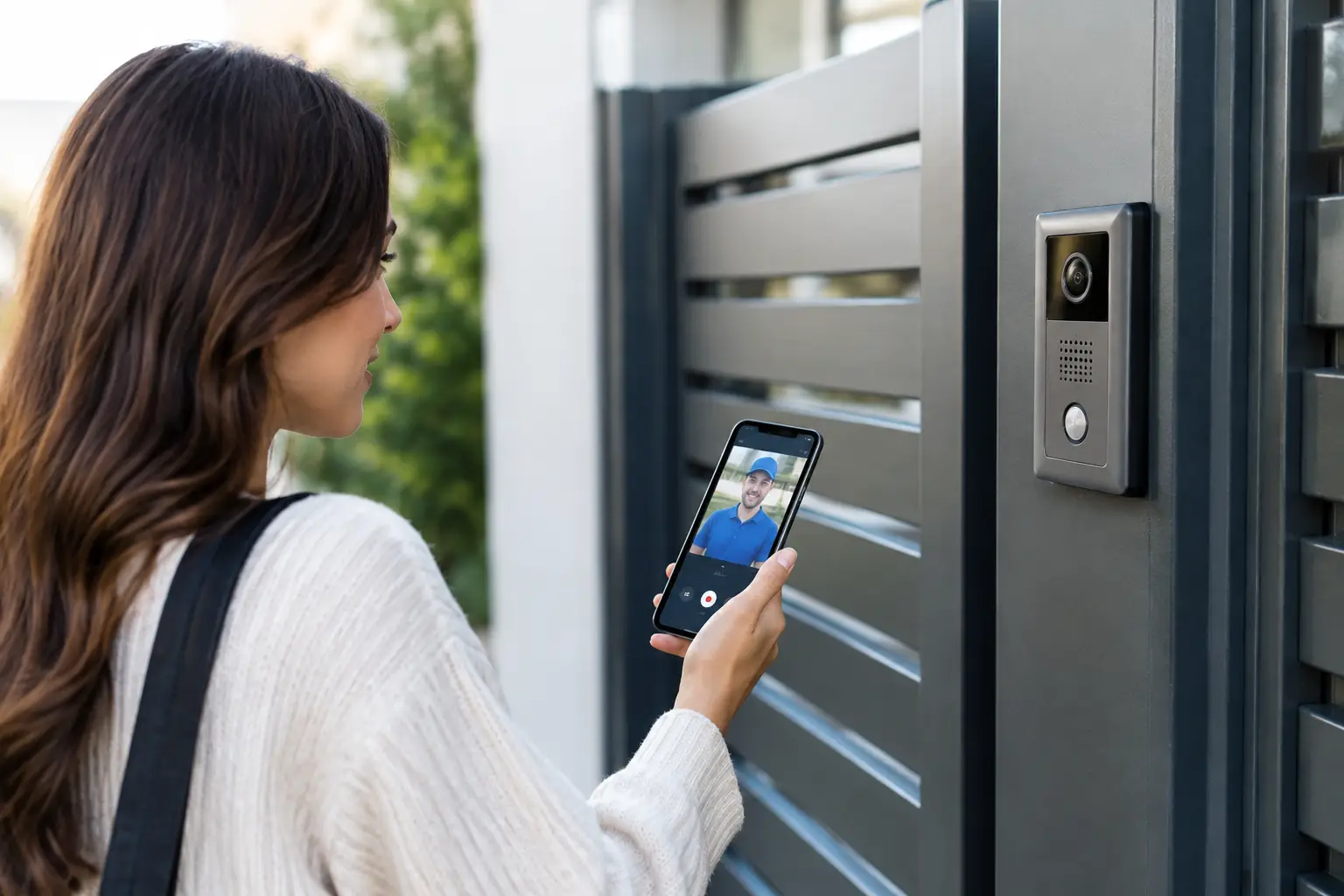
A visitor arrives while you are at work, away on holiday or simply at the other end of a large property. Do gate intercoms work remotely in that situation? Yes, provided the system has the right connection, power supply and installation. A remote intercom can call your mobile phone, show you who is at the gate and allow you to release access from almost anywhere.
That convenience is useful, but it should not be confused with a standard wireless gate control. The performance of a remote intercom depends on the communication method selected and the conditions at the gate. For homes, estates and commercial premises, choosing the right system at the outset avoids unreliable calls, poor video and unnecessary return visits.
How remote gate intercoms work
A gate intercom has an external call panel at the entrance, normally fitted with a call button, microphone, speaker and, on video models, a camera. When a visitor presses the button, the intercom sends a call through a mobile network or internet connection to one or more authorised users.
The recipient can speak to the visitor through a mobile app or telephone call. With a suitable electric gate automation system, they can also send a release command that opens the gate. The gate then operates in the same controlled way as it would from a keypad, fob or internal release button.
The key point is that the opening command is sent to the gate controller, not directly to the gate motor. A properly installed system includes safety devices such as photocells and force limitation, so the gate should not close onto a vehicle, person or obstruction.
Do gate intercoms work remotely over Wi-Fi or mobile signal?
They can work through either connection, although each approach suits different properties.
Wi-Fi and internet-connected intercoms
Wi-Fi intercoms connect to the property’s broadband network. They are often a good choice where the gate is relatively close to the house or a separate wireless link can be installed between the building and entrance. They can provide clear app calling, live video and useful features such as call history or multiple user permissions.
The limitation is range and stability. A router signal that works adequately in a kitchen may be too weak at a gate 50 metres down a driveway, particularly where there are stone walls, mature trees, metal gates or changes in ground level. Extending Wi-Fi to an entrance needs proper planning rather than relying on a basic domestic repeater.
Broadband outages must also be considered. If the internet connection fails, remote app functions may stop until it is restored. A local exit device, keypad, key switch or fob system can ensure regular users are not left without access.
GSM and 4G gate intercoms
GSM or 4G intercoms use a SIM card and the mobile network. When a visitor calls, the unit contacts programmed telephone numbers or connects through an app. This makes them particularly practical for rural driveways, farms, commercial yards and sites where broadband is unavailable at the entrance.
Mobile signal is the deciding factor. Before installation, signal strength should be checked at the exact location of the intercom, not just at the property. In some cases, an external antenna can improve reception. The unit also needs an active SIM arrangement, which may involve a monthly cost depending on the provider and required features.
For many remote locations across Dorset and the South of England, a well-sited 4G intercom offers a dependable solution without the expense of running a data cable over a long distance. It is not automatically the best option, though. Where mobile coverage is inconsistent, a wired or broadband-based arrangement may be more reliable.
What you can do from your phone
The available functions depend on the intercom model and its configuration. At a minimum, a remote system should allow authorised users to answer a visitor and trigger the gate safely. Video models add a live view, which can be valuable where deliveries, contractors or unknown visitors need to be checked before entry.
For a private home, this means you can admit a family member, cleaner or delivery driver while away, without sharing a permanent access code. For commercial premises, managers can give access to approved visitors, check arrivals outside normal office hours and add or remove users as staff arrangements change.
Some systems also allow multiple users to receive calls. This is helpful for shared driveways, managed sites and busy family homes. It is worth agreeing who should receive calls and who has authority to open the gate. Too many users can create confusion, while too few can mean missed visitors.
The practical limits of remote access
Remote access is convenient, but it is not a substitute for sensible security decisions. Opening a gate without seeing the visitor may be acceptable for a known courier or contractor, but less so for an unexpected caller. Video verification, clear site procedures and controlled access permissions matter more on commercial properties and estates.
Power is another consideration. Electric gates and intercoms require a suitable electrical supply. If there is a power cut, the precise behaviour of the gate will depend on the equipment fitted. Options can include manual release, battery backup or a separate access arrangement. This should be discussed before installation, particularly where access is essential for vehicles, staff or emergency services.
A remote intercom also cannot compensate for a poorly designed entrance. If vehicles have no safe place to wait off the road, if the gate opens towards a public highway, or if visibility is restricted, the entire access layout needs consideration. The intercom is one part of a wider gate automation system.
Choosing the right remote intercom for your gate
Start with how the entrance is used. A single household may only need video calling and two or three app users. A business may need numerous users, timed access, a keypad for staff and a record of calls or entry events. An estate manager may need a system that can be administered easily when residents or contractors change.
The gate type also matters. Swing gates, sliding gates and underground automation can all work with remote intercoms, but cable routes, control cabinet space and safety equipment vary. Existing gates can often be upgraded, although older automation may need assessment to ensure it is compatible and operating safely.
The most dependable installations are planned as a complete system. That means considering the gate structure, motors, control panel, safety devices, power, cable runs, signal strength and access controls together. Adding a remote intercom as an afterthought is possible, but it may involve compromises that could have been avoided during the original installation.
Installation and aftercare matter
A gate intercom is exposed to rain, temperature changes, vehicle vibration and regular use. The external panel should be installed at a practical height, protected where appropriate and positioned so visitors can use it without standing in an unsafe place. Cameras need a useful viewing angle and sufficient lighting, especially for evening arrivals.
Cabling should be properly protected, connections weatherproofed and equipment configured before handover. Users should understand how to answer calls, issue a release command, add authorised contacts and use any manual override. For commercial sites, it is also sensible to keep access permissions under review.
Crabtree Electrical Gates installs gate automation and integrated access control for residential and commercial properties, with systems selected around the site rather than a one-size-fits-all package. A site assessment can establish whether Wi-Fi, 4G, hard-wired communication or a combination will offer the most reliable result.
When a remote intercom is the right investment
Remote intercoms are particularly useful when people regularly arrive while the owner or manager is elsewhere. They reduce the need to hand out keys or permanent codes, give greater control over who enters and make a gated entrance more practical day to day.
They are less suitable where there is no dependable mobile or internet connection and no realistic way to improve it. In that case, a conventional audio intercom, keypad, proximity reader or fob-based system may be the better choice. Reliability should take priority over features that look impressive but cannot perform consistently at the entrance.
If you are considering remote gate access, arrange a site visit before choosing the equipment. Checking signal, power, gate condition and daily use at the property will lead to a system that is straightforward to use and dependable when it matters.
0 Comments