
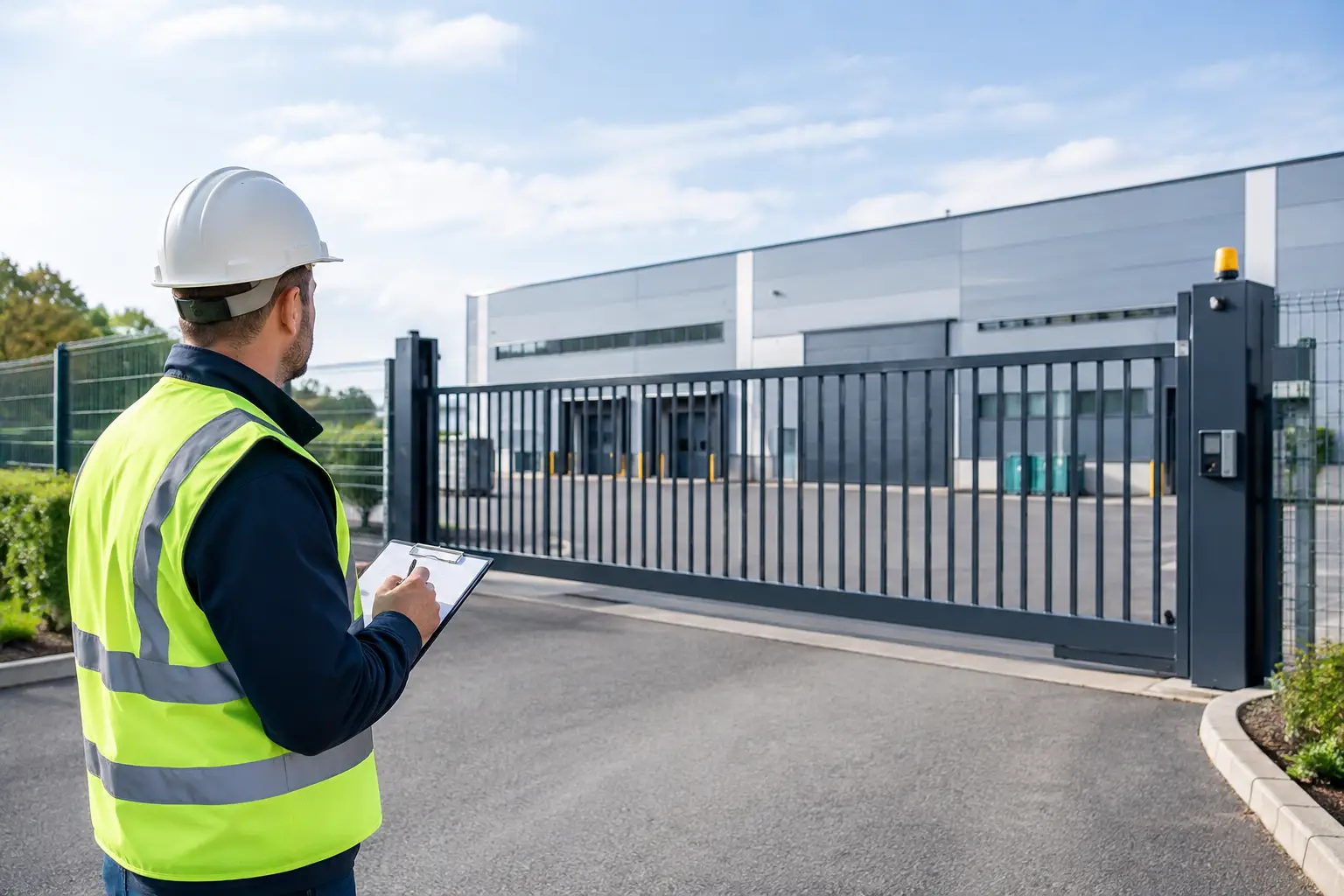
A powered gate at a commercial entrance is more than a security feature. It is moving machinery used by employees, visitors, delivery drivers and contractors, often several times a day. This commercial gate compliance guide explains the practical checks that help commercial sites meet their safety responsibilities before, during and after installation.
The right gate can improve access control, reduce unauthorised entry and keep traffic moving. However, an automated gate that has been poorly specified, installed or maintained can create serious crushing, trapping and impact risks. Compliance starts with treating the gate as part of the wider site safety plan, not as a standalone product.
Commercial gate compliance guide: start with the site
No two commercial entrances operate in quite the same way. A gate serving a private office car park has different risks from one controlling access to a farm, storage yard, school, industrial unit or shared business park. Before choosing the automation, assess how people and vehicles actually use the entrance.
Consider the size and weight of the gate, the available run-back space for a sliding gate, gradients, sight lines and the condition of the driveway. Also look at who may approach it. Staff who use fobs every day understand the system better than a visiting courier trying to enter for the first time. Pedestrians, cyclists, children, wheelchair users and people walking dogs may all be present, even where the entrance is principally for vehicles.
A proper site survey should identify foreseeable hazards and decide how they will be controlled. For a commercial installation, this normally includes:
- crushing and shearing points at hinges, gate posts, rollers and closing edges;
- gaps where hands, limbs or clothing could become trapped;
- the possibility of a vehicle or pedestrian entering the gate’s travel area;
- blind approaches, poor lighting, slopes and uneven ground;
- manual release arrangements during a power cut or emergency; and
- the effect of wind loading, vehicle strikes and everyday wear.
The safest answer is not always to add more devices to an unsuitable gate. In some cases, changing the gate design, relocating controls, creating a separate pedestrian route or selecting a sliding system instead of a swing gate is the better solution.
Know the main UK duties and standards
Commercial gate compliance is based on risk assessment, safe design, correct installation and ongoing management. The precise legal duties will depend on the premises and who controls them, but site operators should be aware of the main framework.
The Health and Safety at Work etc. Act 1974 places general duties on employers and those in control of premises to protect employees and others affected by their activities. Where a powered gate is used at work, the Provision and Use of Work Equipment Regulations 1998, commonly known as PUWER, are also highly relevant. Equipment must be suitable for its intended use, maintained in a safe condition and used by people who have appropriate information and instruction.
New machinery and safety components placed on the market must meet the applicable product safety requirements. A competent installer will consider the current UK conformity requirements and the technical documentation that applies to the complete automated gate system, rather than viewing the motor as the only regulated item.
Relevant British and European standards are commonly used to demonstrate good practice. These include BS EN 12453, covering safety in use of power operated doors and gates, alongside standards relating to construction, installation and testing. Standards can change, and they do not remove the need for a site-specific risk assessment. They provide a recognised route for deciding what safe performance looks like.
For a site owner, the practical point is simple: ask how the finished gate has been assessed as a complete machine. A high-quality motor, photocell or intercom alone does not make an unsafe layout compliant.
Choose safety measures for the real risks
Most commercial automated gates rely on more than one safety measure. The controls must protect people approaching from either side of the entrance and account for the gate’s full travel, not just the final closing movement.
Photocells are widely used to detect a person, vehicle or object breaking a beam across the entrance. They are useful, but a single pair may not cover every danger area, especially on wide entrances, sloping ground or long sliding gates. Safety edges can detect contact at a closing edge or other risk point and command the gate to stop and reverse. Force limitation settings can provide further protection, but they should not be relied upon where a person could be trapped against a fixed object.
The location of activation controls matters as much as the protection devices. A keypad, key switch or intercom should be positioned so users do not have to stand within the gate’s movement area. Vehicle detection loops can prevent a gate closing onto a car, while hold-to-run controls may suit particular lower-use or supervised applications. The correct approach depends on the site, traffic volume and level of public access.
Physical measures are often overlooked. Guarding hinge gaps, covering exposed drive components, fitting suitable fencing and providing a clearly separated pedestrian route can reduce risks before the automation is even considered. Good lighting and clear warning signage also help visitors understand where to stop and how to request entry.
Installation, commissioning and handover matter
A compliant design can still fail if installation and commissioning are rushed. Gate leaves, posts, tracks, foundations and fixings must be structurally suitable for the operating forces involved. Underground automation needs particular care with drainage and cable protection. Sliding gates require a stable track or correctly engineered cantilever arrangement, as well as secure guards around rollers and drive components.
Electrical work must be properly planned, including isolation, earthing, suitable cable routes and protection against damage. On commercial premises, access control may need to work with existing intercoms, barriers, fire procedures or building management systems. These integrations should be tested as part of the completed system.
Commissioning should include functional tests of every safety device and manual release, with measured checks where required to confirm that operating forces are within safe limits. The installer should not simply demonstrate that the gate opens and closes. They should test how it responds when a safety edge is activated, a photocell beam is broken or a vehicle remains in the opening.
At handover, the responsible person should receive operating instructions, emergency release information, test records and relevant declarations or documentation for the installation. They also need to know which checks staff can carry out and when to call a specialist. Keeping this information with the site health and safety records makes future inspections and maintenance more straightforward.
Maintenance is part of commercial gate compliance
An automatic gate can become unsafe gradually. A photocell may move out of alignment, a safety edge can suffer damage, hinges may wear or a closing force may change as components age. A gate that was safe on installation day still needs planned inspection and maintenance.
The frequency should reflect the gate’s use and environment. A busy logistics entrance, exposed coastal site or shared industrial estate will normally need closer attention than a lightly used private staff car park. High winds, grit, standing water and repeated heavy vehicle movements all place additional demands on the equipment.
Between professional service visits, nominated site staff should carry out simple visual checks. They should look for damaged cables, loose covers, unusual noises, bent gate leaves, failed warning lights and obstructions in the gate path. They should also report any collision, even if the gate appears to operate afterwards. A vehicle strike can affect alignment, structural integrity and safety settings.
Staff must know not to bypass safety devices or force a faulty gate to operate. If there is any concern about safe operation, isolate the system where appropriate and arrange inspection by a competent gate automation engineer. Keeping a maintenance and fault log provides evidence that the site is managing the equipment responsibly.
Common mistakes to avoid
One common mistake is treating the gate as a security purchase only. Security matters, but a gate that prevents unauthorised access while creating an avoidable entrapment risk is not a successful installation. Another is adding automation to an old manual gate without checking whether its structure, hinges and clearances are suitable for powered operation.
Commercial operators should also avoid assuming that a remote control system removes pedestrian risk. Someone can still walk through an open gateway, follow a vehicle or approach from the inside while the gate is moving. Finally, do not regard a one-off installation certificate as permanent proof of compliance. The condition, use and surroundings of the gate can all change.
Before committing to a new commercial gate, arrange a site assessment that considers your traffic, access requirements and existing layout. Crabtree Electrical Gates can advise on suitable gate automation, safety measures and access control for commercial properties across the South of England, with a clear handover and ongoing support plan.
0 Comments