
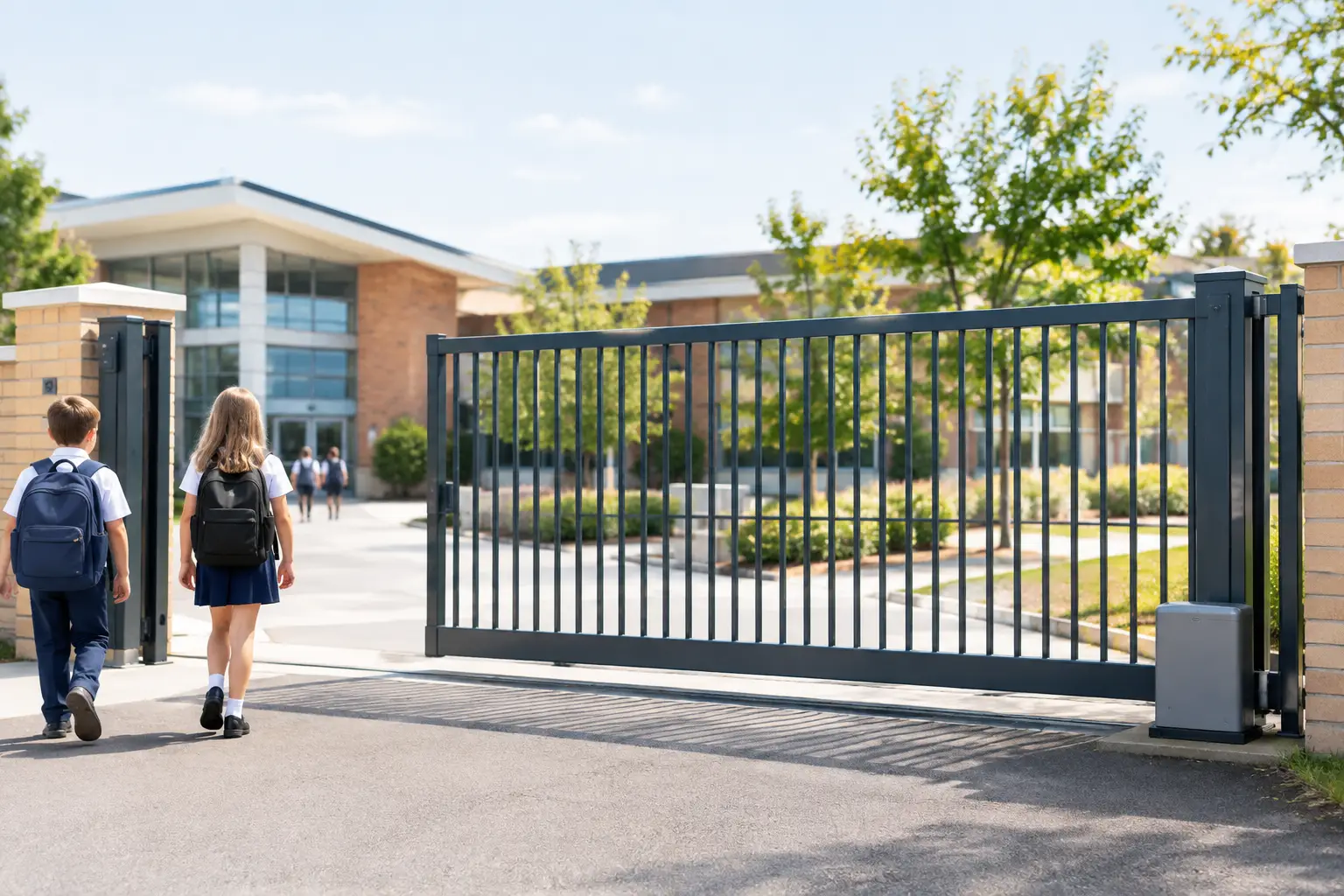
The school gate is one of the busiest and most sensitive points on site. It has to welcome pupils and parents at the right times, allow staff and deliveries through, and prevent unauthorised vehicles or visitors entering when they should not. Automatic gates for schools give site managers far greater control over that daily movement without creating an impractical barrier for the people who need access.
A well-planned system is not simply a gate with a motor attached. It should reflect the layout of the grounds, the number of users, safeguarding procedures, emergency arrangements and the pressures of the school day. Getting those details right is what makes automated access useful rather than troublesome.
Why automatic gates for schools need careful planning
Schools are different from many commercial sites. A warehouse may have predictable vehicle movements and restricted public access throughout the day. A school often has intense arrival and collection periods, visitors with different reasons for attending, pedestrian traffic close to vehicles, and grounds that may be used outside normal teaching hours.
The aim is to create a controlled boundary while keeping the entrance clear, safe and manageable. Automatic gates can be programmed to open and close around set hours, with authorised access available to staff and approved users at other times. This reduces the need for gates to be manually opened or left unsecured when reception is busy.
However, automation cannot replace good site procedures. Reception staff need a clear way to communicate with visitors, staff need to understand how access works, and the school must retain safe pedestrian routes. The gate system should support these arrangements, not dictate them.
Choosing the right gate arrangement
The best type of gate depends on available space, the ground conditions and how vehicles approach the entrance. Swing gates can suit entrances with sufficient clear space inside the boundary. They provide a traditional appearance and can work well for schools where the gate line is set back from the road.
Sliding gates are often a practical option where there is limited room for opening leaves or where a wide vehicle entrance is needed. A sliding gate travels along the boundary, although it requires enough run-back space and a suitable track or cantilever arrangement. For busy access points, this design can offer a clear and controlled opening.
There is no one-size-fits-all answer. A narrow entrance with a steep approach may need a different solution from a large campus with separate staff, visitor and service entrances. The position of existing fences, footpaths, drains, trees and underground services should all be considered before a design is agreed.
Separate pedestrians from vehicles where possible
This is one of the most important decisions for a school entrance. Children should not be expected to share a vehicle gate opening with cars, vans or service vehicles. A dedicated pedestrian gate, positioned alongside or away from the vehicle entrance, gives people a clear route and helps reduce conflict at peak times.
Pedestrian access can be controlled by a fob, keypad, card reader or staff release button, depending on the school’s policy. During arrival and collection, it may be appropriate to keep the pedestrian route open under supervision while the vehicle gates remain controlled. The right arrangement depends on the school’s safeguarding assessment and the way the entrance is staffed.
Access control makes the gate system useful
The automation is only part of the installation. Access control determines who can request entry and how staff verify visitors. A video intercom at the main gate allows reception to see and speak to a caller before releasing the gate. This is particularly useful where the school building is set back from the entrance or where visitors cannot be supervised immediately.
Keypads can be suitable for contractors, regular evening users or maintenance teams, but codes should be managed carefully and changed when necessary. Proximity fobs and access cards are often easier to control for staff because individual credentials can be removed if they are lost or when a member of staff leaves.
For vehicle entrances, ground loops can detect an authorised vehicle that has safely passed through the gate area before it closes. They can also assist with exit arrangements, avoiding the need for staff to leave a vehicle to operate the gate. The exact controls should be based on who uses the entrance, when they use it and the level of oversight required.
Safety is part of the specification, not an extra
Any powered gate must be designed and installed with safety at the forefront. This is especially true in a school environment, where young people may move unpredictably and may not recognise the hazards around moving gates.
A properly specified installation uses measures such as safety photocells, pressure-sensitive safety edges and controlled force settings to help prevent contact or trapping. The gate’s movement, hinge areas, closing edges and adjacent fencing all need consideration. A gate may look secure, but if there are gaps where a hand, arm or person could become trapped, the design needs attention.
The entrance should also remain visible and clearly signed. Site users need to know where to stand, which route to use and what to do if they need assistance. Good lighting can make a significant difference for breakfast clubs, evening activities and winter collections.
Emergency access must be agreed before installation. The school needs a reliable method for emergency services and authorised personnel to enter if normal controls are unavailable. Depending on the site, this may involve agreed release arrangements, monitored access or a separate emergency route. It should never be an afterthought.
Plan for the school day, not just the gate
The morning drop-off and afternoon collection are the real tests of an entrance system. If a gate opens too slowly, queues can form near the highway. If it remains open for too long, the site boundary is less controlled. If visitors, staff cars and delivery vehicles all use the same route at once, even a good gate will not solve the resulting congestion.
A sensible design looks at timings and traffic flow. Staff parking may need a separate controlled entrance. Deliveries may be best restricted to quieter periods. Visitor access can be directed through a single point with an intercom, while pedestrian routes remain separate and obvious.
Schools also need to consider use outside teaching hours. Sports facilities, halls and community spaces may be hired in the evening or at weekends. An automated system can make this easier to manage, but only if the access permissions and closing times are planned properly. Giving every occasional user a permanent gate code is rarely the best long-term approach.
Installation, power and ongoing care
Gate automation relies on sound electrical work as well as correctly fitted mechanical components. The power supply, cabling, control equipment and safety devices must be selected for the location and protected from weather, accidental damage and everyday use. Underground cabling routes should be planned carefully, particularly on older sites where services may not be clearly recorded.
A professional survey will identify practical issues early, including uneven ground, poor drainage, weak gate posts, unsuitable existing gates or insufficient space for safety clearances. In some cases, retaining an old gate leaf may be possible. In others, a new gate designed for automation will be the safer and more reliable choice.
Like any electrical and mechanical system, school gates require regular inspection and maintenance. Leaves can move out of alignment, tracks can collect debris, safety devices can be knocked or obscured, and frequent operation places wear on moving parts. Planned servicing helps identify problems before they cause a failure at a busy entrance.
Schools should also nominate people who know how to use the manual release safely should there be a power failure or equipment fault. That does not mean staff should be expected to repair the system. It means there is a clear, documented process for keeping the site accessible and secure until an engineer attends.
A gate system should give staff confidence
For estate managers and school leaders, the value of automated gates is not limited to keeping vehicles out. It is the confidence of knowing that entry is controlled, visitors can be checked, staff are not repeatedly leaving reception to open gates, and the site boundary is managed consistently.
Crabtree Electrical Gates can assess school and commercial access requirements across Dorset and the South of England, including gate automation, intercoms, keypads and vehicle detection systems. Every site should be surveyed on its own layout and operating needs, with safety and practical day-to-day use considered from the outset.
The most helpful starting point is to walk the entrance at drop-off or collection time and watch how people, vehicles and visitors actually move. That real-world picture will usually show where better control is needed and what a properly planned gate system must achieve.
0 Comments