
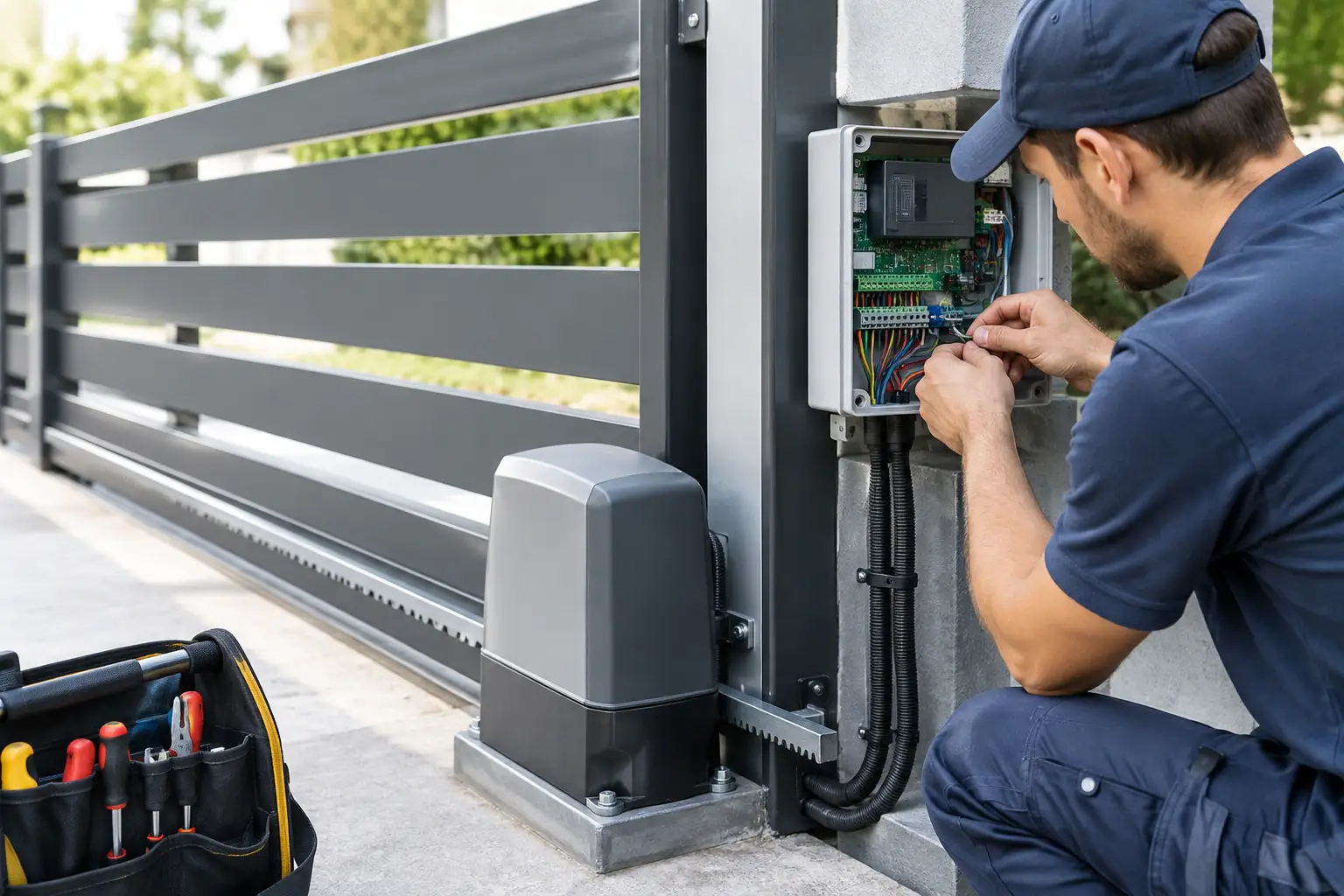
A gate may look like a straightforward addition to a driveway or site entrance, but the wiring behind it determines how safely and reliably it works. This automatic gate wiring guide covers the key electrical and control considerations for a professionally installed system, from the incoming supply to safety devices and access control.
Every property is different. A pair of swing gates on a rural Dorset driveway has different cable routes, operating forces and access requirements from a sliding gate protecting a commercial yard. Good wiring design starts with the gate, the site and the people who will use it – not with a one-size-fits-all cable plan.
Start with the gate system and site survey
The automation equipment must suit the gate structure before wiring is considered. Gates need to be sound, correctly hung or tracked, and able to move freely by hand. An operator is not designed to disguise poorly aligned hinges, a dragging sliding gate or inadequate foundations.
A site survey establishes where the control panel will sit, how power can reach it, where the gate motors are located and which safety devices are needed. It should also account for drainage, vehicle movements, pedestrian routes and future additions such as an intercom, keypad, lighting or ground loop.
For domestic installations, the control cabinet is often positioned close to one gate post or within a secure nearby location. On larger commercial sites, it may make more sense to locate the controls where they can be protected and accessed for servicing, while allowing practical cable runs to motors, photocells and entry equipment.
The shortest route is not always the best route. Cables must be protected from damage, installed at appropriate depths where buried, and kept clear of areas likely to be excavated later. Planning this at the beginning avoids lifting finished paving or crossing a driveway twice to add an overlooked safety device.
Power supply and isolation
An automated gate requires a suitable, dedicated electrical supply. The precise arrangement depends on the equipment, distance from the property supply, load requirements and the installation environment. The work must comply with current electrical requirements and be tested properly once complete.
A local means of isolation is essential. It allows the automation system to be safely disconnected for maintenance, fault finding or repair without affecting unrelated circuits in the property. The control equipment also needs suitable protection against electrical faults and, where appropriate, protection from power surges.
Outdoor electrical equipment faces rain, condensation, temperature changes and the occasional insect making its way into a cabinet. Enclosures, cable glands and junction points must be selected and installed for their location. A neat-looking installation is useful, but weather resistance and long-term accessibility matter more.
It is also worth considering mains failure. Most gate operators include a manual release so the gate can be moved by hand when power is unavailable. Battery back-up may be appropriate where access cannot be interrupted, although it adds cost and requires occasional checking. Commercial premises may need a more detailed plan for staff, deliveries and emergency access during an outage.
Automatic gate wiring guide: motors and controls
The control panel is the decision-making point of the system. It receives commands from remotes, keypads, intercoms or push buttons, checks the safety inputs and instructs the motors to open, close or stop. Its position should allow an engineer to inspect it without climbing over gates or working in an exposed location.
Motor cables should be correctly sized for the equipment and the cable length. Voltage drop can become a problem on longer runs, particularly on larger properties or where a sliding gate motor is set well away from the electrical intake. Using the wrong cable may lead to poor performance, intermittent faults or shortened motor life.
Cables should be clearly identified at the control panel and at accessible junctions. This saves time during servicing and makes future alterations safer. It is particularly valuable on sites with several access points, multiple gate leaves, intercoms and vehicle detection equipment.
For swing gates, each operator needs its own protected route back to the controls. Underground operators require particular care: their foundations, drainage and cable entry points must be dealt with correctly before the driveway surface is completed. For sliding gates, the motor, limit arrangements and any safety edges need wiring that will remain protected from movement, weather and impact.
Safety devices are not optional extras
An automatic gate can create trapping, crushing and impact risks. Safety must be designed around the whole gate movement, including hinge areas, closing edges, gaps near posts and the path used by pedestrians. The correct combination depends on the gate type, its size, force and surroundings.
Photocells are commonly used to detect a person, vehicle or object in the gate opening. They should be positioned so they protect the relevant risk area rather than simply being fitted wherever is easiest. A vehicle could be protected in the clear opening while a pedestrian remains exposed near a closing edge, so one pair of photocells is not always enough.
Safety edges are often needed where a gate could trap someone against a fixed surface or where a moving edge presents a foreseeable risk. They stop or reverse the gate when activated. Induction loops can also prevent a gate from closing onto a vehicle and can provide convenient exit control without a remote.
The control panel must be configured so a damaged cable, blocked photocell or failed safety device causes a safe response. Bypassing a safety input to get a gate moving again is not a repair. It may leave the property owner responsible for operating an unsafe machine.
A professional installer will assess the likely users of the entrance. That includes children, visitors, delivery drivers and members of the public where a gate is close to a pavement or shared access. Warning signs may be appropriate, but they do not replace suitable physical safety measures.
Wiring access control equipment
The most useful gate is one that gives the right people access without creating unnecessary inconvenience. A simple residential system may use remote controls and a keypad. A larger home might benefit from a video intercom at the entrance, while a commercial site may require fob access, timed operation, ground loops and a managed exit button.
Intercom wiring deserves careful planning. The entrance panel needs a clear position for visitors, while the internal handset, monitor or network equipment must be convenient for the building occupants. Cable routes should be allowed for before driveways, landscaping and walls are finished.
Access control should work with the gate safety logic rather than around it. A keypad command can request opening, but it must not allow the gate to close when detection equipment identifies an obstruction. Where emergency services, refuse collection or regular contractors need access, agree the access method early. A lock box, programmed control or authorised keypad code may be more reliable than leaving gates open.
Testing, commissioning and handover
Wiring is only one part of a safe installation. Before handover, the gate must be tested through its full travel and under realistic operating conditions. Motor direction, opening and closing limits, force settings, photocells, safety edges, remotes, intercom functions and manual release should all be checked.
Testing should include deliberate activation of every safety device. A gate that opens perfectly is not necessarily safe to close. The installer should verify that it stops or reverses as intended when a photocell beam is interrupted, an edge is pressed or a vehicle loop is occupied.
The property owner should be shown how to operate the controls, use the manual release and recognise a fault indication. Keep remotes and override keys secure, particularly on commercial premises or rental properties where staff and access arrangements may change.
Plan for servicing from day one
Automated gates are exposed mechanical and electrical systems. Hinges, rollers, tracks, operators, safety devices and control equipment all benefit from planned servicing. Leaves and debris can affect photocells; settling ground can alter alignment; and a minor impact from a vehicle can damage a safety edge or cable without immediately stopping the gate from moving.
Regular inspection helps identify these issues before they become an access problem or safety concern. The right service interval depends on how frequently the gate operates, its size, the equipment installed and whether the entrance is domestic or commercial.
Crabtree Electrical Gates provides specialist gate automation and access control installations across Dorset and the South of England, with wiring and safety considerations assessed as part of the wider installation. A site visit and clear quotation give you a practical route to a system that suits the property rather than an off-the-shelf arrangement.
A well-planned installation gives you more than a gate that opens by remote control. It gives you controlled access, dependable operation and the confidence that the electrical and safety systems have been considered properly before the first cable goes into the ground.
0 Comments