
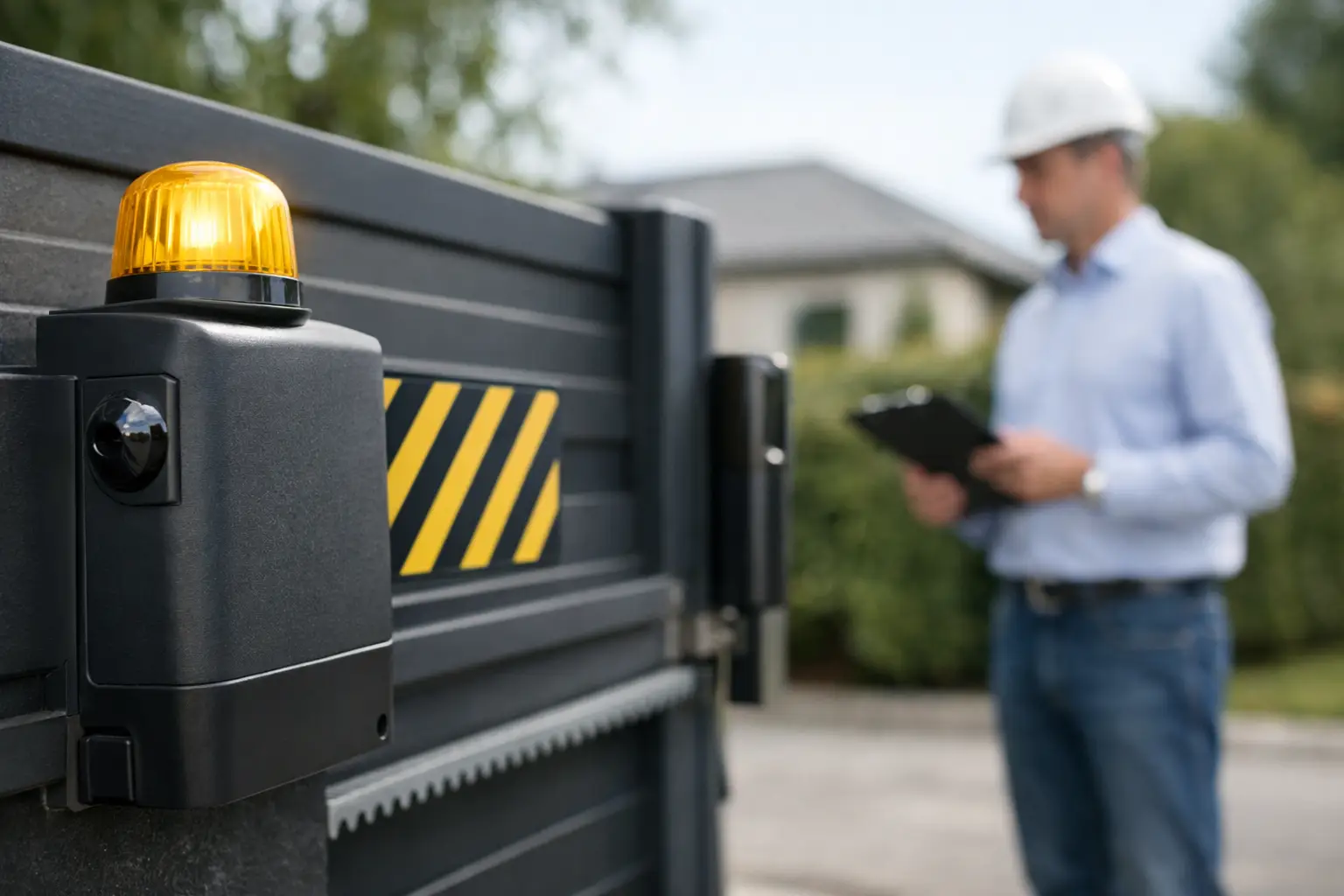
A powered gate can weigh several hundred kilograms and close with considerable force. That is why automatic gate safety regulations are not a paperwork exercise to deal with after installation. They shape how a gate is designed, automated, tested and maintained from the outset.
For homeowners, the priority is protecting family members, visitors and delivery drivers. For commercial premises, there is also a duty to manage risks to staff, contractors and the public. A well-specified system provides controlled access without creating avoidable hazards at the entrance.
What Automatic Gate Safety Regulations Cover
In the UK, there is no single piece of legislation that applies only to electric gates. Safety is instead governed by a combination of product safety law, health and safety duties, electrical requirements and recognised British and European standards.
The standards most often associated with automated gates include BS EN 12453, which addresses safety in use for power-operated doors and gates, and BS EN 12445, which covers methods for testing protective devices and operating forces. Other relevant standards may apply depending on the gate type, controls, electrical supply and access arrangements.
The key principle is straightforward: an automated gate must be assessed for the risks it presents and fitted with suitable measures to reduce those risks. A gate that operates smoothly is not necessarily a safe gate. The design must account for movement, force, trapping points, the people likely to use the entrance and how the system could fail.
Where a new automated gate is supplied and installed as a complete system, the party placing that finished machine into service has responsibilities for conformity, technical documentation, safety testing and declarations. If an existing manual gate is automated, the installer must consider the whole completed system rather than treating the motor as an isolated addition.
A Risk Assessment Must Come Before Installation
Every driveway and site entrance is different. A swing gate opening towards a road raises different concerns from a sliding gate at a warehouse, while a rural property with irregular visitors may need a different access arrangement from a managed residential development.
A proper assessment considers the gate structure, its condition, hinge or track arrangement, available run-back space, surface levels and the position of walls, posts and fencing. It also looks at how pedestrians, vehicles, children and cyclists may approach the gate.
Particular attention should be paid to areas where someone could be crushed, sheared, drawn in, trapped or struck. Common examples include the closing edge of a swing gate, the gap between a sliding gate and its support post, exposed rollers, hinge areas and the space behind a sliding gate as it opens.
It is not enough to assume that users will keep clear. Safety measures need to work for someone who is distracted, unfamiliar with the site or unable to react quickly. That is especially relevant where gates are close to a pavement, public highway or shared access route.
Safety Devices Are Selected for the Site
Most compliant automatic gates use more than one safety measure. The exact combination depends on the risk assessment and gate layout, but a professionally installed system may include safety edges, photocells, light curtains, guards and correctly set force limitation.
Safety edges are pressure-sensitive strips fitted to a gate edge or another danger point. If the edge meets an obstruction, it signals the operator to stop and reverse. They are particularly useful where a physical gap or closing edge cannot be protected by photocells alone.
Photocells create an invisible beam across an opening. When something breaks that beam, the gate should not close or should stop, depending on its programmed function. They are useful for detecting vehicles and people passing through the entrance, but a single pair may not identify every hazardous position. Their location and coverage matter.
Light curtains use several beams and can provide more comprehensive protection over a larger area. On some installations, they are the more suitable choice where the risk level is higher or the gate geometry is complex.
Guards and covers are equally important. A gate may need mesh, infill panels, roller covers or other physical protection to stop fingers, hands or clothing reaching hazardous moving parts. The correct solution depends on the gate construction. Adding automation to an older open-bar gate, for example, can expose risks that were less significant when it was manually operated.
Force Testing Is Not Optional
A gate should not rely solely on its motor’s built-in obstruction detection. Electronic force limitation is useful, but it does not remove the need for appropriate protective devices where a person could be trapped or crushed.
Following installation, the operating forces should be measured with suitable testing equipment at relevant points in the gate’s travel. This confirms whether the system is operating within the limits expected by the applicable standards and identifies whether adjustments or additional protection are required.
Testing should cover realistic operating conditions, including the gate opening and closing, not just a quick demonstration from a remote control. The installer should also check that emergency release mechanisms work correctly, safety devices stop or reverse the gate as intended, and manual release can be used safely if power fails.
A professionally completed installation should be handed over with clear operating instructions, safety information and records appropriate to the system. Keep these documents. They are useful for future servicing, fault finding, property sales and demonstrating that the installation was approached correctly.
Electrical Work and Controls Need Careful Planning
Gate automation is an electrical installation as well as a moving machine. The supply, isolation, earthing arrangements, cable protection and control equipment must be suitable for outdoor use and the conditions at the property.
Access controls should be planned with safety in mind. An intercom, keypad or fob reader is usually positioned so the user does not need to stand in a danger area to operate the gate. Vehicle loops can help prevent a gate closing onto a vehicle, but they are not a substitute for pedestrian protection.
Emergency stop controls may be appropriate in commercial and higher-risk locations. Any release key, control cabinet or manual override should be accessible to authorised users without encouraging unsafe operation. For sites with regular deliveries, it is worth considering how drivers will enter, exit and communicate without leaving vehicles in an exposed position.
Existing Automated Gates Need Ongoing Attention
Safety responsibilities do not end when the installation is complete. Weather, ground movement, vehicle contact and general wear can affect a gate’s performance over time. A photocell can become misaligned, a safety edge can be damaged, hinges can develop play and a sliding track can collect debris.
Property owners and duty holders should arrange regular maintenance at intervals suited to how often the gate is used and the conditions it works in. A busy commercial entrance will usually need more frequent inspection than a lightly used private driveway. Any fault involving safety devices, unusual movement, impact damage or inconsistent operation should be investigated promptly.
Users should never bypass photocells, disconnect safety edges or increase force settings simply to keep a troublesome gate operating. A gate that repeatedly reverses, stops unexpectedly or catches on the ground is signalling a problem that needs proper diagnosis.
When an Upgrade Becomes a New Safety Responsibility
Replacing controls, changing an operator, fitting a new gate leaf or adding automation to a manual gate can alter the safety of the complete installation. The more substantial the change, the more important it is to reassess the system as a whole.
This is where specialist electrical and gate automation knowledge matters. A gate operator may be capable of moving a particular weight, but that does not confirm the gate structure is sound, the trapping risks are addressed or the protective devices are adequate. Compatibility on paper is only one part of a safe installation.
Crabtree Electrical Gates assesses the gate, automation and access control arrangement together, helping residential and commercial customers across the South of England choose a practical solution that does not compromise safety.
Choosing the Right Installer
Ask how the installer will assess risks, what safety devices they expect to use, whether force testing will be carried out and what handover documentation you will receive. For an existing gate, ask whether the structure and surrounding area will be inspected before automation is recommended.
The lowest quote can become expensive if key safety measures are omitted or an unsuitable operator is fitted. A clear, site-specific proposal is more valuable than a generic package because it explains what is being installed and why.
A safe automated gate should feel straightforward to use. If you are planning a new installation or concerned about an existing gate, a professional site assessment can identify the practical improvements needed before a minor issue becomes a serious safety risk.
0 Comments