
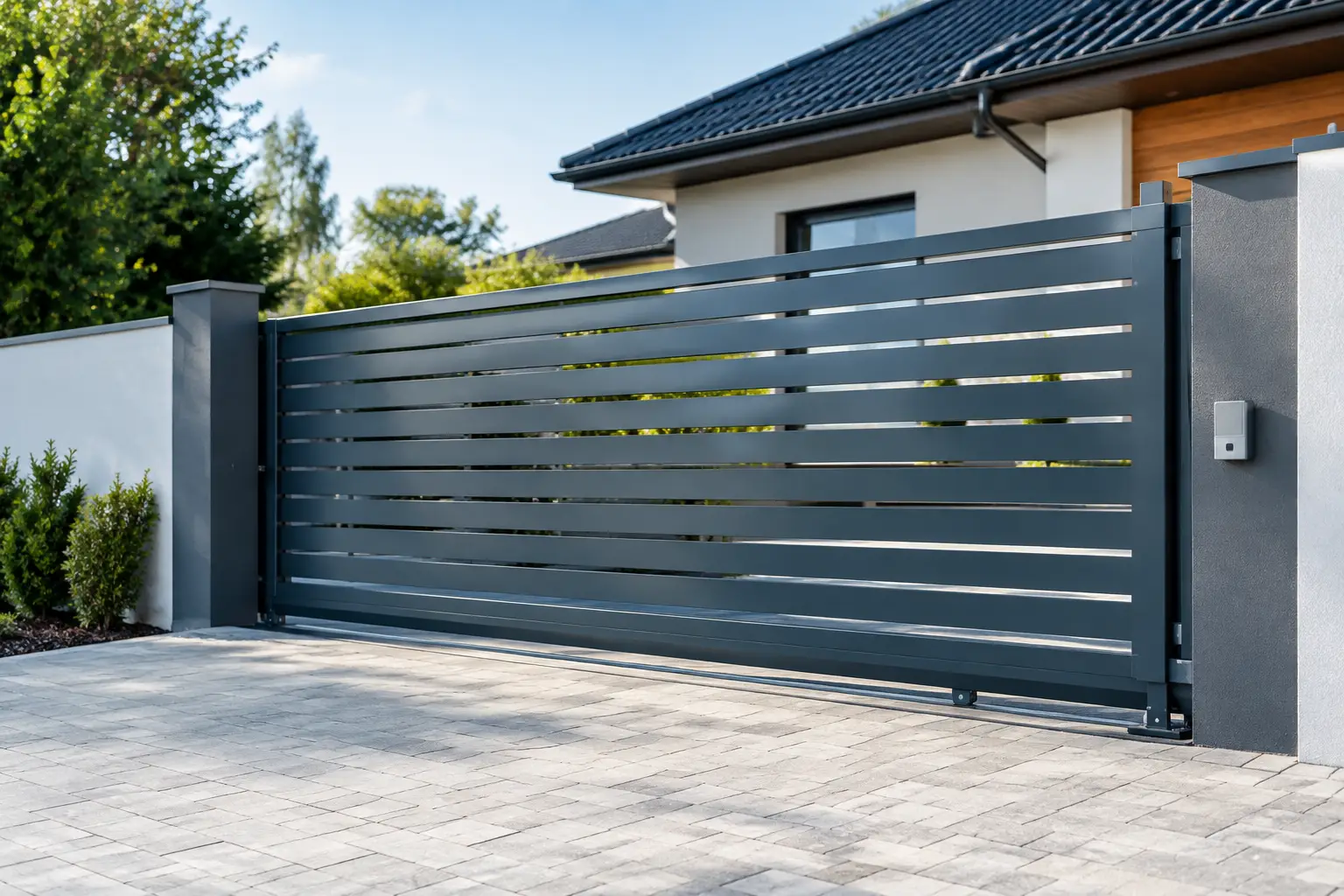
A gate that swings into a sloping drive, catches the wind or blocks a vehicle waiting to enter soon becomes more than a minor inconvenience. Sliding gates provide a practical alternative where controlled access, security and dependable daily operation matter. For homes, estates and commercial premises, they can create a secure entrance without requiring the clear arc of space needed by a swing gate.
The right system is not simply a matter of choosing a gate panel and adding a motor. Ground conditions, available run-back space, the gate’s weight, traffic levels and safe operation all need to be considered before installation. A properly specified sliding gate should feel straightforward to use, while being designed around the way your property actually operates.
How sliding gates work
Sliding gates travel horizontally alongside a fence line, wall or boundary rather than opening into or out of a driveway. When the gate opens, it needs clear space to one side of the entrance. This is known as the run-back area, and it is one of the first points to assess during a site survey.
Most domestic installations use either a tracked system or a cantilever system. A tracked gate runs on wheels along a rail fixed into the driveway, with guide hardware holding the gate upright. It is a familiar and cost-effective arrangement where the driveway surface is level and can be kept clear.
A cantilever gate is supported above ground and does not run on a track across the entrance. This can suit sites where loose gravel, leaves, mud, snow or regular vehicle movements could interfere with a ground track. Cantilever gates usually require a longer overall gate structure and substantial supporting foundations, so they need suitable room and careful structural planning.
Both arrangements can be automated using an electric sliding gate operator. The motor engages with a toothed rack fitted to the gate and moves it at a controlled speed. Quality automation is selected to suit the gate’s size, weight and expected use, rather than simply being chosen on price.
When a sliding gate is the better option
Sliding gates are particularly useful where a driveway rises towards the property. A swing gate can be difficult to operate across a slope without changes to the entrance level or specialist hinge arrangements. Because a sliding gate moves sideways, it avoids this issue.
They also work well at entrances that need to remain clear. A business park, yard, managed estate or busy private drive may not have room for gate leaves opening into the access route. A sliding gate keeps its movement within the boundary line, provided there is adequate side space.
For wider entrances, a single sliding gate can often be more practical than two very large swing leaves. It can provide a clean, controlled opening for cars, vans and service vehicles. The appearance can be tailored to the property too, from timber infill and traditional metalwork to contemporary aluminium or composite designs.
There are trade-offs. A sliding gate is not the automatic answer for every property. If there is no usable run-back space, a swing gate, bi-folding gate or another access solution may be more appropriate. Narrow boundaries, sharp bends close to the entrance and heavily landscaped sides of a drive can all limit what is possible.
Security is more than the gate itself
An automated gate controls vehicle entry, but its effectiveness depends on the wider system. A well-designed installation considers how visitors request access, how authorised users enter, what happens when a vehicle is near the gate and how the system performs during a power interruption.
For a home, this may mean remote controls combined with an intercom at the entrance. For a commercial site, a keypad, proximity control, GSM calling system or vehicle ground loop may offer better day-to-day management. Ground loops detect a vehicle and can be configured to prevent a gate closing onto an authorised vehicle or to allow exit without a remote control.
The choice should reflect the people using the entrance. A family home has different requirements from a site with staff, deliveries, contractors and out-of-hours access. It is often better to establish these routines at the start than add unsuitable access equipment after the gate has been fitted.
Visible security can also act as a deterrent. A substantial, correctly installed gate makes the boundary clear and signals that access is controlled. However, the gate should be considered alongside fencing, lighting, CCTV and the wider layout of the property rather than treated as a standalone security measure.
Safety must be built into the installation
Electric gates are powerful moving systems. Safety cannot be an optional extra or left to a final adjustment on commissioning day. A sliding gate needs appropriate safety devices and control settings so that it can detect an obstruction and stop or reverse as required.
The exact measures depend on the gate and site, but may include photocells, safety edges, force limitation, warning lights and protected areas around moving components. Attention is also needed around the closing edge, the run-back section, rollers, rack and any gaps where fingers could be trapped.
This is especially relevant at properties used by children, visitors or members of the public. Gates should not be relied upon as play equipment, and controls should be positioned so that users can operate the system safely. A professional installer will assess foreseeable risks rather than fitting a standard arrangement to every entrance.
Regular maintenance matters too. Leaves and gravel around a track, impact damage, poorly aligned guides and worn hardware can affect reliable movement. Periodic checks help identify faults before they become a security issue or lead to unnecessary strain on the operator.
What a professional installation involves
A reliable automated gate begins with a detailed survey. This establishes the width of the entrance, ground levels, available run-back distance, gate construction, services, drainage and the position of the electrical supply. It should also account for the type and frequency of vehicles using the entrance.
Groundworks are often a significant part of the project. Tracks, posts, cantilever foundations and motor bases must be secure and properly aligned. The gate can only run as well as the structure supporting it. Drainage is also worth considering early, particularly where water could collect around a track or electrical equipment.
The electrical work should be planned as part of the installation, not treated as an afterthought. Cabling may be needed for the gate motor, safety equipment, intercom, keypad, lighting and exit controls. A tidy, protected installation makes future testing, maintenance and fault finding far easier.
Once the gate and automation are installed, the system is commissioned and tested. This includes setting limits, checking safety devices, confirming manual release operation and showing the owner how to use the controls. You should understand what to do in a power cut, how to release the gate manually and who to contact if the system develops a fault.
Crabtree Electrical Gates installs automated sliding gate systems and integrated access control for domestic and commercial properties across Dorset and the South of England. The focus should always be on a system that suits the entrance, is electrically sound and can be supported properly after installation.
Choosing a gate that will last
The material and construction of the gate affect both appearance and performance. A heavier timber-clad gate may look excellent at a country property, but it needs the right frame, rollers or cantilever hardware and motor capacity. Lightweight aluminium can offer a lower-maintenance contemporary option, while steel can provide strength and design flexibility when correctly protected against corrosion.
Do not choose solely by the opening width. A gate’s height, infill, exposure to wind and overall weight all affect the automation required. Solid panels catch more wind than open bar designs, which may influence the structural design and the motor specification on an exposed site.
Think about the entrance in five or ten years as well. Will a wider vehicle need access? Is the drive likely to be resurfaced? Are there planned changes to fencing, planting or drainage? Raising these points during the survey can avoid costly alterations later.
A sliding gate should make arriving home or managing a site easier, not add another thing to worry about. The most useful next step is a site assessment that considers the entrance, the people using it and the level of access control you need. With the right design and professional installation, the result is a gate that operates safely, looks appropriate to the property and gives you confidence each time it closes.
0 Comments