
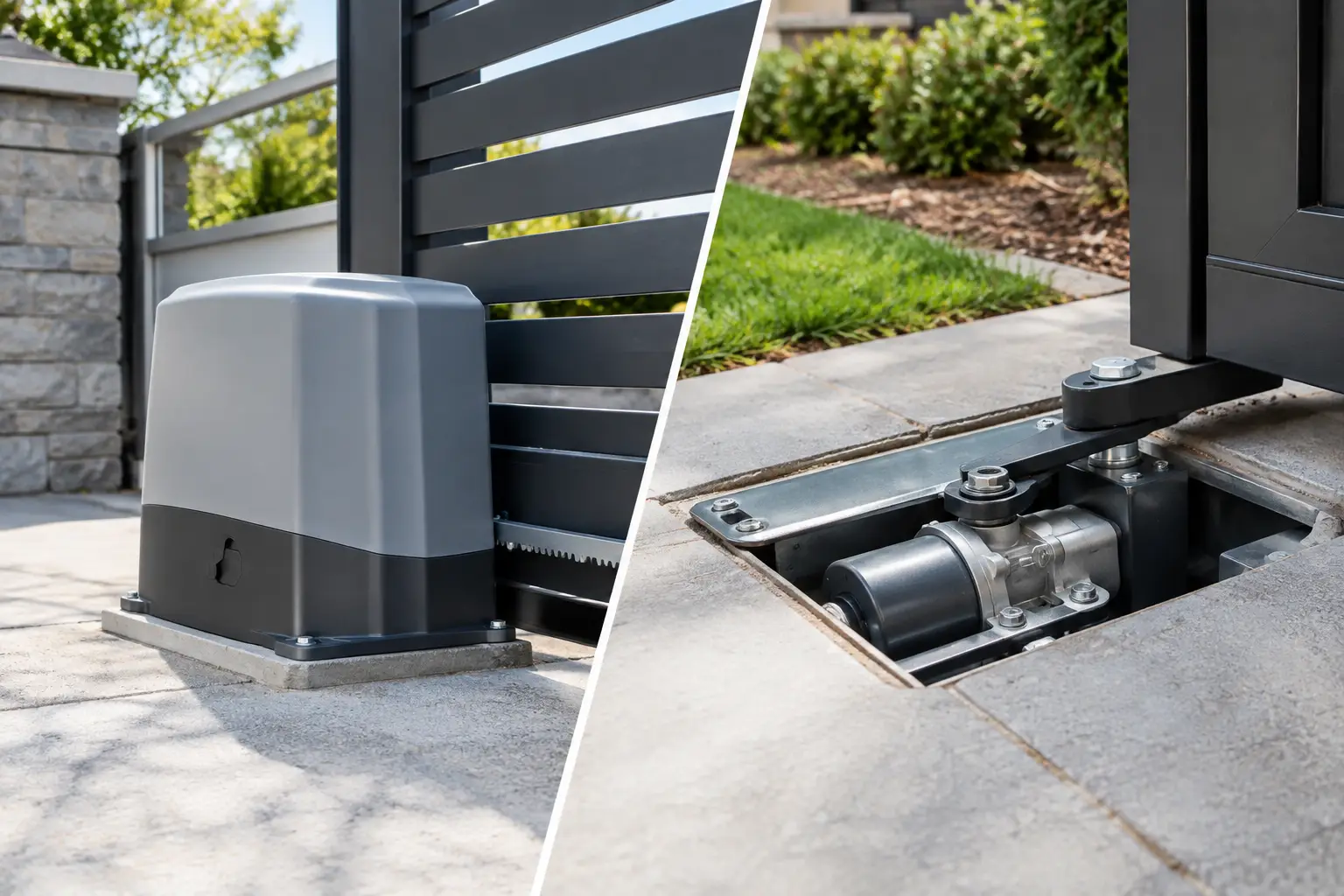
A gate motor is easy to overlook once the gates are moving reliably, but its position has a major effect on how your entrance looks, how it is maintained and what the installation involves. When comparing above ground vs underground motors, the right answer depends on more than appearance. Gate weight, driveway levels, drainage, daily use and future servicing all need to be considered before work begins.
For most properties, both options can provide secure, convenient automated entry. The difference is in the way they achieve it, and in the preparation needed to make the system dependable for years to come.
What are above-ground gate motors?
Above-ground motors are fitted visibly to the gate posts, pillars or nearby structure. On swing gates, they commonly take the form of articulated arms, linear rams or compact motors mounted at the hinge end of each gate leaf. They move the gates by pushing or pulling from a fixed point.
This is the most familiar form of swing gate automation and, in many cases, the most practical. The equipment remains accessible, which makes routine adjustment, fault finding and servicing more straightforward. It can also be a sensible solution where existing gates and posts are suitable but the driveway cannot easily be excavated.
A properly selected above-ground system should be matched to the size, weight and construction of the gates. A light timber gate, for example, requires a different approach from a heavy steel or hardwood entrance gate that is exposed to wind.
What are underground gate motors?
Underground motors sit in foundation boxes below ground level, usually at the base of each gate hinge. The motor connects to the bottom of the gate and moves it from below, leaving the gate face and pillars free from visible automation arms.
The principal attraction is appearance. Underground automation is often chosen for period properties, architect-designed homes and entrances where clean lines matter. It allows the gates themselves to remain the focus, without external motors changing the look of the entrance.
However, the motor being out of sight does not mean it is maintenance-free. The installation relies on correctly positioned foundation boxes, sound cable routes and effective drainage. Those details are essential in the British climate, particularly on driveways that collect surface water or sit below surrounding ground levels.
Above ground vs underground motors: appearance and access
If appearance is the priority, underground motors usually have the advantage. They are discreet and preserve the original design of decorative wrought iron gates, timber gates or masonry pillars. They can make an automated entrance look less obviously automated.
Above-ground motors are visible, although modern units are far more compact and unobtrusive than older designs. On many driveways, particularly those with substantial gate posts or solid side returns, they can be fitted neatly and without detracting from the entrance. Colour and mounting position can also reduce their visual impact.
The trade-off is access. An above-ground motor can generally be inspected and serviced without lifting a gate or opening a below-ground housing. With underground motors, access is through the foundation box, and the condition of the box and drainage becomes part of every service consideration. Neither option is inherently unreliable, but accessible components make diagnosis simpler when a problem occurs.
Installation work and site conditions
Above-ground systems often require less groundworks. The installer still needs to provide a safe electrical supply, protected cabling and suitable control equipment, but there is usually no need to excavate beside every hinge. This can reduce disruption to block paving, tarmac, gravel or established landscaping.
Underground installation is more involved. Each motor needs a securely set foundation box at the correct height and alignment. The surrounding ground may need to be dug out, drainage installed and surfaces reinstated once the work is complete. On an existing driveway, this is a significant part of the project rather than an afterthought.
Drainage deserves particular attention. Water entering an underground motor box must have a planned route away from the equipment. If a site has poor natural fall, heavy clay soil or regular standing water, the drainage solution may add cost and complexity. A professional survey should identify this before a system is specified, not after excavation has started.
Cost: look beyond the motor price
Underground motors commonly cost more to install because of the groundworks, drainage and reinstatement involved. The equipment itself may also be more specialised. This does not make it the wrong choice. For a high-value entrance where discretion is essential, the additional investment can be justified.
Above-ground motors are often more cost-effective, particularly when retrofitting automation to existing gates. Installation time may be shorter and future access can be easier, which can help keep servicing costs more predictable.
The lowest initial quote is not always the best value. A system should include suitable controls, safe operation, correctly protected electrical work and a motor rated for the gates and expected usage. Cutting corners on foundations, cable protection or safety devices can lead to unnecessary repairs later.
Gate type, hinge geometry and opening angle
The gates themselves often decide which motor is appropriate. Above-ground arms and rams need suitable fixing points and enough room to operate through the required arc. Deep-set gates, wide pillars or unusual hinge positions can restrict where an external motor can be mounted.
Underground motors can suit certain difficult layouts because the drive point is at the bottom hinge. They can also allow wide opening angles where the site needs them, although this depends on the chosen equipment, gate design and surrounding space. A gate that opens into a steeply sloping drive, towards a wall or across a public footpath needs careful assessment whichever system is used.
Existing gate condition matters just as much. Automation places repeated forces on hinges, frames, posts and latches. Before fitting motors, a competent installer should check that the gates swing freely by hand, are structurally sound and will not twist or sag under powered operation.
Reliability, maintenance and everyday use
Both types of motor can give reliable service when correctly specified and installed. Reliability is less about whether a motor is above or below ground and more about workmanship, environmental protection and regular servicing.
For above-ground units, maintenance generally involves checking fixings, arms or rams, cable entries, limits and the gate’s mechanical movement. Because the components are visible, damage or corrosion can often be spotted early.
For underground units, the foundation boxes should be kept clear of debris and checked for water management issues. Leaves, silt and grit can build up around the housing, especially near gravel drives or mature planting. A neglected drainage arrangement can shorten the life of any below-ground equipment.
Usage also matters. A private home with a handful of movements each day has different requirements from a commercial entrance, flat development or managed estate with frequent traffic. Commercial sites may need higher duty-rated motors, more advanced access control and a planned maintenance schedule regardless of motor position.
Safety and access control should be part of the design
A motor choice should never be made separately from gate safety. Powered gates can create crushing, shearing and trapping points, so the whole entrance needs to be assessed. Photocells, safety edges, appropriate force settings and manual release arrangements all have a role in protecting people, vehicles and the gate itself.
The control system can be tailored to the property. A video intercom, keypad, key fob, GSM entry or ground loop may be added to either above-ground or underground automation. For commercial sites, controlled access for deliveries, staff and visitors can be designed around how the site operates, rather than relying on a basic remote control alone.
A power failure should also be considered. Quality installations include a means of manual release, and some systems can be supported by battery backup where continued operation is important.
Which gate motor is right for your property?
Choose underground motors when a concealed finish is a priority, the site can accommodate excavation and drainage, and you are prepared to invest in a more involved installation. They are particularly well suited to premium entrances, heritage-style gates and projects where visible arms would compromise the intended appearance.
Choose above-ground motors when you want a practical, proven system with easier access for servicing, lower installation disruption and strong value for an existing driveway. They are an excellent choice for many domestic and commercial gates, provided there is suitable mounting space and the system is correctly matched to the gate geometry.
The most reliable answer comes from a site survey rather than a photograph or a standard package. Crabtree Electrical Gates can assess gate construction, ground conditions, electrical requirements and access needs before recommending a system that suits the property. A well-planned installation should leave you with gates that look right, operate safely and remain straightforward to look after long after the work is complete.
0 Comments