
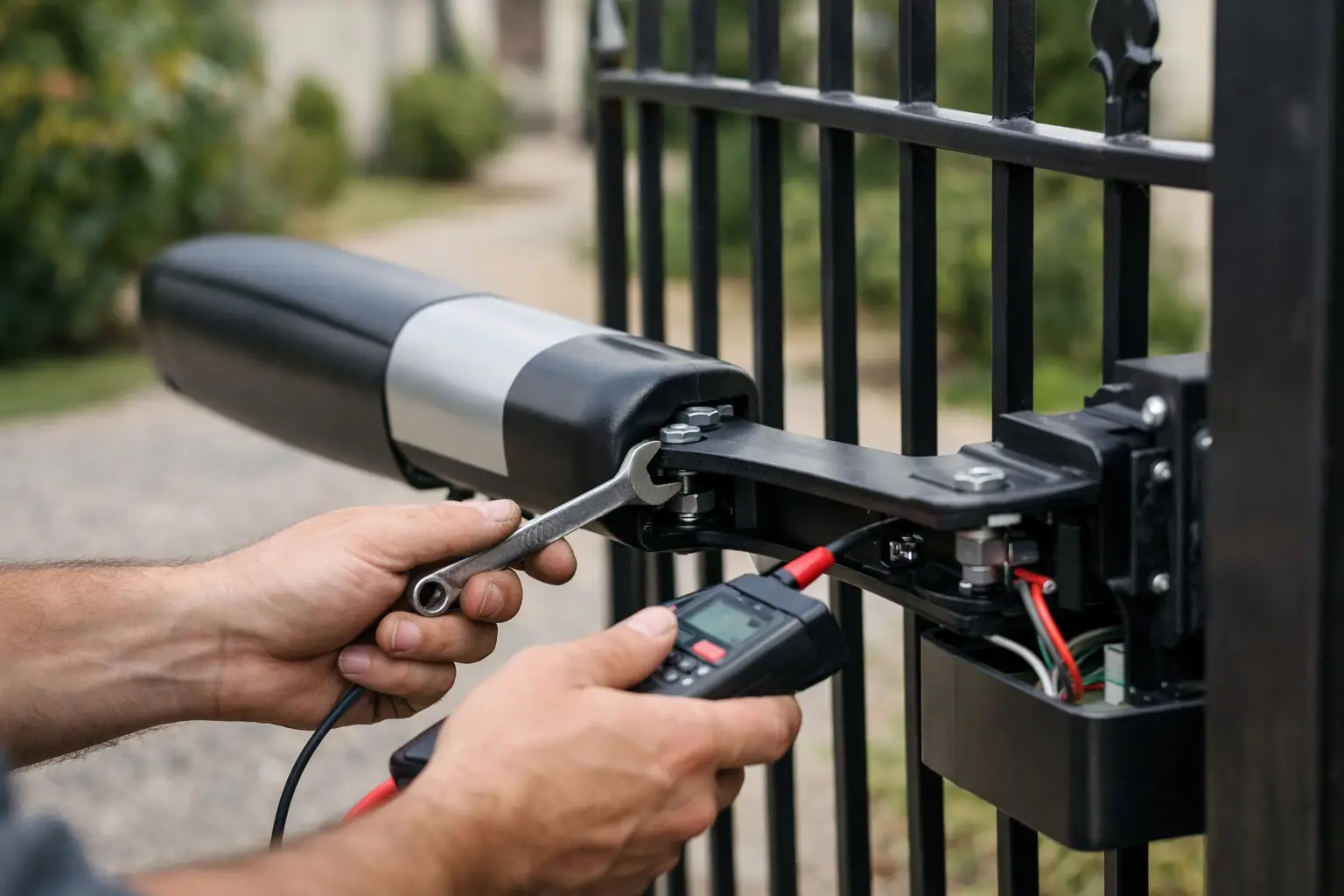
A swing gate that stops short, slams shut, or struggles in wet or windy weather usually is not failing outright – it is often out of adjustment. If you are searching for how to adjust swing gate opener settings, the first thing to know is that small changes can make a big difference, but the wrong change can create a safety risk very quickly.
That matters because an automatic gate is not just a convenience feature. It is a powered entrance system with moving parts, electrical controls and safety devices that all need to work together properly. If the gate is adjusted badly, you can end up with nuisance faults at best and an unsafe installation at worst.
What a swing gate opener is actually adjusting
When people talk about adjusting a swing gate opener, they often mean one of several different things. It may be the opening and closing limits, the motor force, the speed, the delay between leaves on a pair of gates, or the physical position of the arms and brackets. In some cases, the issue is not the automation settings at all. It can be worn hinges, dropped gates, misaligned stops, poor cable connections or failing safety photocells.
That is why a proper adjustment starts with identifying whether the problem is mechanical, electrical or purely a control setting. If the gate leaf is dragging on the ground or binding against a post, changing the force setting will not solve the real fault. It may simply make the system push harder against an obstruction, which is exactly what you do not want.
Before you adjust a swing gate opener
Start with the safe basics. Isolate the power if you are inspecting wiring, terminals or motor connections. Keep vehicles, children and pets clear of the area. If your gate has a manual release, know how to operate it before you touch any settings. That gives you a way to secure or move the gate if something goes wrong during testing.
It is also worth checking the manufacturer instructions for your specific control board and operator type. Underground motors, articulated arm systems and ram operators all behave differently. The menu layout and adjustment method vary from one brand to another, even when the end goal is the same.
If your system is under warranty, be careful. Unauthorised changes can affect cover, especially if force settings or safety devices are altered without proper testing.
How to adjust swing gate opener limits
Limit settings tell the gate where to stop in the open and closed positions. On some systems this is done with physical limit stops or cams. On others it is programmed electronically through the control panel.
If the gate does not open fully, leaves too wide a gap, or tries to drive beyond its stop, the limit settings are the first place to look. Begin by inspecting the gate travel path. Make sure the end stops are secure, the hinges are sound and the leaf moves freely by hand in manual mode. There is no point programming limits around a mechanical problem.
Once the physical travel is confirmed, reset or adjust the open and close positions according to the control board procedure. Usually this involves entering a learning mode, moving the gate through a full cycle and allowing the board to store the positions. On dual-leaf systems, the order matters. The primary and secondary leaf often need separate timing and stop points so they close cleanly without clashing.
A common mistake is setting the close limit too tight. That can cause the motor to keep driving into the stop, leading to strain, noise and premature wear. Too loose, and the gate may not latch or align properly. The right adjustment is firm and consistent, without excessive pressure at the end of travel.
Adjusting force and sensitivity
Force settings control how much effort the motor uses during movement. Sensitivity settings affect how readily the gate reacts to resistance or an obstruction. These are safety-critical adjustments.
If the gate reverses randomly, stops mid-cycle or struggles in normal use, the force may be set too low. If it continues pushing hard when it meets resistance, the force may be too high or the obstacle detection may be poorly configured. Neither condition is ideal.
The correct approach is to use the lowest force setting that still gives reliable operation in real conditions. That includes colder mornings, wet hinges and moderate wind load if the gate is partially boarded. A solid timber gate will need a different setup from an open-bar design because wind resistance changes the load on the motors.
This is where experience matters. Turning the force up until the problem disappears is not a proper repair. If the gate only works with unusually high force, there is usually another issue underneath it, such as hinge friction, poor geometry, failing capacitors or an installation that has shifted over time.
Speed, delay and soft stop settings
Many modern systems allow you to adjust running speed, slowdown near the end of travel and the delay between two leaves. These settings affect not just convenience, but also wear and tear.
If the gate closes with a jolt or bangs into the stop, the soft close setting may need refining. If one leaf starts too early or too late on a pair of gates, the delay timing may be out. The meeting stile should line up neatly without one leaf forcing the other out of position.
Faster is not always better. A gate that moves too quickly can feel aggressive and may reduce the margin for safe stopping. Slower, controlled movement is usually preferable, especially on larger domestic entrances and commercial access points where reliability matters more than speed.
Physical alignment still matters
Not every adjustment happens in the control panel. In fact, some of the most important ones are mechanical. The gate hinges need to be level and free-moving. The mounting brackets must be secure. The ram or arm geometry must match the gate width, hinge setback and opening angle.
If the operator is mounted at the wrong angle, the gate may slow down in the wrong part of its travel or place excess strain on the motor. If a post has moved slightly or a gate has dropped over time, the opener may begin behaving unpredictably even though the electronics are unchanged.
Look for uneven gaps, scraping, twisting or signs that the leaf no longer meets the stop squarely. These clues often point to the real cause of the fault. Adjustment in software can only compensate so far.
Safety devices must be checked after any adjustment
Every time you change the travel, force or closing behaviour, the safety devices need testing. That includes photocells, safety edges where fitted, vehicle detection loops and any stop commands through access control equipment.
For example, if the gate now closes further or faster than before, the photocell alignment and response may need rechecking. If the gate has a timed auto-close function, confirm there is enough warning and enough margin for users to pass through safely. On commercial premises especially, safety compliance should never be treated as optional.
This is also why DIY adjustment has limits. A gate may appear to work after a few tweaks, but unless the safety functions are properly verified, you do not really know whether the system is safe.
When not to adjust it yourself
There is a difference between basic user-level checks and technical adjustment. If you are simply resetting a remote, changing an auto-close timer within the permitted menu, or clearing debris from the gate path, that is one thing. If you are altering force settings, rewiring safety inputs, repositioning motors or trying to correct repeated faults, that is work for a specialist.
You should also stop and get professional help if the gate is jerking, tripping electrics, opening on its own, failing to detect obstructions, or showing signs of water ingress in the motor or control panel. Those issues can point to deeper electrical or mechanical faults.
For property owners and site managers, the practical question is not just can you make the gate move again. It is whether you can be confident it will keep operating safely and reliably afterwards.
A sensible approach to how to adjust swing gate opener systems
The safest way to deal with adjustment is to treat the gate as a complete system rather than a motor with a few settings. Start with the mechanical condition, then the control setup, then the safety testing. If one part is overlooked, the result is often temporary.
At Crabtree Electrical Gates, we see this regularly on systems that have been altered to mask an underlying fault. A force setting has been increased to overcome stiff hinges, or a limit has been shifted to hide poor alignment. It may work for a while, but it rarely stays that way.
If your gate has become unreliable, the best next step is usually an inspection by an experienced gate automation specialist. That gives you a clear answer on whether the system needs a simple recalibration, a repair, or a more substantial correction to the installation.
A well-adjusted swing gate opener should open smoothly, close positively and stop safely every time. If it does anything else, it is worth getting it sorted properly before a minor annoyance turns into a larger fault.
0 Comments