
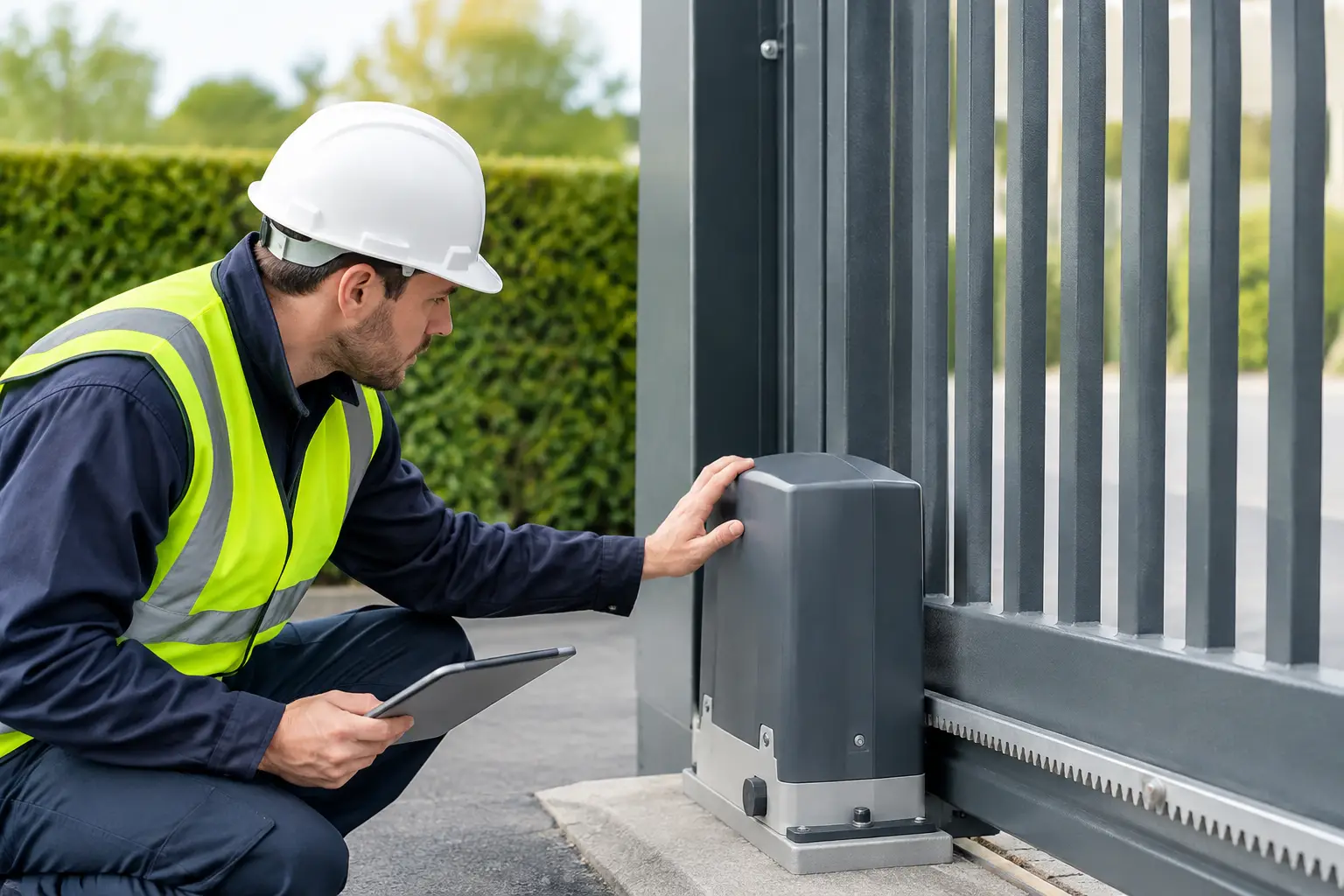
An automated gate that looks impressive but closes onto a person, vehicle or obstruction is not a finished installation. This electrical gate compliance checklist is designed for homeowners, estate managers and commercial operators who need to understand what safe, properly planned gate automation should involve before work begins.
Electric gates are classed as machinery once automated. That means safety cannot be treated as an optional extra added at the end of the job. The gate, motor, control equipment and access controls must work together to reduce foreseeable risks in normal use, during maintenance and if something goes wrong.
Start with a site-specific risk assessment
Every compliant installation begins with the site, not with a standard motor package. A sliding gate on a busy commercial entrance has different risks from a pair of swing gates at a private rural driveway. The gate design, its weight, travel speed, surrounding walls, pedestrian routes, gradients and expected traffic all affect the solution.
The assessment should identify crushing, shearing, drawing-in, trapping and impact hazards. Particular attention is needed where moving gate leaves meet posts, hinge areas, rollers, guide rails and any fixed wall or fence. A gap that appears harmless on a static gate may become a serious pinch point once the gate moves under power.
Consider who will use the entrance. Children, visitors, delivery drivers, pedestrians and people unfamiliar with the controls may all approach the gate differently. For commercial sites, think about larger vehicles, timed access, shift changes and whether people might try to enter on foot while vehicles are passing through.
A professional installer should explain the identified hazards and how each one will be controlled. If the existing gate is unsuitable for automation, adapting or replacing it may be the safer and more economical decision than forcing a motor system onto a poor base.
Check the gate structure before automation
Automation cannot compensate for an unstable, damaged or badly fitted gate. Before motors are selected, check that the gate is structurally sound, correctly aligned and moves freely by hand. Posts, hinges, tracks, rollers, foundations and end stops must be suitable for the gate’s size and loading.
Swing gates need properly engineered hinge points, adequate clearances and reliable mechanical stops. Sliding gates need a stable track or cantilever arrangement, secure guides and protection around the moving edge. A gate that binds, sags or catches will place unnecessary strain on the automation and make safety settings less predictable.
This is also the time to check drainage and ground conditions. Underground motors, cabling and control cabinets need protection from standing water and damage. On exposed sites across Dorset and the South of England, wind loading can be significant, particularly with solid or close-boarded gate designs. The motor and gate structure must be specified with this in mind.
Make sure safety devices match the risk
Most automated gates require more than one method of protection. The exact arrangement depends on the risk assessment, but it should not rely solely on the motor detecting resistance. Obstacle detection settings are part of a safe system, not a substitute for correctly positioned physical safety measures.
Photocells are commonly used to stop or reverse the gate when a person, vehicle or object breaks an infrared beam. They must be fitted at suitable positions and heights for the opening, including areas where someone could be trapped by a closing gate. A single pair of photocells may be sufficient in a straightforward low-risk layout, but more complex entrances can need additional protection.
Safety edges are pressure-sensitive strips fitted to hazardous moving edges or fixed points. When activated, they command the gate to stop or reverse. They are particularly useful where a gate could create a crushing or shearing point that cannot be eliminated by its design. Wireless safety edges can be practical on moving gate leaves, but their batteries and signal performance need to be included in ongoing maintenance checks.
Other safeguards may include guarded rollers, mesh infill, fixed guarding, warning signs and carefully positioned control stations. The best answer is often to remove a hazard by design rather than add more electronics around it. For example, reducing dangerous gaps or guarding a roller may be more reliable than expecting users to avoid the area.
Confirm safe manual release and emergency access
Power cuts, faults and emergencies happen. The gate must have a manual release mechanism that allows authorised people to disengage the motor safely. It should be accessible without creating another hazard, protected from casual misuse and demonstrated to the person responsible for the property.
For sites where access must be maintained, a battery backup, alternative pedestrian entrance or emergency override may be appropriate. This depends on the property and its use. A private driveway may simply need a reliable manual release, while a managed commercial site may need a clearer plan for staff, emergency services and deliveries during a power failure.
Manual release keys should not be left in an obvious place or handed to people without instructions. The procedure should be recorded, especially where more than one member of staff manages the entrance.
Check the electrical installation
Electric gate automation needs more than a convenient outdoor socket. The supply, isolation, earthing arrangements, cable routing and protective devices must be appropriate for an external powered installation. Electrical work should be completed and tested by a competent person, with the relevant electrical certification provided where required.
Cables must be protected from damage and installed to suit their environment. This is particularly important beneath driveways, across vehicle routes and near landscaping works. Low-voltage safety-device cables, mains supplies and data cables for intercoms or access control should be planned properly from the outset rather than added as an afterthought.
An accessible local isolator allows the system to be safely disconnected for servicing. Control enclosures should be secure, weather-resistant and positioned so engineers can work without standing in the gate’s travel path. Good installation practice makes future fault-finding and maintenance safer as well as easier.
Verify controls and access equipment
Keypads, fobs, intercoms, telephone entry systems and ground loops improve convenience, but they must not encourage unsafe use. Controls should be positioned where users can operate them without reaching through the gate or standing in a hazardous zone.
A keypad for drivers should be placed where a vehicle can stop safely, without obstructing a public road or blocking a pavement. Intercom users should be able to communicate clearly and enter without rushing through a moving gate. For commercial premises, access permissions should be reviewed when staff or contractors leave, particularly where fobs, codes or app-based entry are used.
Exit loops must be correctly located and commissioned so gates do not close onto a vehicle that is still within the opening. Where pedestrian access is common, a separate gate or defined pedestrian route is often safer than expecting people to share a vehicle entrance.
Test, document and hand over the installation
A compliant electric gate installation requires commissioning, not just a demonstration that it opens and closes. The system should be tested in all operating modes, including opening, closing, obstruction detection, photocell activation, safety-edge activation, emergency release and any automatic closing function.
Force testing is a key part of this process. The forces created by the moving gate must be measured and adjusted to meet the applicable safety requirements. This should be undertaken with suitable calibrated equipment, not estimated by hand. Changes to the gate, its controls or its safety devices can affect those results, which is why alterations should be assessed and tested properly.
The owner or duty holder should receive clear documentation. This normally includes the risk assessment, declaration and technical information for the completed system, operating instructions, maintenance guidance and records of testing. Relevant safety standards commonly considered include BS EN 12453 and BS EN 12445, alongside the legal duties that apply to machinery and electrical work in the UK.
For a business, retaining these records is particularly important. It demonstrates that safety was considered and provides a reference point for future servicing, repairs or upgrades. For homeowners, it gives confidence that they understand the gate’s safe operation and know whom to contact if a problem develops.
Plan routine inspections and maintenance
Compliance is not a one-off event on installation day. Gates are exposed to weather, movement, vehicle impact, dirt and general wear. Safety devices can be knocked out of alignment, hinges can loosen and tracks can become obstructed. A gate that was safe when commissioned may become unsafe if it is not inspected.
The frequency of servicing depends on use, location and the equipment fitted. A lightly used domestic gate may need a different schedule from a high-traffic commercial entrance. However, regular checks should cover the gate structure, fixings, rollers or hinges, safety edges, photocells, cables, control equipment, manual release and operation under fault conditions.
Users should also report changes promptly. Unusual noise, slower movement, intermittent photocells, visible damage or a gate that reverses unexpectedly are reasons to stop relying on the system until it has been checked. Bypassing a safety device to keep an entrance operating is never an acceptable fix.
At Crabtree Electrical Gates, installations are planned around the gate, the property and how people will use the entrance every day. A properly designed automated gate should provide dependable access and security without asking users to take risks. If you are considering a new system or have concerns about an existing one, arrange a professional assessment before small issues become safety problems.
0 Comments