
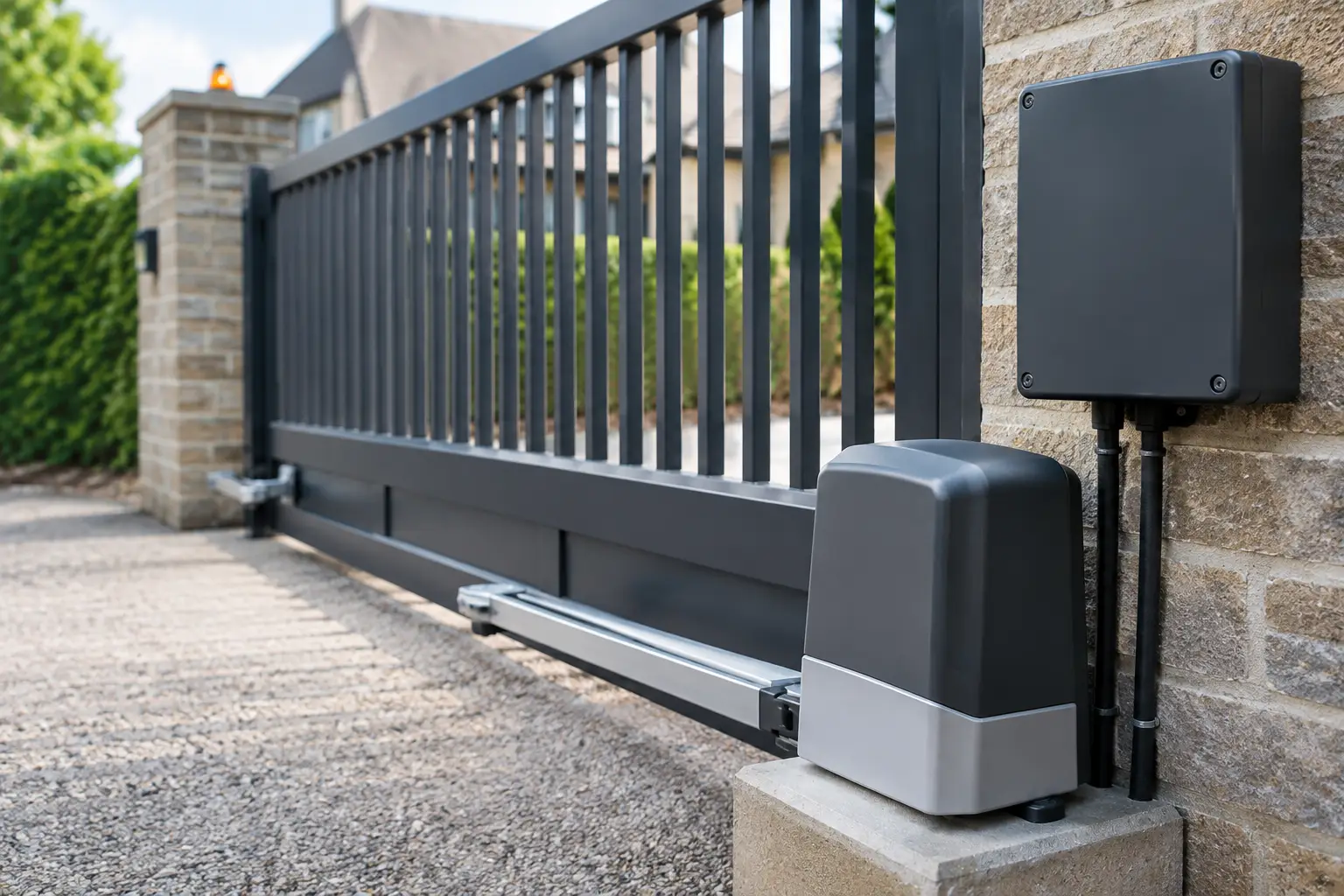
A gate can have the strongest motors and a well-made entrance, but it is the controller that decides how reliably the system works each day. The best electric gate controllers are not simply the units with the most functions. They are correctly matched to the gate’s weight, layout, usage, safety equipment and access requirements.
For a private driveway, that may mean dependable remote operation with an intercom at the entrance. For a commercial yard, it could mean timed access, vehicle detection, multiple users and a controlled exit route. Choosing the right control equipment at the outset avoids frustrating faults, poor security and costly alterations later.
What an electric gate controller does
The controller, often called the control board or control panel, is the working centre of an automated gate system. It receives a command from a remote, keypad, intercom, key switch or ground loop, then tells the gate motors when to open, close or stop.
A good controller also monitors the gate’s safety devices. Photocells, safety edges and other protective equipment provide signals to the controller if a person, vehicle or obstruction is in the gate’s path. The controller must respond correctly, stopping or reversing the gate where required.
This is why a controller should never be treated as a separate, off-the-shelf purchase without considering the whole installation. A board suited to a light domestic swing gate may not be appropriate for a long, heavy sliding gate used throughout the working day.
Best electric gate controllers: what matters most
The best option depends on the installation rather than a single brand or price point. In our experience, there are several areas that deserve proper attention before equipment is selected.
Gate type, size and duty cycle
Swing gates, sliding gates and underground systems all place different demands on a controller. The board must be compatible with the motor type and capable of managing its operating limits, force settings and opening sequence.
Duty cycle matters just as much. A pair of gates at a family home may open a handful of times a day. A shared entrance, business premises or busy estate entrance can operate many times more often. Equipment that is adequate for occasional domestic use can wear prematurely when asked to manage continuous commercial traffic.
For sliding gates, a controller should allow accurate control of travel and safety reversal. For swing gates, it should manage the leaves in the correct order, particularly where one leaf overlaps the other or the entrance has a pedestrian opening arrangement.
Safety compatibility
Safe operation is a core requirement, not an optional upgrade. A suitable controller needs enough inputs to accommodate the safety devices specified for the site, including photocells and safety edges where required. It should be configured and tested as part of the completed installation.
The correct safety arrangement depends on the gate design and the surrounding area. A gate close to a public pavement, a busy driveway or pedestrian access route may require more careful planning than a straightforward private entrance. The controller is only as effective as its setup, wiring and commissioning.
Access control options
Most customers want more than a basic handset. Modern gate controllers can work with intercoms, keypads, GSM calling systems, proximity fobs, vehicle loops and timed opening functions. The right choice comes down to who needs access and how often that list changes.
A homeowner may prefer an audio or video intercom that lets them speak to visitors before opening the gate. An estate manager may need fobs that can be added or removed as residents change. A commercial operator may need a keypad for staff, an intercom for visitors and a ground loop to open the exit automatically for authorised vehicles.
It is sensible to plan these requirements before the gates are installed. Adding access control later is possible in many cases, but running extra cables and altering an existing control cabinet can add unnecessary cost.
Power supply and resilience
A professionally installed controller requires a suitable electrical supply and protection. The position of the control enclosure matters too. It should be accessible for servicing while protected from weather, accidental damage and unauthorised interference.
Power cuts are worth discussing at the design stage. Some systems can be fitted with battery backup so the gate continues to operate for a period when mains power is unavailable. Others may include a manual release mechanism for emergency access. The better option depends on how critical access is to the property and whether there is an alternative entrance.
Diagnostics and aftercare
A reliable controller should make faults easier to identify, not harder. Clear status indicators, fault reporting and properly labelled wiring help an engineer inspect the system efficiently. This becomes particularly valuable on commercial sites, where a gate fault can delay staff, deliveries and customers.
Avoid choosing equipment solely because it is the cheapest available. A lower upfront price can be poor value if replacement parts are difficult to obtain, settings are limited or a local specialist cannot provide ongoing support. Established automation equipment with accessible spares is generally the more practical long-term choice.
Common controller choices for homes and businesses
For many domestic installations, a purpose-made controller with remote controls, photocell inputs and an intercom connection is the right balance. It provides straightforward everyday use without making the entrance unnecessarily complicated. If the property has regular deliveries or visitors, a keypad or GSM entry system can reduce reliance on handsets.
For larger homes, shared drives and estates, multi-user access becomes more relevant. Controllers can be paired with systems that allow user credentials to be managed individually. This gives greater control than sharing a single keypad code with every visitor or contractor.
Commercial sites often need a more considered specification. Vehicle loops can help manage exit movements, while timed settings can keep an entrance open during business hours and secured outside them. Separate controls for staff, visitors and delivery drivers may also be needed. In these situations, the controller should be selected as part of a wider access-control plan, not as an afterthought.
Features worth paying for, and features to question
Remote operation, safety-device connections and dependable manual override are basic requirements for most automated entrances. Battery backup can be worthwhile where access must be maintained during an outage. Mobile-phone access is also useful where users change frequently or the property owner wants to manage entry without issuing physical remotes.
Some advanced features are helpful only when they solve a genuine problem. App control can be convenient, for example, but it should not replace safe local controls, reliable intercom communication or a suitable release method. Equally, a system with extensive programming options is not automatically better if those settings are unlikely to be used.
The best specification is usually the one that is easy for the people using the entrance every day. A site manager needs clear control over access. A family needs a simple, dependable way to get in and out. Visitors need an obvious way to call. Complexity should serve the property, not create another point of failure.
Why professional installation makes the difference
Even high-quality controllers can perform poorly when they are incorrectly wired, poorly protected or set up without proper testing. Gate automation combines mechanical movement, electrical supply, safety equipment and access control. Each part affects the others.
A specialist installer will assess the gate structure, hinges or track, available power, cable routes, site conditions and likely usage before recommending a controller. They will also consider practical details that are easy to overlook, such as whether an approaching vehicle has enough space to stop safely before the gates, or whether a keypad can be used without leaving a car in the road.
At Crabtree Electrical Gates, installations are specified around the property and how it is used, whether that means a discreet underground system at a home or controlled entry for a commercial site. Professional commissioning, insured work and clear aftercare give customers confidence that the controller, motors and safety devices are working together as intended.
Questions to ask before choosing a controller
Before approving a quotation, ask how the proposed controller suits the gate type and expected daily use. Check what safety devices are included, how visitors will call, what happens during a power failure and whether future additions such as an intercom, keypad or vehicle loop can be accommodated.
It is also worth asking who will support the system after installation and whether replacement parts are readily available. A gate controller is a long-term part of the property’s security and access arrangement, so serviceability matters as much as its initial feature list.
The right controller should make entering your property feel routine and secure, not like managing another piece of technology. A site visit and a properly considered specification are the surest way to achieve that.
0 Comments