
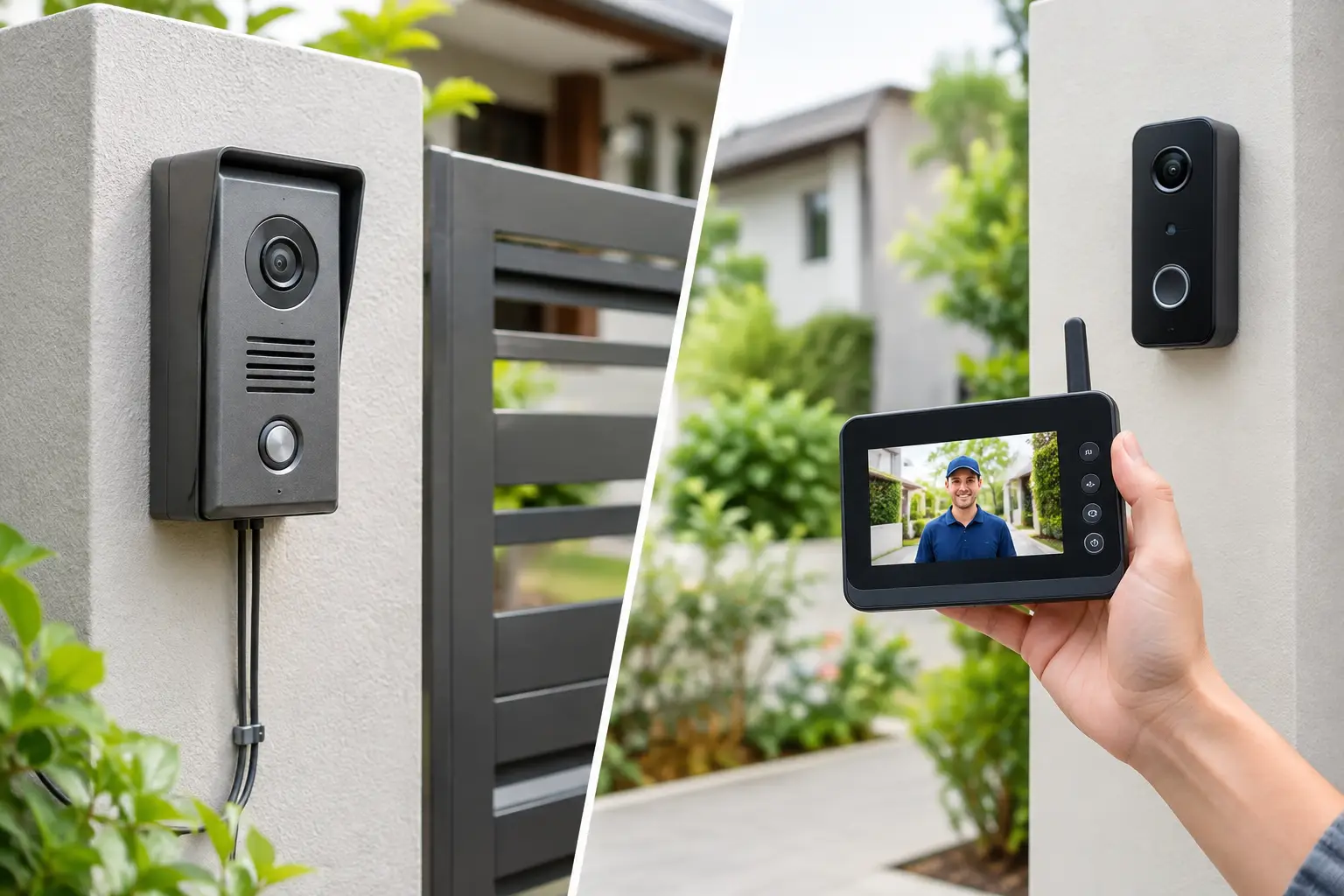
A gate intercom has one simple job: let you identify a visitor and control entry without walking down the drive or leaving a building unsecured. However, the decision between a wired vs wireless gate intercom affects much more than the handset or monitor you choose. It influences reliability, installation work, long-term maintenance and how well the system performs at the edge of your property.
For a short driveway with a clear line between gate and house, either option may be suitable. For a long rural entrance, a busy commercial yard or a property where dependable access control matters every day, the right choice needs more careful consideration.
Wired vs wireless gate intercom: the key difference
A wired gate intercom uses physical cabling between the gate entrance, the property and, where required, the gate automation control panel. The cable carries power, audio, video and gate-release signals, depending on the system design.
A wireless intercom sends communication signals by radio, Wi-Fi, mobile network or a combination of these methods. Some wireless units are battery powered, while others still require a local power supply at the gate. “Wireless” usually refers to the connection between the entrance station and the property, not necessarily an installation with no wiring at all.
The practical choice is therefore not simply old technology versus new technology. It is a question of whether the site can support a cable route, how much reliability is required and which access features the owner wants to use.
Why wired intercoms remain the dependable option
A wired system is generally the preferred option where cables can be installed properly during a new gate project, driveway excavation, landscaping work or renovation. It creates a fixed connection that is not affected by weak Wi-Fi, changing router settings or the distance limits of radio equipment.
For homes, this means clearer communication and more consistent video monitoring at the gate. For commercial premises, it can mean a more reliable point of control for staff, deliveries and authorised visitors. A wired system can also be integrated neatly with keypads, proximity readers, vehicle ground loops, timed access settings and electric gate controls.
Reliability over distance
Distance is often the deciding factor. Wireless performance can fall away where an entrance is a long way from the property, particularly if there are stone walls, metal gates, mature trees, outbuildings or changes in ground level between the two points. These can interrupt or weaken the signal.
A correctly specified cable does not have the same limitations. The cable route and type still need to be planned around distance, voltage drop and the equipment being used, but the result is normally more predictable. This is particularly valuable on country properties and larger estates where gates sit well away from the house.
Better support for video and integration
Video intercoms need a stable connection to provide a useful image when someone calls. A wired connection is usually better suited to high-quality video, multiple indoor monitors and reliable release control. It also avoids relying on a homeowner’s broadband service for core gate access.
That does not mean every wired system needs an indoor screen. Audio-only handsets, app-connected systems and mixed arrangements are all possible. The important point is that the physical connection gives the installation a strong foundation, especially when the intercom forms part of a wider automated gate system.
The trade-off: installation work
The main disadvantage of wired intercoms is the civil work involved. Cables may need to be run through ducts under a driveway, across a garden or along a boundary. On an established property, this can add time and cost compared with fitting a standalone wireless unit.
This is why planning matters. If gates are being installed from new, fitting suitable ducting and cables at the same time is usually the sensible approach. It protects the option to add or upgrade access control later, without reopening finished surfaces.
When a wireless gate intercom makes sense
Wireless intercoms have a clear place, particularly where running a cable would be disproportionate to the job. They can be a practical solution for existing gates, secondary entrances, temporary access arrangements or properties where digging up a finished driveway is not desirable.
Many modern wireless systems offer useful features such as mobile app calling, video alerts, keypad entry and remote gate release. For a homeowner who wants to answer a visitor from a mobile phone while away from the property, these functions can be attractive.
Faster installation with fewer disruptions
Where signal conditions are good, a wireless system can often be installed with less disruption than a cabled alternative. There may be no need to excavate a long trench between the gate and the building. This can make it a sensible choice for a modest driveway or an entrance that is difficult to reach with machinery.
It is still essential to assess the site rather than assume it will work. A quoted wireless range is normally measured in favourable conditions, not through several stone walls or around a large metal-clad outbuilding. Testing and correct positioning are crucial.
Ongoing considerations for wireless systems
Wireless equipment introduces a few dependencies that should be understood from the outset. Battery-powered entrance units need their batteries checked and replaced or charged. Wi-Fi-based systems depend on adequate broadband coverage and may need network settings reviewed if a router is changed. Mobile-connected devices can require a SIM card and an ongoing data arrangement.
These are manageable requirements, but they make wireless less suitable where gate access must work without fail. A commercial site with regular lorry deliveries, a shared private road or a property with vulnerable occupants may place greater value on a fixed, wired connection.
Choosing the right system for your property
The best intercom is one that suits the site, the gate automation and the people using it. The following questions help narrow down the decision.
First, consider the distance from the gate to the property and what lies between them. A short, open driveway gives wireless equipment a far better chance than a long route with walls, trees and outbuildings.
Next, think about how the system will be used. If you simply need to speak to visitors and release a gate occasionally, a straightforward audio or app-based intercom may be enough. If you need video verification, multiple users, keypad codes, timed access or connection to other security equipment, a wired installation is often the better long-term route.
It is also worth considering future changes. A property owner may initially want a single handset but later decide to add video, a second internal station, pedestrian access or remote controls for staff. Installing ducting and cable capacity early can avoid unnecessary expense later.
For commercial sites, access management should lead the decision. Consider delivery traffic, staff turnover, out-of-hours entry, visitor control and how quickly faults would affect daily operations. A professionally installed wired system often provides the consistency these sites require, while selected wireless equipment can be useful for supplementary or remote entrances.
Power, safety and professional installation
Intercoms should not be treated as separate from the gate system. The entrance panel, control board, safety devices and release functions need to work together correctly. Poor cable sizing, unsuitable connections or an incorrectly positioned intercom can create faults that are inconvenient at best and unsafe at worst.
Gate automation also requires appropriate safety measures, including correctly positioned safety edges, photocells and controls. An intercom should allow convenient entry without encouraging users to bypass safe operation or leave gates unsecured. For this reason, system design is as important as the product selected.
Crabtree Electrical Gates assesses the whole installation, from gate type and power supply to intercom location and intended use. This approach helps ensure the access control system is practical for the property rather than simply fitted where it is easiest to install.
A practical way to decide
Choose a wired intercom when the driveway is being constructed or altered, when the gate is far from the property, or when you need dependable video and integrated access control. It normally costs more to install initially, but it offers the strongest long-term reliability.
Choose wireless where cable installation would cause excessive disruption, where the gate is within proven signal range and where the system’s battery, broadband or mobile-network requirements are acceptable. It can be an effective solution, provided it is selected for the real conditions on site rather than its headline range.
Before committing to either option, have the entrance assessed in person. A clear route for cables, a realistic signal test and a discussion about daily use will give you a gate intercom that remains convenient long after the installation is complete.
0 Comments