
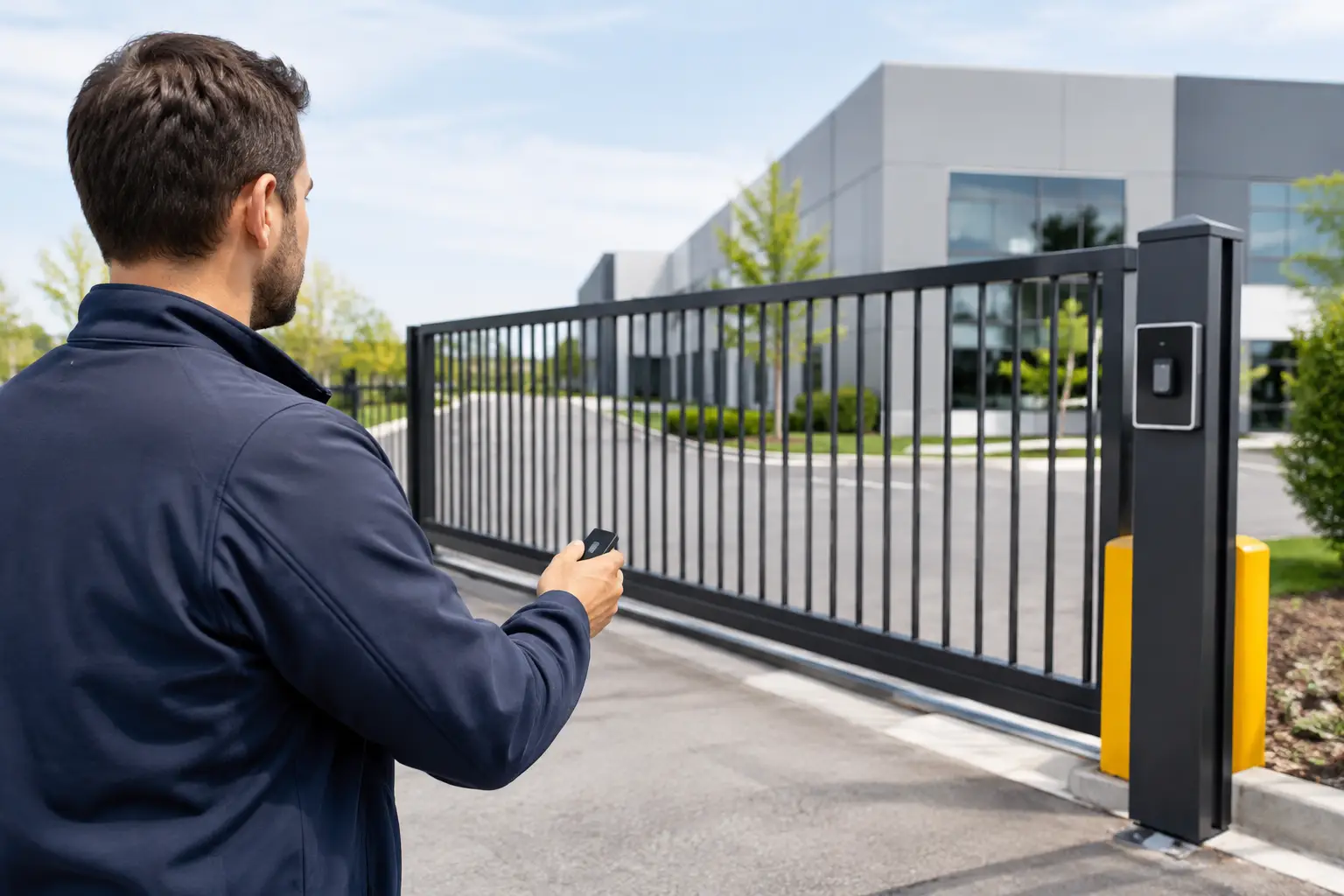
A commercial gate that opens for the wrong vehicle, closes too quickly behind a van, or creates a queue onto a public road is not doing its job. Specifying commercial gate access properly means looking beyond the gate itself and planning how people, vehicles, deliveries and emergency services will use the entrance every day.
For estate managers, business owners and site operators, access control should improve security without making the working day harder. The right arrangement depends on the site, its traffic, operating hours and the level of control required. A warehouse with frequent lorry movements has different needs from a managed office park, school, farm yard or private industrial estate.
Start with how the entrance is actually used
The first question is not which keypad or intercom to choose. It is who arrives at the gate, when they arrive and what they need to do next. A site with ten staff cars arriving within half an hour each morning needs a different approach from one where contractors appear at irregular times and must be screened before entry.
Consider the full movement through the entrance. Is there enough space for a vehicle to wait safely off the highway while credentials are checked? Can a delivery driver reach the intercom without leaving the cab? Will articulated lorries need a wider opening, a longer clear run or a separate route? These practical details often determine whether swing gates, sliding gates or a barrier arrangement is most suitable.
It also helps to separate regular users from visitors. Staff may need quick, reliable entry using a fob, proximity tag, keypad code or vehicle recognition system. Visitors and deliveries may need to call a nominated contact through an intercom. Where access must be logged or managed by several people, a networked system may be appropriate, but it should only be specified where the site can support and maintain it.
Choose the gate type around space and traffic
Sliding gates are often a strong choice for commercial premises because they can provide a wide opening and do not sweep into driveways or vehicle routes. They need sufficient run-back space along the fence line, a sound track or cantilever arrangement, and suitable foundations. On exposed or sloping sites, the ground conditions and wind loading require particular attention.
Swing gates can work well where the entrance is wide and there is clear space inside the boundary. They can offer a traditional appearance and may suit offices, managed estates and premises where traffic is moderate. However, their opening arc must never obstruct pedestrians, parked vehicles or public areas. Underground automation can keep the appearance tidy, although it requires careful drainage and planned access for future servicing.
A rising barrier can be useful where fast vehicle throughput matters more than a physical perimeter gate at every point. It is not a like-for-like replacement for a gate. Barriers control vehicle movement but do not prevent pedestrian access, so they are commonly paired with fencing, pedestrian gates and other site security measures.
The best choice is usually made after a site survey. Measurements, gradients, existing services, drainage, visibility and the condition of the entrance all affect what can be installed safely and reliably.
Specifying commercial gate access controls
Access controls should make entry simple for authorised users while preventing casual or unauthorised access. The right system is rarely the most complicated one. It is the one that matches the people using it and the way the premises operate.
For many sites, a keypad offers a straightforward option for staff, contractors or regular visitors. Codes should be changed when staff leave or access arrangements change. A keypad alone may be less suitable for a busy site where codes are widely shared, as control can be lost over time.
Fobs, cards and proximity tags give better individual control because lost credentials can be removed without changing access for everyone else. They are well suited to offices, compounds and managed commercial premises. Intercoms allow visitors to request entry and can be installed with audio or video capability, depending on how the site is supervised.
Ground loops are particularly useful for safe and convenient exit. Installed beneath the driveway surface, they detect a vehicle and can trigger the gate to open automatically from inside the site. They can also be used as part of a safety arrangement, helping to prevent gates closing on a stationary vehicle. Ground loops need to be considered before surfacing works are completed, especially where a new driveway or entrance is being laid.
For sites with several entry points or changing user groups, access can be organised around different permissions. For example, staff may have 24-hour access, cleaners may have restricted times and delivery vehicles may only be admitted once a contact has confirmed their arrival. This is where a clear access policy matters as much as the equipment.
Safety must be designed in, not added later
Commercial automated gates are powered moving machinery. Their safety cannot be treated as an optional extra or left to the end of the project. The design should identify pinch points, crushing zones, shearing risks and the possibility of people entering the gate’s path.
Safety devices may include photocells, safety edges, monitored sensors, warning signage and appropriate controls positioned away from moving parts. The exact arrangement depends on the gate design, its location and who could reasonably come into contact with it. A gate on a secured industrial site presents different risks from one at a shared business park entrance used by pedestrians and visitors throughout the day.
Emergency access also needs a decision at the specification stage. Consider how the gate will be released during a power failure, how authorised emergency services can gain entry, and who is responsible for responding if an intercom call is unanswered. Manual release systems must be accessible to the right people, but not so exposed that they compromise security.
A professional installer should assess the installation as a complete system rather than simply automating an existing pair of gates. The structure, hinges, tracks, posts, foundations and electrical supply all need to be suitable for the intended operation.
Plan the electrical work and civil works early
Gate automation performs best when the electrical and groundwork elements are planned together. Retrofitting power after a gate has been installed can mean avoidable disruption, visible conduit or additional excavation. Commercial installations may require dedicated supplies, protected cabling, control cabinets, data connections and ducting for future additions.
The position of control equipment matters. It needs to be protected from accidental damage and weather while remaining accessible for servicing. If an intercom is fitted at the roadside, the mounting height and location should suit both cars and larger commercial vehicles. A poorly positioned call point can force drivers to open doors, stretch out of cabs or reverse to try again.
Think ahead as well. A site may only need fob access now, but may later require visitor intercoms, additional pedestrian access, CCTV integration or separate tenant controls. Allowing for spare ducts and suitable cabinet space during the initial works is generally simpler than digging up a finished entrance later.
Reliability is part of the specification
A gate that works intermittently becomes a security concern and a source of frustration for staff and visitors. Reliability comes from suitable equipment, correct installation and regular maintenance. It also depends on choosing components appropriate for the gate weight, length, daily cycles and local conditions.
High-use entrances should not be specified in the same way as a lightly used private driveway. Frequent movements, heavy gates, poor drainage, vehicle impacts and coastal weather can all increase wear. A realistic assessment of use helps ensure the motors, controls and safety devices are fit for purpose rather than merely adequate on paper.
Routine servicing should be considered from the outset. Gates need mechanical checks, safety testing, adjustment and inspection of electrical connections. A clear record of maintenance and any repairs supports safer operation and helps identify issues before the entrance fails at a busy time.
Get a site-specific proposal
The most effective commercial gate access system is one that reflects the daily reality of the premises. It gives authorised users a straightforward route in and out, provides sensible control over visitors, protects people around moving equipment and remains serviceable for years to come.
Crabtree Electrical Gates provides site-specific advice, gate automation and integrated access control for commercial premises across Dorset and the South of England. A survey allows the entrance, traffic pattern, electrical requirements and safety measures to be considered together, so the finished system works for the site rather than forcing the site to work around it.
Before committing to a design, walk the entrance at the busiest time of day and imagine every user journey, from the first staff car to the final delivery. That simple exercise often reveals the detail that makes a commercial gate system genuinely dependable.
0 Comments