
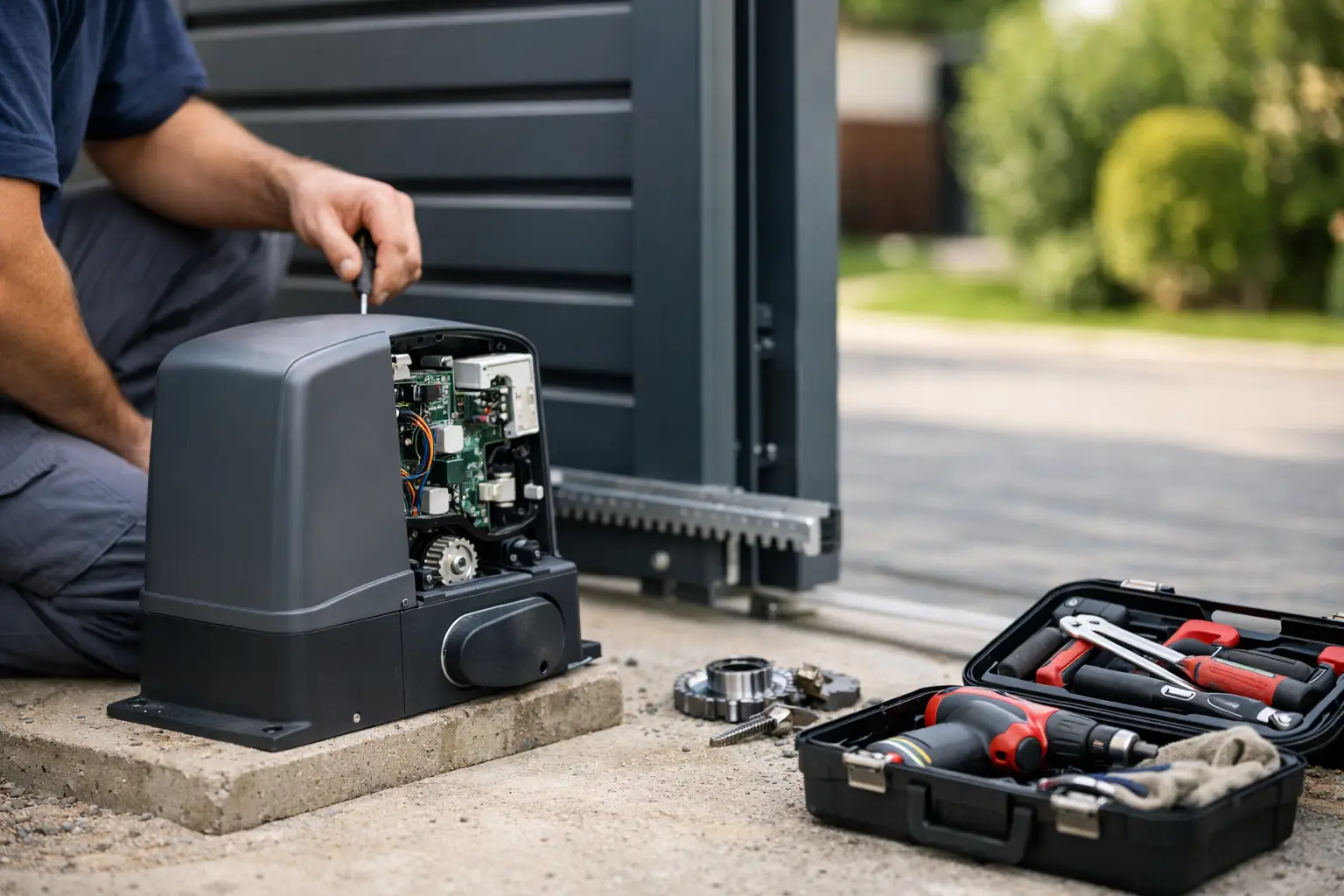
A gate that stops halfway across a driveway, reverses without warning or only works when it feels like it is more than an inconvenience. It can leave a home unsecured, disrupt access to a commercial site and create a real safety concern. Gate motor replacement is often the right answer, but it should follow a proper assessment rather than a quick swap of one unit for another.
The motor is only one part of an automated gate system. Its performance depends on the gate’s weight, hinges or track, electrical supply, control board, safety devices and daily use. Choosing the correct replacement means looking at the whole installation and making sure it will operate safely and reliably for years to come.
When a gate motor can be repaired
Not every fault calls for a new motor. A professional inspection may find a straightforward issue such as a damaged remote control, a failed capacitor, water ingress in a junction box, a loose connection or a poorly adjusted limit setting. In these cases, a targeted repair may restore normal operation at a sensible cost.
Repair is usually worth considering where the existing motor is from a current, supported range and suitable spare parts remain available. It also makes sense when the gate itself is in good mechanical condition and the automation system still meets the needs of the property.
However, repeatedly repairing an ageing motor can become false economy. If breakdowns are becoming regular, components are obsolete or the gate has been working harder than the motor was designed to handle, replacement is often the more dependable long-term option.
Signs gate motor replacement is likely needed
A motor does not always fail completely before it needs attention. Changes in how the gate moves can be early indicators that the motor, drive system or gate structure needs professional assessment. Common warning signs include:
- The gate moves slowly, struggles under load or stops before reaching its open or closed position.
- The motor makes grinding, clicking or unusually loud noises during operation.
- The gate opens or closes inconsistently, particularly in wet or cold weather.
- The unit trips the electrical supply, overheats or gives repeated fault codes.
- Replacement parts are no longer available, or previous repairs have not lasted.
These symptoms can point to a failed motor, but they can also be caused by seized hinges, worn rollers, an obstructed sliding track or poor alignment. Replacing a motor without correcting those underlying faults risks damaging the new equipment just as quickly.
The replacement motor must suit the gate
Gate motors are not interchangeable simply because they look similar or have the same voltage. A replacement must be selected for the type of gate, its dimensions and weight, how often it is used and the conditions at the site.
For swing gates, the installer will consider the length and weight of each leaf, hinge position, opening angle and the available space behind the gate. Above-ground ram, articulated arm and underground systems each have different fitting requirements. A motor that is too small may struggle and wear prematurely, while an oversized system can be unnecessarily costly and may require changes to the existing mounting arrangement.
For sliding gates, the condition of the track, rollers, rack and end stops is equally important. The motor needs sufficient pulling capacity for the gate and suitable protection from weather, debris and impact. On a busy commercial entrance, the expected duty cycle matters as much as gate weight. A motor suited to a private driveway may not be appropriate for a site with frequent vehicle movements throughout the day.
Power supply is another essential consideration. Some systems use mains power, while others may incorporate battery backup, solar charging or low-voltage controls. The replacement should be installed with suitable electrical protection and cable routes, not connected as a temporary fix.
Safety should be reviewed at the same time
A new motor can improve reliability, but gate motor replacement also presents an opportunity to check whether the complete system is operating safely. Automated gates create crushing, shearing and trapping points. The controls must respond correctly to an obstruction, and safety devices need to be positioned and tested for the layout of the entrance.
Photocells, safety edges, warning lights, emergency release mechanisms and force settings all have a role to play. Their importance depends on the gate design and who uses the entrance. For example, a family driveway with children, pedestrians and pets may need a different safety arrangement from a controlled commercial entrance with separate pedestrian access.
A competent installer will not treat safety devices as optional extras where they are needed. They will assess the risks around the moving gate, test the automation after installation and explain how the system should be used. This is particularly important where an older gate is being upgraded, as original safety provisions may no longer be adequate.
Access control can be improved during replacement
If the motor has reached the end of its serviceable life, it is worth considering whether the access controls still work for the property. There is little value in fitting a reliable new motor if the keypad is unreliable, the intercom has poor audio quality or residents and staff cannot manage entry conveniently.
A replacement project can include a video or audio intercom, coded keypad, key fob access, vehicle ground loop or timed opening function. For commercial sites, this may mean better control of deliveries, staff access and visitor entry. For homeowners, it may provide clearer communication with callers and easier access without leaving the house.
The right approach depends on how the entrance is used. A simple, dependable control arrangement is often preferable to adding features that will not be used. The objective is safe, practical access that suits the people relying on it every day.
Why professional installation matters
Gate automation combines mechanical work, electrical installation, programming and safety testing. A replacement motor must be mounted securely, aligned accurately and configured to stop at the correct positions. The gate must move freely before the automation is asked to control it.
Professional installation also avoids common causes of early failure. Poor cable joints, inadequate weather protection, incorrect force settings and badly positioned photocells can all lead to faults or unsafe operation. A system may appear to work on the day it is fitted, yet prove unreliable after the first period of heavy rain or regular use.
At Crabtree Electrical Gates, replacement work is approached as a complete gate automation job, not simply an exchange of parts. That means checking the gate’s mechanical condition, recommending suitable equipment and ensuring the finished system is properly tested. Customers across Dorset and the South of England benefit from specialist electrical knowledge alongside practical experience with domestic and commercial gate systems.
What to expect from an assessment
A useful site assessment should begin with the problem you have noticed, but it should not end there. The installer should inspect the gate structure and movement, the existing motor and controls, electrical supply, safety devices and the general condition of the entrance.
You should then receive clear advice on whether repair is viable or replacement represents better value. Where a new motor is recommended, the quotation should set out what is included, such as removal of the old equipment, installation, programming, safety checks and any required upgrades to controls or protection devices.
It is also sensible to ask about ongoing support, guarantees and what to do if the gate needs manual release during a power cut. A well-installed system should be straightforward to use, but knowing how to operate it safely in an emergency provides useful reassurance.
Do not wait for complete failure
A struggling gate motor can often be assessed before access is lost altogether. Acting early gives more time to consider the right equipment, arrange any safety improvements and avoid the disruption of a gate that will not open on the day it is needed.
If your gate is noisy, unreliable or no longer supported, arrange a professional inspection and get clear advice before authorising a replacement. The right motor, correctly installed and safety tested, will protect both the entrance and the people who use it.
0 Comments