
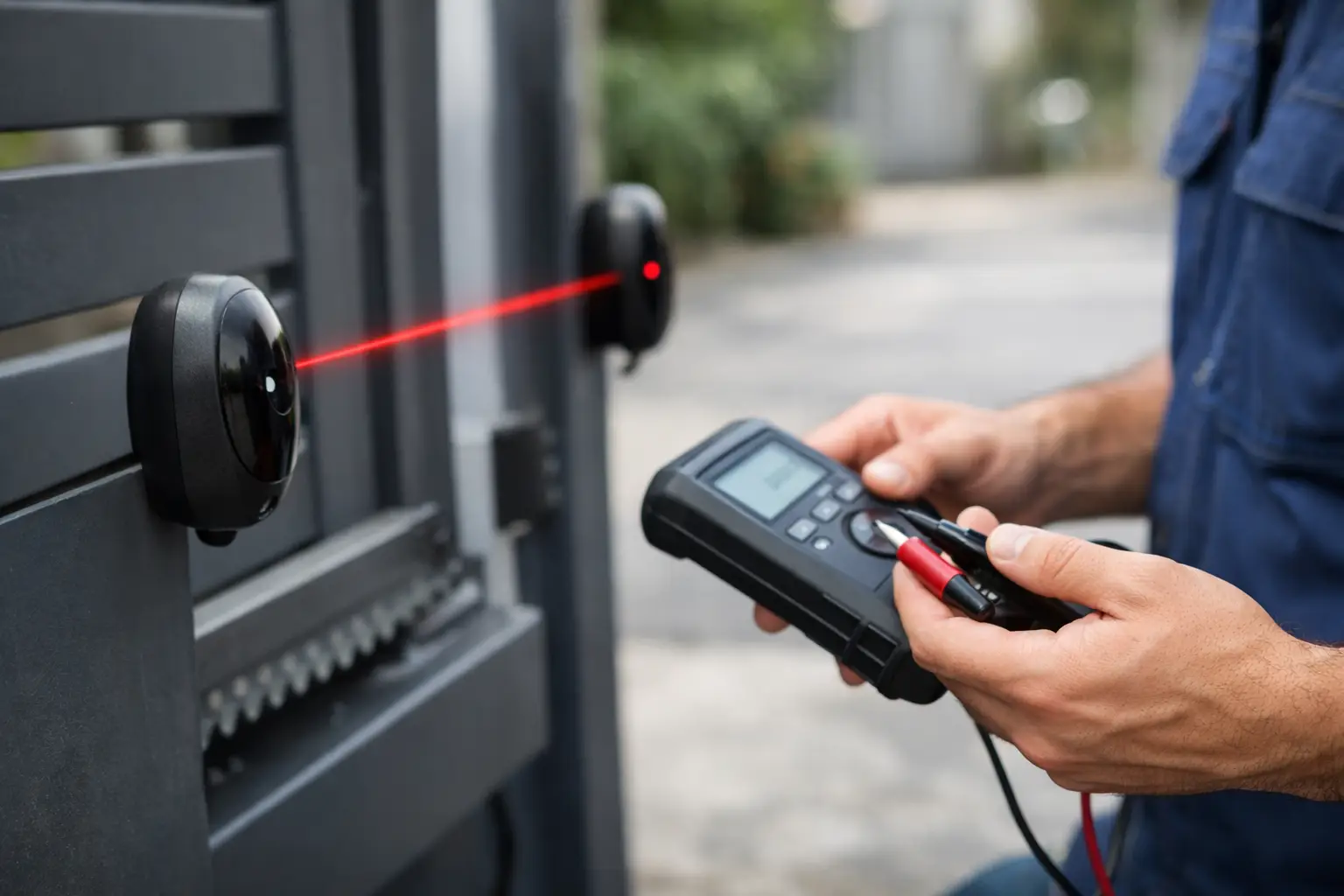
A gate that closes when a person, vehicle or pet is in its path is not simply inconvenient – it is a serious safety concern. Regular gate photocell testing helps confirm that your automated gate can detect an obstruction and react as intended, protecting those using the entrance and helping to prevent avoidable damage.
Photocells are only one part of a safe gate system, but they are a vital one. They need to be correctly positioned, wired, aligned and commissioned alongside the gate operator, safety edges and any access-control equipment. A quick visual check by an owner is worthwhile. Formal safety testing and fault diagnosis, however, should be carried out by a competent gate automation specialist.
What gate photocells do
Gate photocells, often called photo eyes, work as a pair. One unit sends an infrared beam across the opening and the other receives it. When the beam is broken, the automation control board should recognise that something is in the gate’s travel area.
Depending on how the system has been designed, interrupting the beam may stop the gate, prevent it from closing, or cause it to reverse. The expected response varies between swing and sliding gates, the direction of travel and the site risk assessment. This is why photocells should never be treated as a simple add-on.
A properly installed system may have photocells on both sides of the entrance. For example, one pair may protect the approach to a sliding gate while another protects the area behind it. A large commercial entrance, a gate close to a public footpath, or a driveway used by children and visitors can require more considered safety measures than a straightforward private drive.
Why photocell testing should not be overlooked
Photocells are exposed to the weather all year round. Rain, frost, direct sunlight, spiders, insects, dirt and vehicle spray can all affect their performance. A slight knock from a wheelie bin, hedge cutting or a delivery vehicle can move a unit just enough to disrupt the beam alignment.
Faults are not always obvious. Some photocells fail safe, meaning the gate will refuse to operate when the beam is lost. Although frustrating, that response shows the system has identified a problem. Other issues may be intermittent, with the gate working normally on some occasions but not others. These faults need prompt attention because they can be difficult to reproduce and may point to water ingress, damaged cabling, a loose connection or a control-board issue.
Routine gate photocell testing is also sensible after building work, driveway resurfacing, landscaping, a vehicle impact or any alteration around the entrance. Even a change in ground level can leave safety equipment at the wrong height or in the wrong position for the protected area.
A basic owner check between services
Property owners and site managers can carry out a simple observation check as part of normal gate care. Do this only when the area is clear, with no people, vehicles or animals near the gate. Never place yourself in the path of a moving gate or attempt to test it by standing between the leaves.
First, inspect the photocell housings. They should be secure on their posts, clean and free from cobwebs, leaves, mud or condensation. Do not use abrasive cleaners or force the covers open. A soft, dry cloth is generally enough to remove surface dirt.
Then operate the gate from a safe position and interrupt the photocell beam using an inanimate object, such as a solid board held safely across the beam line from outside the travel path. The gate should respond in the manner expected for that point in its operating cycle. If it continues to close, behaves unpredictably, or only works after repeated attempts, stop using the automated function and arrange an inspection.
It is also useful to watch for warning signs during daily use. A gate that stops for no visible reason, only works in manual mode, reverses repeatedly, or closes more slowly than usual may have a photocell fault. It could equally have a mechanical or electrical issue, so avoid assuming that cleaning the sensors has solved the underlying problem.
What a professional gate photocell test involves
A professional test goes beyond breaking the beam once and seeing whether the gate stops. The installer should assess the complete automated system and how the safety devices interact with it.
The photocells are checked for their location, mounting height, alignment, lens condition and security. The technician will inspect cables and connections for signs of damage, corrosion or water ingress, then test the response during relevant opening and closing movements. Indicator lights can assist diagnosis, but they do not confirm that the whole safety function is operating correctly.
The gate itself must also be considered. A poorly maintained sliding gate may bind on its track; a swing gate may have worn hinges or excessive wind loading. If the operator has been set with unsuitable force levels, a functioning photocell alone cannot make the installation safe. Safety edges, manual release operation, controls, warning devices and the gate’s physical condition may all form part of the assessment.
For commercial premises, estate-managed sites and shared entrances, documented maintenance is particularly valuable. It gives the responsible person a clear record of inspections, findings and repairs, and helps identify recurring faults before they lead to an outage or incident.
Common photocell faults and their likely causes
Misalignment is one of the most common issues. The transmitter and receiver may no longer be facing each other accurately, often after a minor impact or movement in a timber post. On long driveways, even a very small change in angle can be enough to weaken the signal.
Contamination is another regular cause. Dust, rain residue, insects and spider webs can obstruct the lens. Cleaning may restore operation temporarily, but repeated contamination can indicate that the photocell position or housing protection needs reviewing.
Electrical faults require more careful diagnosis. Damaged underground cables, loose terminals, moisture in junction boxes and power-supply problems can create intermittent behaviour. Replacing the photocell head without testing the cable route and control equipment may leave the real fault unresolved.
Sunlight can occasionally affect certain installations, particularly where the receiver faces low morning or evening sun. A specialist can assess whether repositioning, shading or different equipment is appropriate. The correct remedy depends on the gate layout and the equipment already fitted.
When to call a gate automation specialist
Stop relying on automatic operation and seek professional advice if the gate fails to stop or reverse when the safety beam is interrupted. The same applies if the photocells have been struck, their casings are cracked, wiring is visible, or the system trips intermittently.
Do not bypass photocells, bridge terminals or alter control-board settings to keep a gate running. These actions can remove a safety function and can create further faults that are more time-consuming to diagnose. A gate that will not operate is inconvenient; a gate operating without dependable safety protection is a greater risk.
Crabtree Electrical Gates provides specialist installation, maintenance and fault-finding support for automated gate systems across Dorset and the South of England. Whether the installation is a private swing gate, a sliding commercial entrance or an integrated access-control system, the work should be approached as a complete electrical and mechanical safety system.
A well-maintained gate should give you confidence each time it opens and closes. Keeping photocells clean and reporting changes early is a practical first step, while scheduled professional testing helps ensure the safety equipment is still doing the job it was installed to do.
0 Comments