
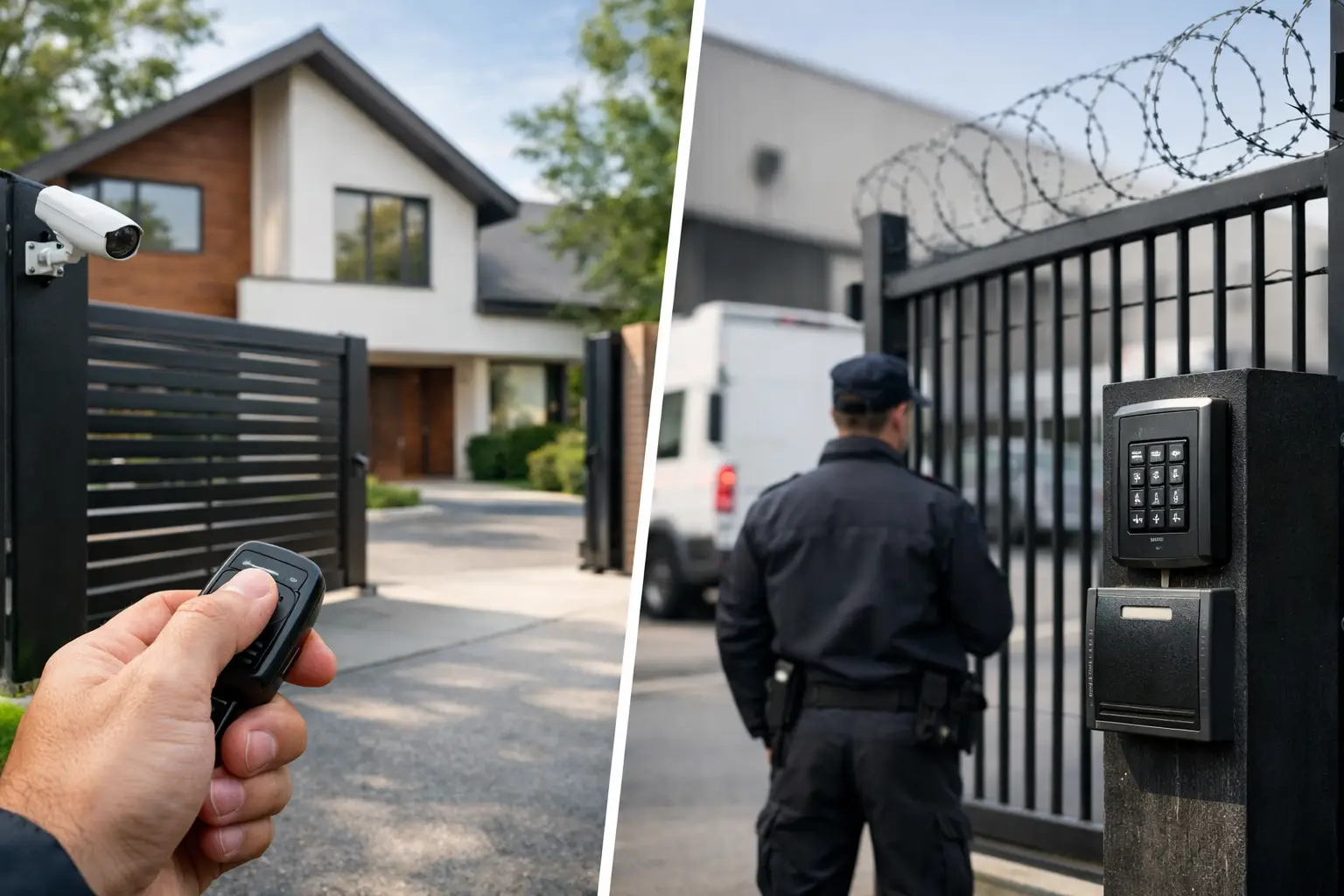
A gate at the entrance to a driveway, yard or commercial premises makes a clear difference to who can approach the property. Effective gate security is not simply about fitting a motor and closing the entrance. It is about choosing a suitable gate, controlling access properly and making sure the system remains safe and dependable every day.
For homeowners, that may mean preventing unwanted callers or vehicles from reaching the house. For a business, estate or managed site, it can mean controlling deliveries, protecting equipment and keeping a record of authorised entry. The right answer depends on the location, how the entrance is used and the level of supervision available.
Start with the risks at the entrance
A gate should address a real access issue, not just add a physical barrier. Before choosing a design or automation system, consider what happens at the entrance throughout a normal week. Is the property on a busy road? Are there regular visitors, couriers, staff or contractors? Does the gate need to operate early in the morning, late at night or outside staffed hours?
A private home may need a simple, secure way for residents to enter while allowing visitors to call from the entrance. A commercial yard may need separate arrangements for staff, delivery drivers and larger vehicles. An estate entrance may need to manage frequent traffic without leaving the gate open for long periods.
The approach and surrounding boundary matter too. A gate will work best as part of a considered perimeter, with fencing, walls, hedges and lighting designed to prevent easy access around it. A tall gate with an open gap beside it will not provide the level of control most owners expect.
Choosing a gate that supports security
Swing and sliding gates can both provide excellent security when they are correctly specified and installed. The practical choice usually comes down to space, ground conditions, traffic flow and the type of vehicles using the entrance.
Swing gates suit many residential driveways and can be fitted with above-ground or underground automation. Underground operators are often selected where homeowners want a cleaner appearance, as the mechanism is concealed below ground. They still require suitable drainage and access for future servicing, particularly in exposed or wet locations.
Sliding gates are often a strong option where a driveway slopes towards the road, space behind the entrance is limited or a wider opening is required. On commercial premises, they can be particularly useful for controlling vehicle access to yards and service areas. Their track, guide equipment and safety devices must be installed accurately, as poor alignment can affect operation and reliability.
The gate itself needs to be capable of resisting normal use, weather and attempted forced entry. Lightweight or poorly constructed gates can undermine the entire system. A professional survey should account for the gate weight, hinge or track arrangement, posts, foundations and the electrical supply needed to operate the automation safely.
Visibility is a practical decision
Solid gates offer privacy and can limit visibility into a property. Open-bar designs provide a clearer view of the entrance and may be preferred where staff need to see approaching vehicles or where visibility from the road is useful. Neither option is automatically more secure.
The right choice depends on what you need the gate to achieve. A solid gate can deter casual observation, while a more open design can make an entrance easier to monitor with lighting, an intercom or cameras. The important point is to avoid choosing on appearance alone.
Access control is where gate security becomes useful
An automated gate only improves control if authorised users can enter easily and unauthorised visitors cannot simply follow someone through. Access control should be planned around the people who use the site.
For a typical home, remote controls, a keypad or an intercom may be enough. An audio or video intercom lets occupants speak to a visitor before opening the gate, avoiding the need to walk down the drive. Keypads can be useful for trusted family members, tradespeople or short-term access, but codes should be changed when they have been widely shared.
Commercial sites often need more structured access. Keypads, fobs, proximity readers and timed permissions can help site managers decide who can enter and when. This is useful for employees, contractors and regular suppliers, particularly where the site is unattended outside working hours.
Ground loops are another valuable tool for vehicle access. Positioned beneath the driveway surface, they detect a vehicle and can be programmed to trigger a gate in a controlled way. They can support safe exit arrangements and help avoid unnecessary manual operation. The exact setup should reflect how vehicles approach, wait and leave the site.
It is worth thinking carefully about pedestrian access as well. A separate pedestrian gate may reduce the temptation for people to walk through a vehicle entrance. Where pedestrians and vehicles share an entrance, the safety measures and access controls need even closer attention.
Safety and security must work together
A secure automated gate must never create an avoidable risk to people, pets or vehicles. Gates move with significant force, and safe installation is not optional. The system should include appropriate safety devices, correctly positioned to suit the gate type and its surroundings.
Photocells can detect an obstruction in the gateway and stop or reverse movement where required. Safety edges provide additional protection at potential trapping points. Force settings, control equipment and emergency release arrangements also need to be properly configured.
Safety is not a one-off consideration at installation. Changes around the entrance can affect the system later. New landscaping, resurfacing, damaged posts, loose hinges or altered traffic routes may all create problems. Regular inspection and servicing help identify wear before it turns into a failure or safety concern.
For commercial and managed properties, clear responsibility matters. Someone should know how to release the gate in an emergency, report a fault and arrange service work. Leaving a damaged gate running because it still opens occasionally is not a sensible risk to take.
Avoid the weak points that undermine a secure gate
Many gate security problems are not caused by the main gate leaf or motor. They arise from small decisions made during installation or daily use. A release key left in an obvious location, a shared keypad code that has not changed for years, or a gate set to stay open too long can all weaken access control.
Power supply and communication equipment should also be protected from casual interference. Control cabinets need to be located and secured appropriately, while cables should be installed professionally rather than left exposed. If the property relies on an intercom, consider how visitors will be handled if there is a power cut or equipment fault.
Tailgating is another common concern at busy entrances. A gate that closes too slowly may allow an unauthorised vehicle to follow an authorised one. Closing times need to balance security with safety and convenience. On a site with regular deliveries, a different entry procedure may be more practical than expecting one setting to suit every vehicle.
Maintenance protects the investment
An electric gate operates outdoors in changing weather, often several times a day. Leaves, grit, standing water and vehicle impact can affect tracks, photocells and moving parts. A gate that becomes noisy, slow or inconsistent should be checked promptly rather than repeatedly reset.
Basic care can include keeping the entrance clear, checking that safety devices are not obscured and reporting visible damage. More technical work, including adjustments to motors, force settings, electrical connections and safety equipment, should be left to a competent gate automation specialist.
A planned service visit can check the condition of the gate structure, hinges or rollers, automation equipment, controls and safety features. This is particularly worthwhile for commercial entrances where a failed gate can disrupt staff, deliveries and site security at the same time.
A professional survey gives clearer answers
Every entrance has practical constraints. The gradient of the drive, underground services, drainage, wind exposure, available power and existing boundary all influence the system that will work best. A site survey allows these points to be assessed before a gate or automation method is selected.
Crabtree Electrical Gates provides electric gate automation and access control installations for residential and commercial customers across Dorset and the South of England. A properly planned installation brings together the gate, automation, safety equipment and access controls rather than treating each as an afterthought.
The best gate security arrangement is one that people can use confidently every day. Choose equipment that suits the property, keep control of who has access and arrange professional support when the system needs attention. That is how an entrance remains secure without becoming difficult to live or work with.
0 Comments