
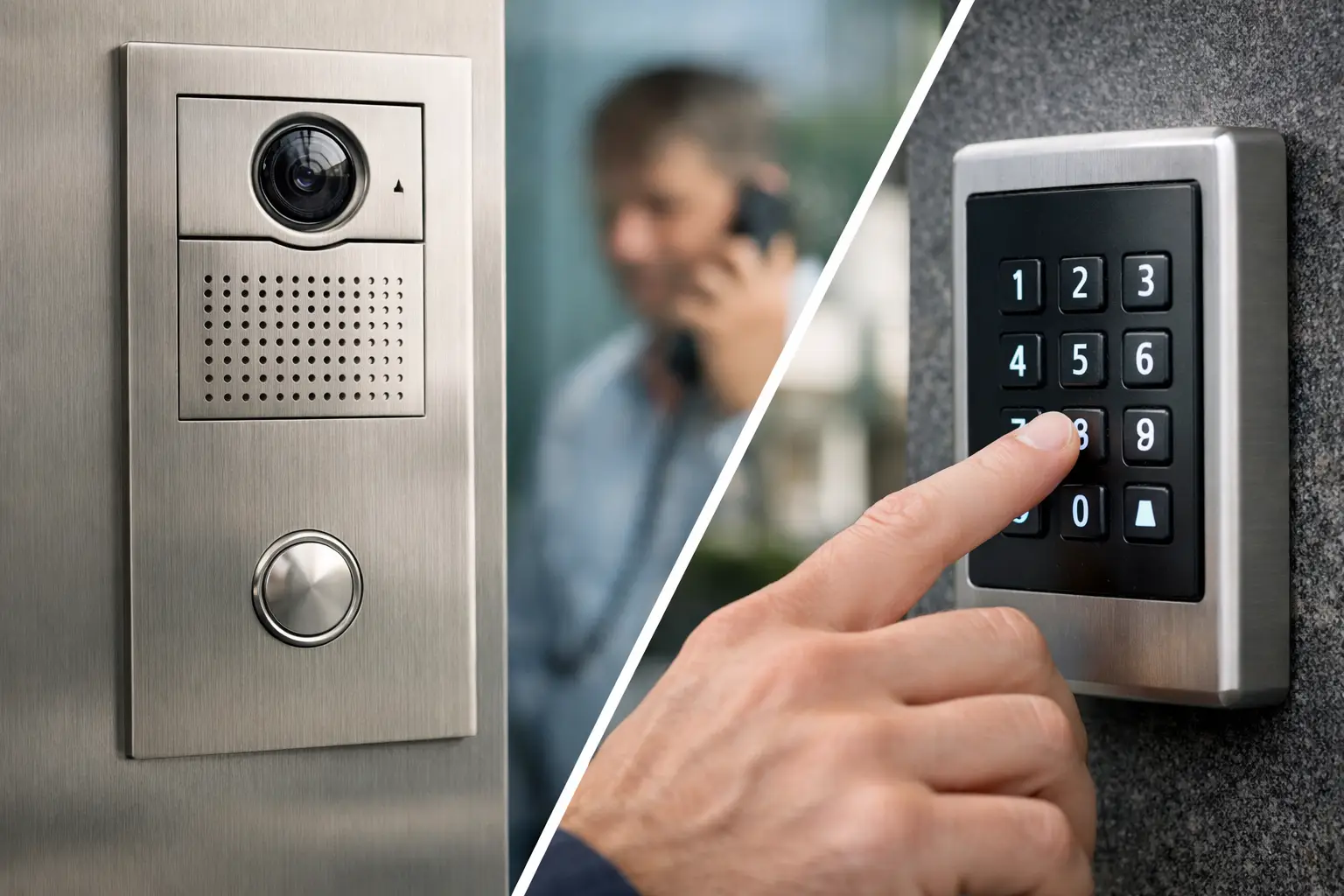
A gate is only as useful as the method used to open it. When weighing up intercom vs keypad entry, the right choice comes down to more than convenience. You need to consider who arrives at the gate, whether someone is available to grant access, how often codes may be shared, and how much control the property needs over time.
For a private driveway, a keypad can be a straightforward and dependable solution. For a busy commercial entrance, a video intercom may offer the reassurance of seeing and speaking to visitors before allowing them in. Many properties benefit from using both.
Intercom vs keypad entry: the key difference
An intercom lets someone at the gate contact a person inside the property. Depending on the system selected, this may be audio-only, video, or a call routed to a mobile phone. The resident, office team or site manager can identify the caller and release the gate remotely if appropriate.
A keypad works differently. The visitor enters a programmed PIN, and the gate opens if the code is correct. There is no need for somebody inside to answer a call. This makes keypads particularly useful for regular visitors who need authorised access without waiting for assistance.
Neither option is automatically better. An intercom provides a decision at the point of entry; a keypad provides quicker self-service access for people who already have permission to enter.
When an intercom is the better choice
Intercom entry is well suited to homes and sites where visitors are not always known in advance. A delivery driver, contractor, guest or prospective customer can call from the gate, rather than relying on a shared access code or someone walking down the drive.
Video intercoms add another level of control. Seeing who is at the entrance can be valuable where the gate is some distance from the house, where sightlines are poor, or where staff need to verify visitors before permitting vehicle access. Audio systems can still be effective for smaller properties where visual confirmation is less critical.
For homeowners, an intercom can reduce unnecessary trips to the gate while keeping control with the household. Systems with mobile connectivity are particularly practical when occupants are away from the building but need to admit a planned visitor, gardener or delivery.
On commercial and managed sites, intercoms are often the sensible option where access needs to be approved by reception, an office, security staff or a designated manager. They can help establish a clear process for deliveries and contractors, rather than leaving a gate code in circulation.
There are trade-offs. An intercom depends on someone being able to answer it, unless calls are routed to a mobile device. It also requires suitable cabling, power and communications planning. A professionally specified system avoids the common frustrations of poor call quality, unreliable wireless connections or an intercom position that is difficult for drivers to reach.
Choose an intercom if you need to verify visitors
An intercom is usually the stronger choice where visitor identity matters more than speed of entry. This includes isolated rural homes, shared private drives, commercial yards, schools, offices, storage sites and properties that receive frequent deliveries. It gives the person inside a chance to decide before the gate moves.
When keypad entry makes more sense
A keypad is ideal when authorised people need regular access without contacting anyone. Family members, staff, tenants, approved contractors and trusted service providers can enter a PIN and operate the gate independently.
For a domestic gate, this can be a simple way to give access to older children, cleaners, gardeners or tradespeople without handing out physical keys or remote controls. It also removes the risk of a remote being left in an unattended vehicle.
For business premises, keypads can work well at staff entrances, secondary vehicle gates or sites with predictable operating hours. Codes can be changed when a member of staff leaves, when a contractor’s work is complete, or whenever there is concern that a code has been passed on.
The limitation is clear: a PIN is only secure while it remains private. On a high-traffic site, codes may be overheard, shared casually or retained by people who no longer need access. A keypad alone may therefore be less suitable for an entrance used by numerous visitors, delivery drivers and temporary contractors.
Good keypad placement also matters. It should be reachable by a driver without forcing them to leave the vehicle, while remaining clear of the gate’s moving areas. The installation must be planned around safe approach distances, vehicle turning space and the gate type.
Choose a keypad for regular, authorised users
Keypad entry is often the practical answer for controlled everyday access. It is quick, familiar and uncomplicated, particularly where the list of users is small and the code can be managed responsibly. It can also be a cost-effective addition to an automated swing or sliding gate installation.
Why a combined system is often best
For many properties, the choice is not strictly intercom or keypad. Combining the two provides the flexibility most owners need: trusted users enter with a code, while unknown visitors call through to the property for approval.
This arrangement works especially well for large homes, farms, estates and commercial premises. Staff can use the keypad during normal working hours, while deliveries and visitors use the intercom. The same gate can then support different types of access without compromising the main entrance.
A combined setup can be tailored further with remote controls, GSM mobile access, proximity fobs, number plate recognition or timed access settings. The correct combination depends on how the entrance is used, not simply which feature sounds most advanced.
Factors to consider before choosing
Start with the people who use the gate. If most callers are known and visit routinely, keypad entry may cover the requirement. If visitors vary from day to day, an intercom gives greater oversight. Consider what happens outside working hours too. A commercial gate may need different rules in the evening than during deliveries and staff arrivals.
The property layout is equally important. Long driveways, poor mobile signal, thick stone walls and a gate positioned well away from the building can all influence the most reliable intercom configuration. Cable routes should be assessed before installation rather than treated as an afterthought.
Security should be considered in practical terms. A keypad code offers controlled access, but it does not confirm who has typed it. A video intercom offers verification, but only if the call is answered. For some sites, access credentials such as fobs or app-based permissions may be more appropriate than a single shared code.
It is also worth planning for future changes. A growing business may need separate codes for staff and contractors. A homeowner may later want mobile answering, cameras or additional pedestrian access. Choosing equipment that can be expanded can prevent unnecessary disruption later.
Installation, safety and reliability
Access control should be designed alongside the gate automation, not fitted as an isolated extra. The controls, safety devices, gate motors and power supply must work together correctly. This is particularly important for sliding gates and heavy swing gates, where the system needs suitable safety edges, photocells, force settings and emergency release arrangements.
A professional survey should look at the gate structure, ground conditions, power availability, cable runs, drainage where underground equipment is proposed, and how vehicles approach and leave the site. For commercial installations, it should also consider daily traffic levels, safe pedestrian routes and operational requirements.
Crabtree Electrical Gates installs access control as part of bespoke electric gate automation projects across Dorset and the South of England. Clear advice at the survey stage helps ensure the chosen entry method is practical for the property, dependable in daily use and suited to the people who need access.
Before deciding, picture a normal week at the gate: staff arriving early, a courier at lunchtime, family returning after dark, a contractor visiting while nobody is home. The best system is the one that manages those everyday moments safely and without creating more work for the people inside.
0 Comments