
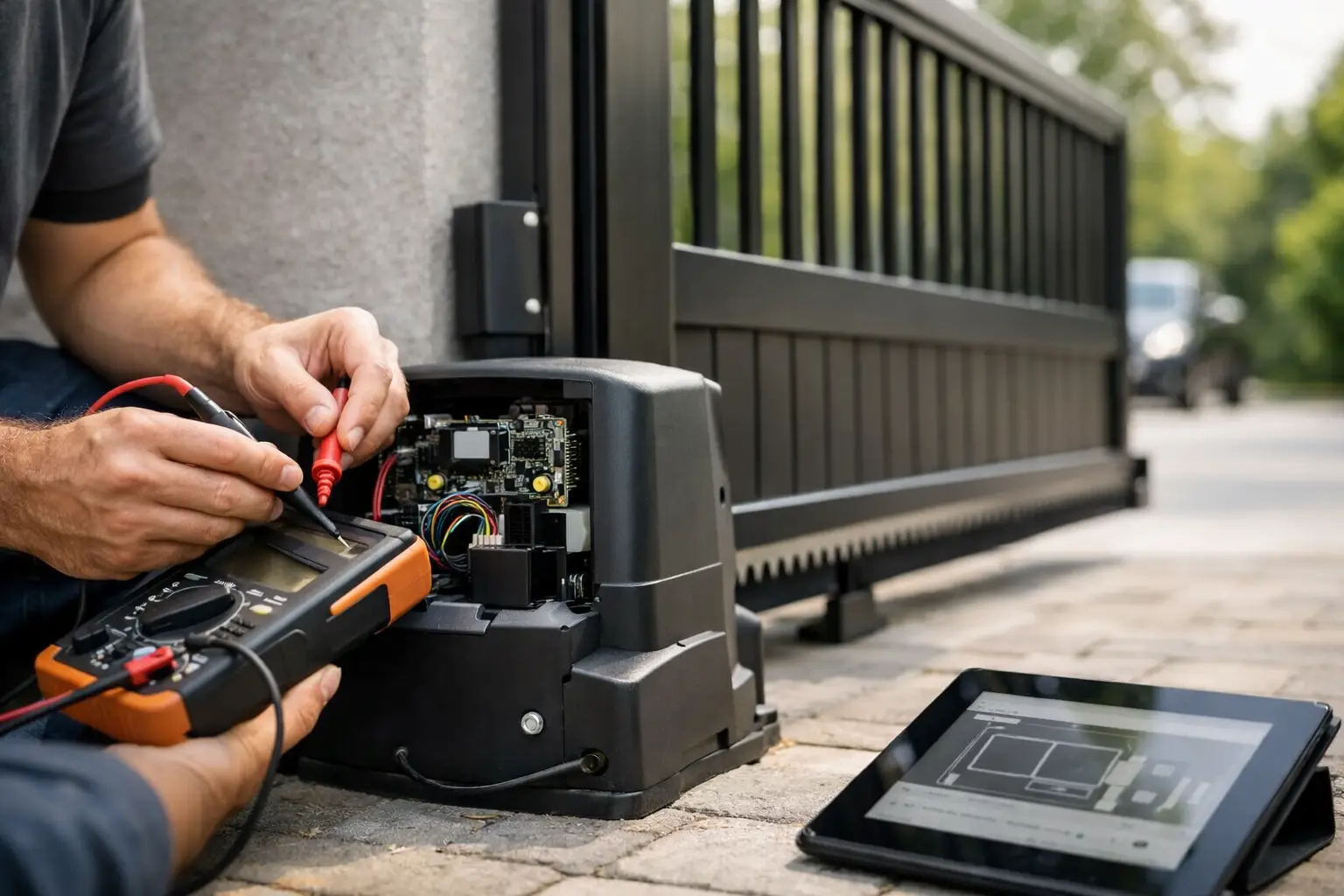
A gate that stops halfway, opens without warning or refuses to respond is more than an inconvenience. It can leave a driveway unsecured, prevent deliveries or staff access, and create a safety concern for people and vehicles. Automatic gate fault diagnosis is the process of finding the true cause of the problem before replacing parts or making adjustments that may not be needed.
Most gate faults are not caused by one dramatic failure. They often begin with a small issue: a weakening battery, a misaligned photocell, water in a connection or an obstruction in the gate’s path. A proper diagnosis looks at the whole system – the gate, motor, control board, safety devices, power supply and access controls – rather than assuming the motor is at fault.
Start with the symptoms, not the replacement part
The way a gate behaves provides useful clues. A gate that has no response at all needs a different investigation from one that moves a short distance and stops. Similarly, a system that works from an internal push button but not from a remote control points towards an access-control issue, not necessarily a mechanical fault.
Before touching any electrical components, observe the fault carefully. Does it happen every time, only in wet weather, or after the gate has been operating for several cycles? Does the control panel show an error code or warning light? Is one leaf of a swing gate working while the other remains still? These details help an experienced engineer trace the problem efficiently.
It is sensible for an owner or site manager to check for obvious obstructions, a tripped supply and damaged remote controls. Beyond that, diagnosis should be carried out by a suitably competent gate automation specialist. Gate systems combine moving machinery and electrical equipment, so an incorrect adjustment can create a safety risk as well as fail to solve the fault.
Common causes found during automatic gate fault diagnosis
Power supply and electrical connection issues
No power, intermittent operation or a gate that behaves unpredictably can result from a supply issue. This may be a tripped circuit breaker, blown fuse, loose terminal, damaged cable or a problem with the control panel transformer. Underground cable runs are particularly worth checking where there has been recent groundwork, flooding or rodent damage.
Solar-powered gates have their own considerations. A shaded panel, dirty surface, tired battery or insufficient winter charging can leave the system without enough reserve power. The gate may appear to work normally in brighter conditions, then fail after several cloudy days. Replacing a motor in this situation would not address the real cause.
Electrical testing should confirm that the correct voltage reaches the equipment under load. A reading that looks normal when the motor is idle may drop significantly when the gate starts to move. This is why specialist electrical knowledge matters during fault finding.
Safety devices stopping the gate
Modern automated gates rely on safety systems to detect obstacles and prevent unsafe movement. Photocells, safety edges, induction loops and force settings all play a part. If a photocell beam is blocked, dirty, misaligned or affected by moisture, the control board may prevent the gate from closing or cause it to reverse.
A safety edge can also trigger because of impact damage, a loose connection or water ingress. On commercial entrances, vehicles may damage posts, photocells and loop cables without the issue being reported immediately. A visual inspection is useful, but testing each safety input is the reliable way to identify the fault.
Safety devices should never be permanently bypassed to keep a gate operating. Doing so can expose users, visitors and the property owner to unnecessary risk. The correct approach is to identify the defective component, repair or replace it, and then test the gate’s safety functions before returning it to service.
Mechanical resistance and poor gate movement
An automation system can only work reliably if the gate itself moves freely. A swing gate may drop on its hinges, catch on the ground or be affected by movement in the posts. A sliding gate may have debris in the track, worn rollers, damaged rack teeth or a problem with its guide assembly.
Excessive resistance makes the motor work harder. In many systems, this leads to the gate stopping, reversing or reporting an obstruction fault. It can also shorten the life of motors, gearboxes and control equipment.
During diagnosis, the gate should be checked in manual release mode where appropriate and safe to do so. If it is difficult to move manually, the problem may be mechanical rather than electrical. The repair could involve hinge adjustment, track cleaning, roller replacement or correcting alignment before any automation settings are changed.
Motors, gearboxes and control boards
Motors and control boards do fail, but they should be diagnosed rather than guessed at. A motor may hum without moving because of a seized gearbox, failed capacitor or excessive gate resistance. It may move in one direction only due to a limit-switch, wiring or control-board output issue.
Control boards can be affected by age, electrical surges, condensation and insect ingress. Signs include erratic operation, lost programming, unresponsive inputs or visible corrosion. Where a board has failed, the wider condition of the enclosure and cable entries should also be assessed. Replacing the board without resolving water ingress can result in the same fault returning.
Underground gate operators require particular care. Their foundations, drainage and cable seals need inspection, especially after prolonged wet weather. Water in an underground motor box can affect electrical connections and mechanical components over time.
Remote controls, intercoms and access controls
When the gate works locally but not through its usual method of entry, attention turns to the access equipment. Flat remote batteries, lost programming, damaged antennae and radio interference are common causes. A remote that works only at very close range may indicate a receiver or aerial issue rather than a handset fault.
Intercom and keypad faults can involve low-voltage wiring, network settings, call routing or the release relay. For commercial sites, vehicle loops may fail to detect a vehicle because of damaged loop cable, poor positioning or control settings. These systems should be tested as part of the complete entrance, not treated as separate accessories.
A practical approach to fault finding
A systematic inspection prevents unnecessary cost and disruption. The most effective process generally follows the same order: confirm the reported symptoms, inspect the gate and safety equipment, test the incoming supply, assess movement, check control inputs and outputs, then test the system through a full operating cycle.
The final stage matters. A gate may open successfully during a basic test but still fail to close safely, respond to a photocell or stop correctly at its limits. Every repair should be followed by checks of the safety devices, force settings and access controls used by the household or site.
For managed premises, keeping a brief record of faults and weather conditions can be helpful. Repeated problems after heavy rain, for example, may point to drainage or enclosure sealing. A fault that occurs only during busy periods may indicate overheating, high usage demands or an issue with loop detection.
When to arrange professional help
A gate that has become unreliable should not be left to deteriorate, particularly where it controls access to a home, shared development, farm, workplace or commercial yard. Arrange professional assistance promptly if the gate moves unexpectedly, fails to stop when obstructed, has exposed or damaged wiring, makes grinding noises, trips electrical protection, or cannot be secured.
Avoid forcing the gate or repeatedly cycling it in the hope that it will reset itself. This can strain the motor and may make a straightforward repair more expensive. If the gate must be placed into manual operation, make sure it is properly secured and that users understand how access will be managed.
Crabtree Electrical Gates provides specialist assessment, repair and installation support for automated gate systems across Dorset and the South of England. An on-site inspection allows the condition of the automation, gate structure and access controls to be considered together, with clear advice on the most suitable repair.
A reliable automatic gate should feel unremarkable: it opens when authorised, closes safely and remains dependable through daily use. Addressing the first signs of a fault with a proper diagnosis is the best way to protect that reliability.
0 Comments