
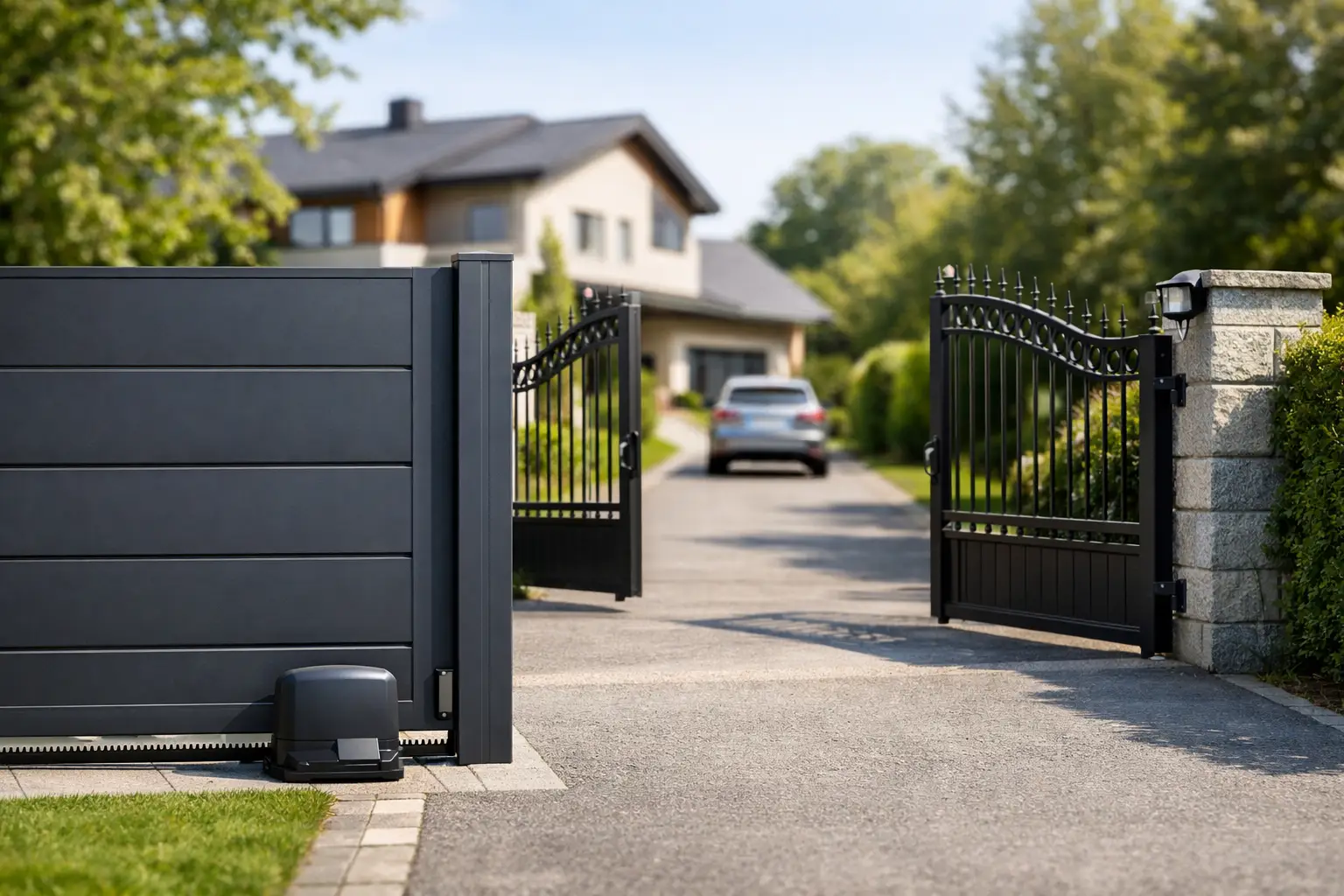
A driveway gate should make arriving home simpler, not create another daily frustration. The best electric gates for homes are the ones that suit the available space, the way vehicles approach the property and the level of security required. A gate that looks impressive but cannot open safely on a sloping drive, or a system that relies on unreliable electrics, is not the right long-term choice.
For most homeowners, the decision comes down to two main gate types: swing gates and sliding gates. The right automation, safety equipment and access control are then selected around the gate and the site. A professional survey is the sensible starting point because every entrance has practical limits that photographs alone can miss.
The Best Electric Gates for Homes Start With the Driveway
There is no single best gate for every property. A wide, level driveway with plenty of room behind the gate may be ideal for automated swing gates. A property close to a road, with a steep incline or limited space for gates to open inwards, may be much better suited to a sliding gate.
Before choosing a style, consider where a vehicle waits while the gate opens, the driveway gradient, the width of the opening and whether the ground is level. You should also think about pedestrians, delivery drivers and visitors. Gates need to operate predictably in all seasons, including heavy rain, frost and strong wind.
The existing gate material matters too. Timber, metal and composite gates can all be automated, but their weight, condition and hinge arrangement must be assessed. In some cases, replacing an unsuitable gate leaf is safer and more economical than forcing an automation system to work beyond its intended limits.
Automated Swing Gates
Swing gates are a popular choice for private homes because they provide a traditional appearance and work well at many residential entrances. They can be made as a pair of opening leaves or as a single leaf for a narrower opening. When closed, they can give a property a strong, welcoming boundary without looking overly industrial.
Above-Ground Swing Gate Automation
Above-ground motors are fitted to the rear of the gate and are generally accessible for servicing. Depending on the installation, they may use articulated arms, ram-style operators or other purpose-made mechanisms. This option is often practical where there is enough room beside the gate and the posts or pillars are suitable.
It is a good choice for homeowners who want dependable automation with straightforward access for future maintenance. The equipment remains visible, however, so it may not be the preferred finish for every entrance.
Underground Gate Automation
Underground motors are fitted below ground level at the base of each gate. With the equipment largely out of sight, they are often selected for period homes, premium metal gates and properties where appearance is a major consideration.
The trade-off is that underground systems require careful groundwork, drainage and electrical installation. Water management is particularly important. A properly installed underground system can offer a discreet, high-quality result, but it should never be treated as a simple cosmetic upgrade. The foundations, gate geometry and drainage all need to be right.
When Swing Gates Are Not Suitable
Swing gates need clear space to open. They should not swing out across a public pavement or carriageway, and an inward-opening gate needs enough level driveway area behind it. A steep rising drive can also prevent conventional swing gates from moving freely unless the gate design and automation have been planned specifically for the gradient.
Wind exposure is another consideration. Solid, wide gate leaves can catch the wind, placing more load on motors, hinges and posts. Open-bar designs may be preferable in very exposed locations.
Electric Sliding Gates for Restricted Space
Sliding gates move sideways along the boundary rather than opening into the drive. This makes them particularly useful for entrances with limited depth, sloping ground or a road immediately outside the property. They also suit wider openings where large swing leaves would be impractical.
A tracked sliding gate runs along a ground track and is supported by rollers. It is a proven option, but the track must be kept clear of leaves, gravel and debris. At properties with loose surfaces or where a clear track would be difficult to maintain, a cantilever sliding gate may be the better solution. This design is supported above ground and does not run on a track across the entrance.
Sliding gates need sufficient room along one side of the opening for the gate to travel when open. That run-back space is often the deciding factor. If a wall, hedge, parking area or change in level prevents the gate from moving fully aside, a sliding design may not be viable.
For homes on busy roads, the ability to open a sliding gate without a vehicle encroaching onto the road can be a major advantage. The gate can also be programmed to open partially for pedestrians where the layout allows.
Access Control Matters as Much as the Gate
Automation gives you control over entry, but the way you operate the gate should match everyday use. A simple remote control may be enough for a single household. For larger properties, shared drives or homes that regularly receive visitors, a more complete access control system is usually worthwhile.
A keypad allows approved visitors and tradespeople to enter using a code. An audio intercom lets you speak to someone at the entrance before opening the gate, while a video intercom adds the benefit of seeing who is there. This is particularly useful where the gate is some distance from the house or cannot be seen clearly from inside.
For properties with regular vehicle traffic, vehicle detection loops can be installed in the driveway. These can prevent a gate closing onto a vehicle and can provide automatic exit operation where appropriate. The correct setup depends on the gate location and the level of control you want over access.
Avoid choosing access control solely on features. A system should be easy for the household to use, reliable for regular visitors and suitable for the location. A complicated setup that everyone bypasses with a manual release defeats the purpose of automation.
Safety Is Not an Optional Extra
An electric gate is a moving machine. It needs to be designed and installed with safety at the centre of the project, especially where children, pets, pedestrians or members of the public may be nearby.
Safety measures may include photocells that detect an obstruction, safety edges that react to contact, correctly positioned controls and force settings that are tested during commissioning. The gate structure itself must also be assessed for gaps, trapping points and areas where fingers or clothing could become caught.
The correct protection depends on how the gate moves and who can access the area around it. A sliding gate has different risk points from a pair of swing gates. This is why a tailored installation is safer than buying a motor kit and attempting to fit it to an existing gate without a full assessment.
A manual release is also essential. In the event of a power cut or system fault, authorised users need a safe way to operate the gate. Battery backup can be considered for sites where continued operation during an outage is particularly important.
Choosing an Installer for Electric Gate Automation
The quality of the installation affects security, reliability and safety for years to come. A suitable installer should assess the gate, foundations, electrical supply, controls and safety requirements before recommending equipment. They should be able to explain why a particular system suits the property, rather than offering the same motor package for every job.
Look for clear information about workmanship, insurance and aftercare. Electric gates require correct electrical work as well as mechanical installation, and future servicing should be considered from the outset. Motors, hinges, tracks, photocells and drainage all benefit from periodic checks.
Crabtree Electrical Gates supplies and installs bespoke swing, sliding and underground automation systems across Dorset and the South of England, with access control options selected to suit the property and its users.
A Better Gate Is One That Fits the Way You Live
A well-planned electric gate improves privacy, controls access and removes the need to leave the car in poor weather or after dark. Yet the best result is rarely the most elaborate system. It is the gate that has enough room to operate safely, uses equipment suited to its weight and layout, and gives you simple, dependable access every day.
If you are considering an automated driveway gate, arrange a site visit and talk through how the entrance is used. A straightforward conversation about space, security and practical access will usually point to the right solution before any installation work begins.
0 Comments